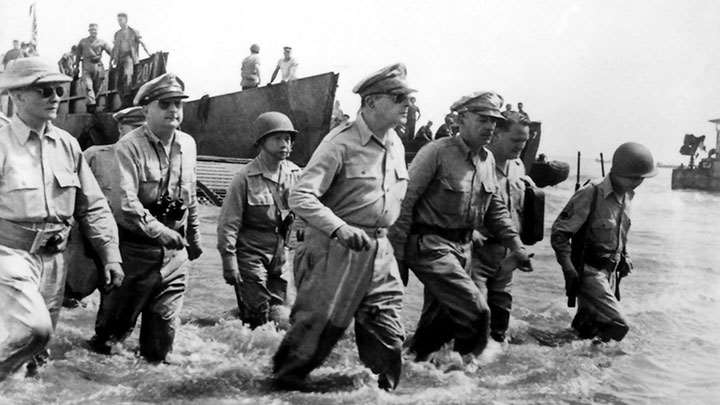
The reconquest of the Philippines began on Friday, Oct. 20, 1944, when two U.S. Army Corps conducted amphibious landings on the east coast of the island of Leyte. It is best remembered as the day Gen. Douglas MacArthur returned after evacuating Corregidor 31 months prior. The photographs taken as he waded ashore that afternoon are among the most memorable from World War II. They depict the beginning of the end of more than two years of Japanese occupation–an occupation noted for its brutality.
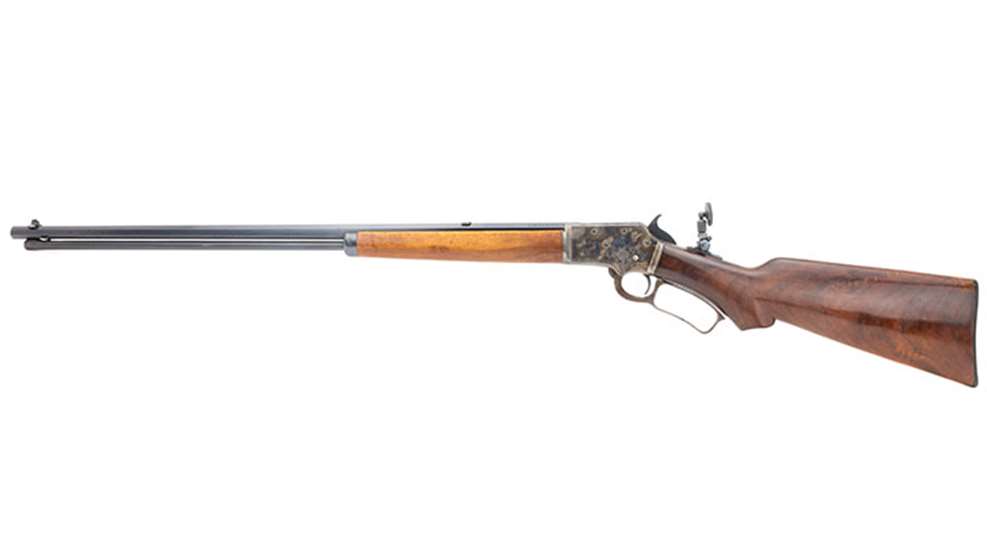
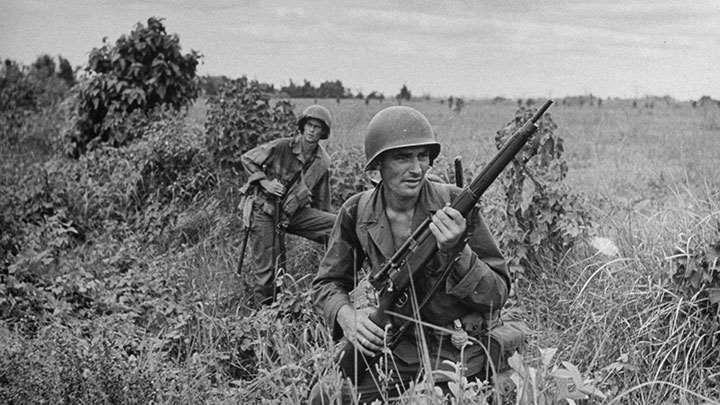
Despite that, Filipinos resisted the Japanese by putting up a fight whenever and wherever they could. That included those on Leyte, and it involved a surprising firearm we don’t associate with WWII. When we think of the guns that fought the Japanese on that island, we tend to think of the M1 rifle, the M1 carbine and the M3 “Grease Gun.” There are even photographs showing the M1903A4 in combat on Leyte, but in one noteworthy example, the Marlin Model 39 lever-action rimfire rifle got in on the fight.
In early 1945, the Marlin Firearms Company received a letter from a soldier who had been a prisoner of war in the Philippines from 1942-1945. After his liberation from a camp on Luzon, he received an assignment in Leyte, where the first battle in the reconquest of the archipelago had taken place during the closing weeks of the previous year. In that letter, the soldier described how, one day, he was invited to visit a “bamboo hut” by a Filipino boy.
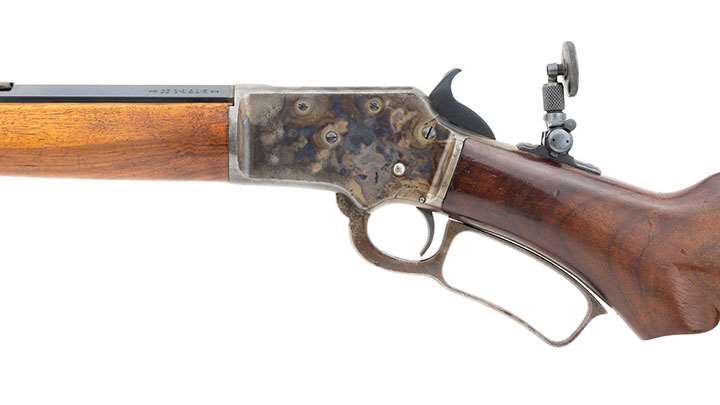
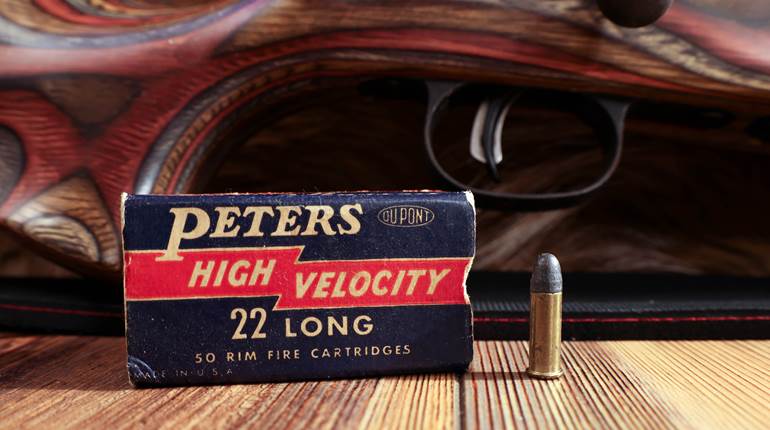
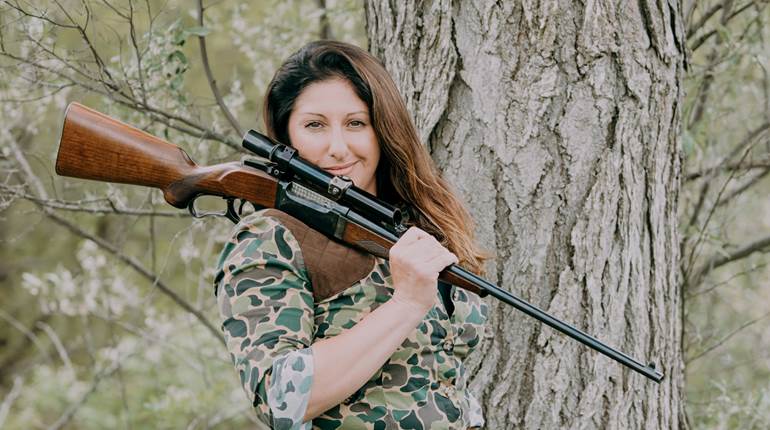
On the wall inside the hut was a rusty Marlin Model 39 that had been left behind by a pair of mining engineers who visited the area prior to the Japanese invasion in late 1941. That Model 39 had evolved from the first lever-action rifle chambered for .22-cal. rimfire ammunition: the Marlin Model 1891. By 1921, the model had become a 6.5-lb. take-down repeater with a 24” octagonal barrel. Its front-feeding tubular magazine could accommodate 26 .22 Short cartridges, 21 .22 Long cartridges or 19 .22 Long Rifle cartridges.
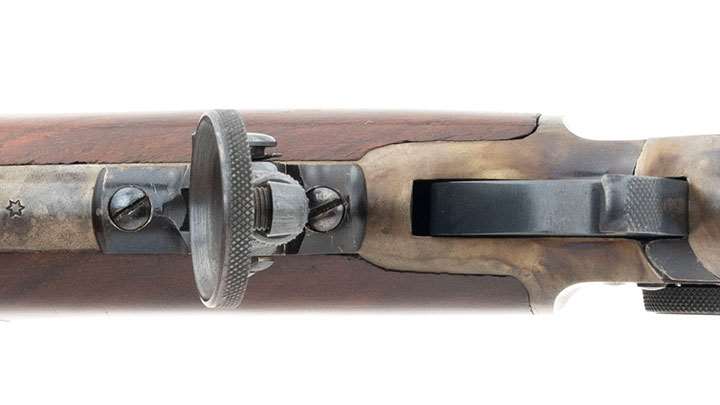
Magazine capacity and impressive accuracy made the Model 39 one of the most popular sporting arms of its day. After retrieving the rifle from the wall of the hut, the Filipino boy explained to the former prisoner of war how, at the beginning of the occupation, he buried the rifle to prevent it from falling into Japanese hands and how he had ultimately used it at one point to kill four Japanese soldiers up in the mountains.
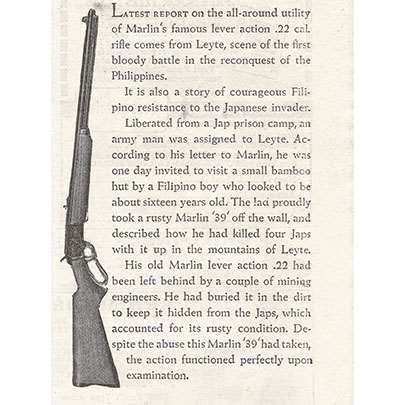
Although the rifle was rusty from being exposed to the elements, it still functioned “perfectly” when the author of the letter inspected it. The story impressed him so much that he felt compelled to write the manufacturer and share it. Marlin headquarters in New Haven, Conn., was quite impressed with the story and quickly began using it as an advertisement in print publications like Popular Mechanics. While it might be the unlikeliest firearm used in combat during WWII, the Model 39 nevertheless did some fighting in at least this one instance.
Most Popular