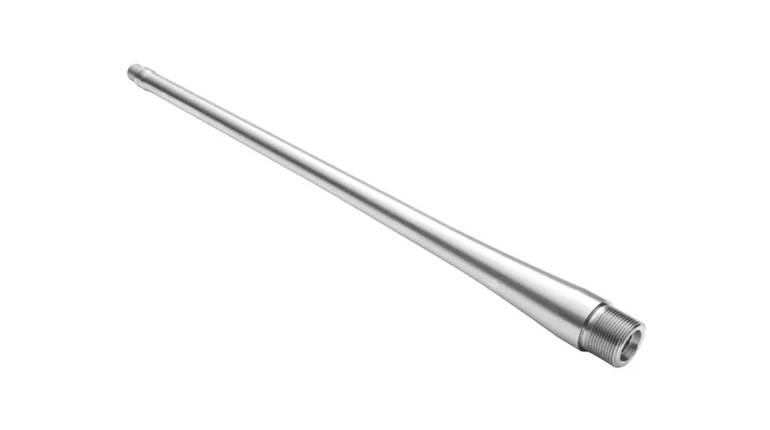
Accuracy is key with any varmint rifle, and the R-15 is designed to deliver in that department. The 22-inch button-rifled, free-floated barrel is made from chromium-molybdenum steel and features a 0.68-inch external diameter. Forward of the gas block, the barrel’s six longitudinal flutes aid in heat dissipation and reduce weight. The muzzle has a recessed crown. The machined aluminum fore-end has subtle knurling around its diameter. It also has eight cooling vents to help dissipate barrel heat. The forward portion of the fore-end is drilled and tapped to accept two short sections of Picatinny rail, allowing the user to easily mount accessories, such as lights, lasers, etc. The bottom of the fore-end is also drilled and trapped to accept two sling swivel studs, allowing for attachment of a bipod and a sling.
The R-15 employs a specially designed single-stage trigger with a shorter and somewhat lighter trigger pull than most two-stage units. The test rifle’s trigger broke at 6¾ pounds.
The R-15 Varmint employs a flattop receiver with a strip of Picatinny rail machined directly into the top of the upper receiver and no iron sights. This is in recognition of the fact that most varmint hunters will immediately mount high-magnification optics on the rifle. The rifle can also accept all standard AR-style aftermarket accessories and parts. Internally, the R-15 is a traditional AR-style rifle, employing a direct gas impingement system.
The controls should be familiar to anyone who has previously fired an AR-style rifle. Although the rifle comes equipped with a five-round magazine, any standard AR-15/M16 magazine can be employed. The upper receiver’s right side has all the familiar AR components, including a forward assist, an ejection port cover and a shell deflector to keep brass from harassing a left-handed shooter.
The fit and finish was extremely good, with the camouflage finish evenly applied and attractive. The matte-black finish on the barrel, gas block, pins and controls is also attractively applied. The upper and lower receivers of the rifle were mated well, with little to no play between them, and the action cycled smoothly. All the controls, such as the safety lever, magazine release and bolt release, worked well.
When it comes to handling, the R-15 is ideal for varmint hunting. Designed to be fired from the bench or prone at long-range targets, the rifle’s 7¾-pound weight balanced well just forward of the magazine. The full-profile, A2-style stock was also quite comfortable, allowing for a good cheek weld.
For accuracy testing, we topped off the rifle with a Burris Fullfield II 6.5-20x50 mm scope with Warne Maxima quick-detach, ultra-high rings. During the course of firing several hundred rounds, the rifle performed well, but with an odd occurrence. When using the Federal V-Shok 32-gr. Nosler Ballistic Tip ammunition, there were two instances in which the bolt did not fully seat. A simple push of the forward-assist button moved the bolt forward a fraction of an inch and fully seated the action. There were no such occurrences with the Remington or Winchester ammunition.
The rifle showed a distinct preference for lighter-weight bullets, faring better with the two 32-gr. loadings than with the single 40-gr. loading. In fact, with the two lighter bullet weights, many of the groups came in under one inch at 100 yards. Recoil was light and pleasant, which should come as no surprise considering the rifle’s 7¾-pound weight and diminutive .204 Ruger chambering.