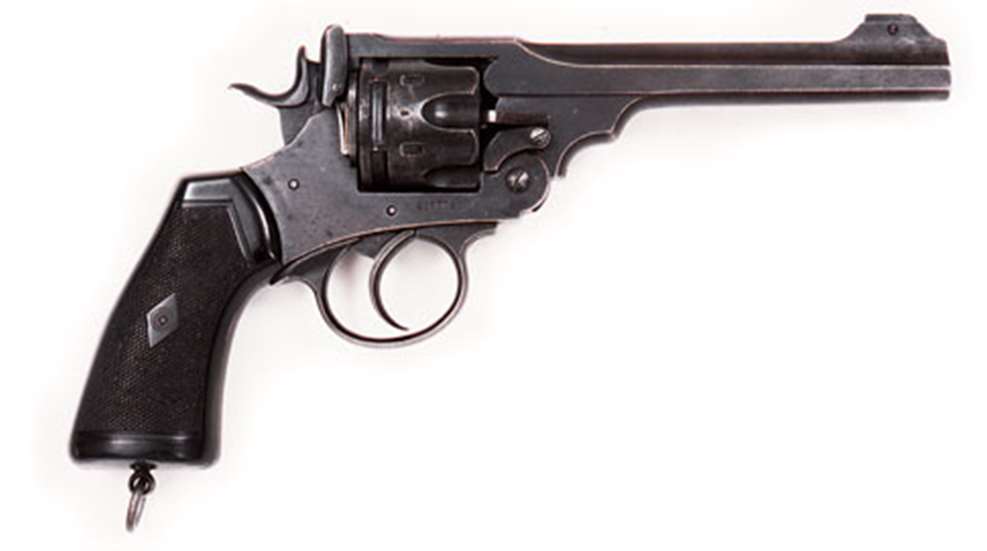
To most arms enthusiasts the stirrup-latch Webley is the quintessential British revolver, and they’re not wrong. It is also assumed it was the first repeating handgun to be accepted by Her Majesty’s forces, but actually the Webley was not accepted into service until the military had run through a succession of percussion and solid-frame Adams and a couple of ungainly, hinged-frame Enfield revolvers.
The Mark I Webley was accepted into British service in late 1887. Designated “Pistol Webley (Mark I) B.L. Revolver,” the caliber was .442. The six-shooter featured the famed stirrup latch devised by Edwinson Green, had a 4-inch barrel and “parrot’s beak” grip. It was loaded by pushing forward on the latch, and dropping the barrel to expose the chambers. The gun was then snapped shut and after rounds had been expended it was again broken open where a spring-loaded star extractor ejected the empties. Soon thereafter the caliber was increased to .455, with both the cartridge and the gun going through several changes prior to the introduction of the Mark VI in 1915.
Basically the gun was a variant of the Mark V, which had appeared two years earlier, with the some of the main differences being that the Mark VI had a 6-inch barrel (though there were some 6-inch Mark Vs, and 4-inch and 7 1/2-inch Mark VIs as well), square butt and removable blade front sight, along with a number of minor alterations in frame, screws, pins, etc. The gun was rugged, reliable and popular with the troops. Chambered for a formidable smokeless-powder .455 cartridge the Mark VI was standard until 1936, when it was replaced by the less-powerful 380 No. 2 Mark I “Enfield” revolver. Still, the Mark VI remained in service through World War II and as reserve standard until 1948.
Disassembly Instructions
To fieldstrip the Mark VI, first push in on the stirrup barrel latch (2), break open the gun and ensure it is unloaded. Now, remove the cam lever lock screw (7) with a screwdriver or coin. Move the cam lever (6) upward. Remove the cylinder (5) from its axle. Unscrew the stock screw (25) pull it out and take off both stocks (22, 24.) Insert two empty cartridge cases in opposing chambers in the cylinder (5). Insert a pin punch or similar instrument through the hole in the extractor rod retainer (15) and unscrew it. Remove the extractor and extractor spring (16). Take out extractor/ratchet (17) from the rear.
Remove the cylinder cam lever screw (8) and take off the cylinder cam lever (6) from the left side. Unscrew the hinge pin screw (36) on the right side and push the hinge pin (35) out of the frame to the left. Remove the barrel (1), being careful not to lose the extractor lever (11) sited in the barrel pivot flange. Remove the extractor lever by drifting out the cam pin (13) releasing the cam (12) and cam spring (14). Take out right and left cylinder cam screws (10) and separate the cylinder cam (9) from the barrel.
The mainspring (38) is removed by cocking the hammer to full-cock to compress it. Secure the mainspring with a spring vise or padded locking pliers. Pull the trigger and lower the hammer. The spring’s hooks may now be carefully unhitched from the hammer stirrup (33). Remove the mainspring by lifting it and freeing the spur from the frame on the lower side. Grasp the mainspring auxiliary lever (39) and remove it to the rear.
Remove the trigger guard (47) and screws (48). Unscrew the hammer pivot screw (32), depress the trigger and lift the hammer assembly (28) from its slot. Remove the barrel latch (2) by depressing the latch spring (4), relieving the pressure while unscrewing the latch screw. Slip the latch down and to the rear, clearing the recesses in the sides of the frame. Pry the latch spring carefully from the hole in the recoil plate. Remove the recoil plate screw (42) and drift out the recoil plate sideways. Reassembly of the revolver is in the reverse order.
Most Popular