With its Swiss-made 550 series, Schweizerische Industrie Gesellschaft (SIG) earned an impressive reputation for producing rifles used by a nation of riflemen. Now SIG Sauer makes the Model 556 and Model 551-A1 gas-piston operated rifles in Exeter, N.H., as well as the AR-based gas-piston Model 516 rifle. With so many piston-operated designs it came as a surprise when SIG Sauer introduced a direct gas impingement system AR-style variant, the M400 semi-automatic-only carbine.
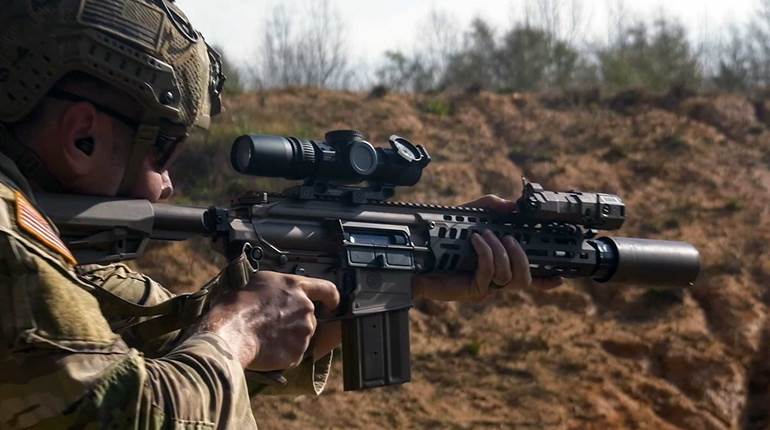
Chambered in 5.56x45 mm NATO, the M400 has some distinct external and internal differences from most AR-style rifles. For sling options the lower receiver has quick attach/detach points machined on either side behind and below the forward assist push-button in addition to the more traditional sling swivels. There is also an ambidextrous magazine release with an extended swell on the left side to prevent it from being unintentionally depressed. The flared magazine well is machined with a more angular profile and features distinct vertical grooves on its front. The standard, left-side safety selector is set up for right-hand use, though the opposite side includes a raised tab, which allows experienced users to determine the position of the safety by touch on that side.
The upper and lower receivers are both forged 7075-T6 aluminum with a hard-coat anodized finish. The six-position collapsible stock rides on a commercial-size buffer tube, and the receiver extension nut is firmly staked to prevent it from coming loose. The buffer tube also includes a standard weight carbine buffer and spring. Inside the lower receiver at the rear a spring-loaded pin serves as a tensioning device, applying pressure between the upper and lower receivers. Tightening the fit between these parts reduces play and can lead to improved accuracy. Unlike some other tensioning devices, this one does not require the use of special tools for disassembly.
The commercial bolt and bolt carrier have a phosphate finish, and the gas key on the bolt carrier is properly staked. The chrome-lined and phosphate-finished 16-inch barrel is rifled with a 1:7-inch twist rate, which aids in stabilizing heavier bullets. The muzzle is topped with a standard A2-style flash hider. The barrel’s profile is slightly altered from that of a standard M4 in that it is missing the rear cut.
The sights include a correctly “F”-stamped elevation-adjustable front sight and a removable windage- and elevation-adjustable M16A2-type carry-handle rear sight. The upper receiver also has standard M1913 Picatinny rails with indexing marks to allow the user to more easily return an optic to the same place on the rail after removal.
At the barrel extension’s rear, the upper receiver includes an M4-style feed ramp, which is cut wider and lower than on a standard rifle to help ensure more reliable feeding from the magazine under adverse conditions. Inside the barrel extension, there is an extractor support pin which lines up with the extractor when the action is closed. In case of an over-pressure round or other cartridge failure, the extractor (as the weakest part of the bolt) could blow out, damaging the rifle and/or causing injury to the shooter. The extractor support pin was added to protect the shooter in the event of such a failure.
For the accuracy evaluation, we used two heavy hollow-point .223 Rem. loads, as well as a Winchester 5.56x45 mm NATO loading, fired from sandbags off the bench at 100 yards. The optic was a Trijicon TR20-2 AccuPoint 3-9X 40 mm scope with a Mil-Dot reticle that features an illuminated amber dot at its center. The accuracy results are shown the accompanying table. The single-stage trigger exhibited little creep and no stacking or overtravel, and it broke cleanly at 6 pounds, 8 ounces.
This lightweight compact carbine handled easily, and the oval polymer handguards’ double aluminum heat shields kept the shooter’s hands cool even through a series of rapid-fire strings. Several failures to feed were encountered using hollow-point ammunition, most typically upon initial feeding of the first round from the magazine. That said, full-metal-jacket ammunition functioned flawlessly in the accuracy test, as did a hodgepodge of several hundred miscellaneous 5.56x45 mm NATO ball rounds and partial boxes of full-metal-jacket loads leftover from previous tests.
With the addition of the M400, SIG Sauer is able to now satisfy all segments of demand for AR rifles, especially traditional gas-impingement enthusiasts. The improved safety features and other meticulous touches are a hallmark of this firm’s solid engineering.
Manufacturer: SIG Sauer, Inc.; (603) 772-2302; www.sigsauer.com
Mechanism Type: direct-impingement, gas-operated, semi-automatic center-fire rifle
Caliber: 5.56x45 mm NATO (.223 Rem.)
Receiver: forged 7075-T6 aluminum
Barrel Length: 16" chrome-lined
Rifling: six-groove, 1:7" RH twist
Weight: 7 lbs., 1 oz. (empty with removable rear sight)
Overall Length: 351⁄2" (stock extended), 32" (collapsed)
Magazine: 30-round detachable box (accepts standard AR/M16)
Trigger: single-stage; 6-lb., 8-oz. pull
Sights: elevation-adjustable front post, detachable carry handle mounted M16A2-type rear; M1913 Picatinny rail on upper receiver
Stock: six-position, black polymer collapsible: length of pull, 13½"; drop at heel, 1¾"; drop at comb, 2"
Accessories: plastic storage case, cable lock, owner’s manual, magazine
Suggested Retail Price: $1,099
Most Popular