10/18/2012
To some, the phrase “shot calling” brings to mind Babe Ruth's famous home run, where the Sultan of Swat pointed to the stands before knocking the next pitch directly where he had pointed. Or perhaps you're a fan of the Southern hip-hop classic "Wanna be a baller,” where the artist pines for the skills of a "baller, shot caller;” a slang term for an outstanding basketball player. Whatever the phrase brings to mind, the shooting sports have a definition of shot caller that is based on the skill of reading the sights of your pistol at the exact moment the shot breaks.
Most shooters see hits by lowering the gun and looking at the target. This exercise is frequently accompanied by wonderment at the location of hits (or the lack thereof ) while the shooter attempts to figure out how exactly his or her rounds ended up in that spot of the target. "I wasn't aiming for that,” is often said just before hopping on the Internet to complain about how the new handgun shoots low and to the left.
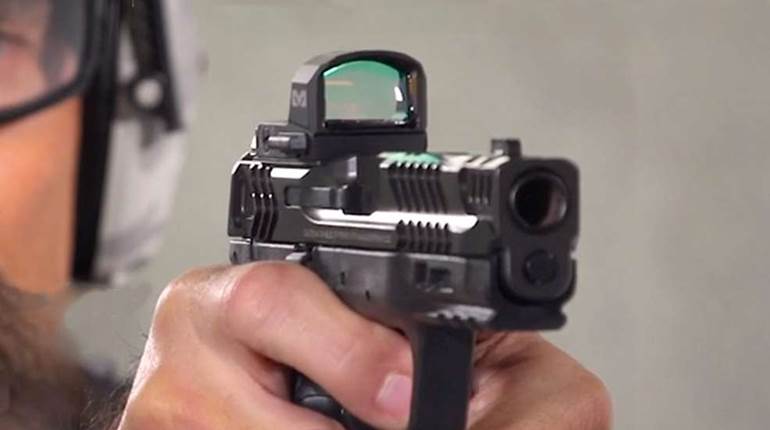
An accomplished shooter, on the other hand, will generally know where the round will strike the target the moment it leaves the gun. Doing this is called calling your shot, and it is the act of seeing the sight picture in relation to the target as you break the shot. It's both a simple and complex skill, and one that all of the top action shooters insist is necessary to truly excel.
In his book on practical shooting, Brian Enos said "see what you need to see,” a statement that reflects his interest in a more Zen style of learning. It's likely that everyone reading this article is familiar with a proper sight picture. Knowing that is Step 1. Step 2 is understanding the relationship between the sights and the target. For example, a bullseye shooter is going to want the most defined sight picture possible to guarantee maximum accuracy. A USPSA shooter firing at an unobstructed target 3 yards away does not need as refined a sight picture (or much of one at all) to get the level of accuracy required. But that same shooter, when confronted with a plate rack 20 yards away, takes a much more precise sight picture to hit a tougher target.
Step 3 is perhaps the most difficult step in the process to explain within text. Because every shooter interacts with sights differently, the perception of sight picture is going to be slightly different from person to person. However, in general terms Step 3 is being able to see your front sight in relation to both the target and the rear sight at the exact moment the shot breaks. So if your front sight is slightly to the left in your sight picture, the round will impact correspondingly left on the target. Having the sight up and out of the notch means you're going to hit high. Of course, this assumes that your gun is sighted in and adequately accurate. Once you're at Step 3, the next ability is to do it every single time.
The secret to learning how to call your shots is practice. I learned to call my shots while practicing for the Bianchi Cup on a plate rack. Shooting 1,000 rounds over the course of three days at a plate rack from as far back as 25 yards took me from "occasionally able to call shots" to "shot caller." Other shooters I know have developed the ability in dry fire, which is probably a better way to do it than wasting thousands of rounds learning how to shoot. Dry fire is hugely beneficial to developing the ability to call your shots. Because there's no live ammo, you can see your front sight as the trigger breaks free of recoil. If you're flinching, slapping the trigger or doing something to disrupt the sights, it will be a lot easier to identify in dry fire than it would be with live ammo.
A .22 LR is also a great way to learn to call your shots, as is air soft training. These are especially good alternatives if you're at all like me and find dry fire to be tediously dull. There are many.22 caliber pistols available as analogs of their larger cousins, or conversion upper units that make a full-size pistol into a rimfire trainer. Personally, I find rimfire training more interesting than dry fire. Dry fire, despite it's obvious benefits, feels like a lot of silly pantomime, and while the beloved trainer isn't a full on centerfire, at least it's still shooting of some sort.
Another tool that's catching on instead of dry fire is the SIRT pistol from Next Level Training. Used by USPSA Production Grandmaster Mike Hughes, the NLT SIRT pistol projects a laser beam when the shooter breaks the shot, showing where the round would have impacted. Ideally the dot should be adjusted so that it's just visible over the front sight of the pistol to prevent the shooter from developing the bad habit of looking at the target instead of the front sight. The SIRT is currently available as a Glock analog, and will soon be available for M&P shooters as well.
The question that you're probably asking yourself now is "why is any of this important?" To be perfectly honest, unless you want to become an expert at shooting, it's not. If you're happy with your current skill level, that's great. Keep having fun! But if you want more, then you need to learn to call your shots. The ability to call your shots means your followup shots will come faster, you'll have fewer points down and misses and your scores in IDPA and USPSA matches will improve. No, it's not a must-have skill for every shooter. But it makes a great party trick at the range to impress your buddies, and more importantly makes you a better shooter.
Most Popular