When John Mahlon Marlin decided to compete with Winchester by entering the lever-action market, his first effort, introduced in 1881 as the top-ejecting Marlin Repeating Rifle (it was not catalogued as the Model 1881 until the appearance of Marlin’s second lever-action in 1888), was a muscular-looking firearm. But then it had to be, as it was the first lever-action with a receiver long and strong enough to chamber what had become one of the most popular cartridges in the country, the .45-70 Gov’t, thus beating Winchester’s Model 1886 by a full five years. Tipping the scales at almost 10 lbs., the 28"-barreled Marlin Model 1881 was a very hefty gun. Even producing a shorter 24"-barreled rifle and, in 1885, a slightly scaled-down “lightweight” version couldn’t bring the rifle’s weight below 8 lbs.
 The Model 1888 (which was produced for only two years) and then the side-ejecting Model 1889 were both smaller, lighter and chambered in the same .32-20, .38-40, and .44-40 Winchester cartridges as the Winchester Model 1873, with the Model 1889 also being offered as a handy 6-lb., 20"-barreled carbine. This made it Marlin’s first practical saddle gun, thereby competing with Winchester’s ’73 carbine. It was a configuration that Marlin continued with its subsequent Model 1893 and Model 1894 carbines. Additionally, many firearm companies were offering non-catalogued features, and shorter 20" carbine-length barrels for lever-action rifles, albeit a rarity, was one such option. Consequently, in 1892, Marlin began producing shorter-barreled carbines, starting with a 15"-barreled Model 1889.
Collectors refer to these shortened carbines as “trappers,” but that term was never officially used by either Winchester or Marlin. Winchester referred to them as “Baby Carbines” or “Special Short Carbines” on the rare occasions when they were cataloged. Marlin, on the other hand, simply called them “special lightweight carbines,” although in his book Marlin—A History Of The Guns And The Company That Made Them, William S. Brophy, who was also Marlin’s senior technical manager and a founder of The Marlin Collector’s Ass’n (marlin-collectors.com), referred to these guns as “baby carbines”—a term the company never used. Although some Marlin trappers had full-length magazines that held nine rounds (compared to 12 rounds in a standard-length carbine), many shortened carbines sported half magazines to save weight, although it reduced ammunition capacity. Firepower aside, those adventurous souls who special-ordered Marlin trappers were in favor of having a light, quick-pointing, fast-shooting lever-action that was easier to carry over long distances.
Although many of Marlin’s early firearm records are incomplete, thanks to Brophy’s efforts, there is an authenticated list of Marlin “special lightweight carbines.” In a letter to the director of the ATF dated April 1, 1980, Brophy states that he has gone through all the Marlin factory records from 1883 to 1906 to locate carbines with barrels shorter than 16". The previous Model 1889 notwithstanding, he only found Model 1893 and Model 1894 examples, and all had 15" barrels.
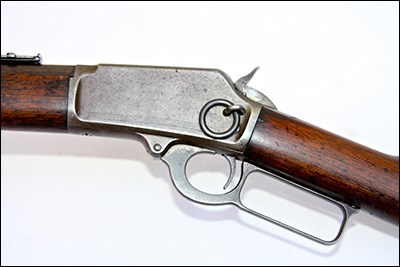
Interestingly, a few years ago, a small number of authentic Marlin Model 1893 and Model 1894 saddle-ring Trappers—all with 15" barrels and allegedly discovered in Mexico—turned up at a gun show. This is one of those guns. Chambered in .44-40 Win., Serial No. 142373 is authenticated by factory records as a factory original, and as a pre-Jan. 1, 1899 gun, is classified as an antique. Model 1894 Trappers made after 1898, though, are classified as modern firearms and subject to NFA regulation, but specific guns have been exempted by the ATF as being factory-original short-barrel rifles that are Curios and Relics. With no remaining finish, it has a moderate bore, is all-original and fully functional, and thus is worth $1,750 to $2,250.
Gun: Marlin Model 1894 Trapper
Chambering: .44-40 Win.
Serial No.: 142373
Condition: NRA Very Good (Antique Firearm Standards)
Manufactured: April 21, 1897
Value: $1,750 to $2,250
Most Popular