2/27/2013
Growing up, many of us were involved in sports where we were told to “Hold onto the ball” or to “Maintain possession of the puck,” while at the same time, we were encouraged to strip away those same objects from our opponents. And for some of us, who went into various uniformed soldiering and law-enforcement careers, “retention” of our firearms against the attacks of others became a serious and essential part of what we did every day.
However, many plainclothes officers and agents, as well as a large segment of the concealed-carry public, have never really understood that concept nor have they appreciated the importance of securely retaining the firearms they take with them everywhere they go. Even the more traditional civilian gun toters (hunters, hikers, campers and farmers), might only give a passing thought to such things; employing only the more long-established straps and thumb breaks to keep their guns in place.
But just as criminals have become more practiced and more emboldened in their efforts to fight you for your gun, outdoor activities have become more strenuous and fast-paced. As a result, a holster with a mechanical means of retention, a true lock, is worthy of consideration. Granted, a lanyard (connecting an unholstered firearm to the user’s belt) might keep a dislodged pistol or revolver from becoming lost in the field while riding a horse, piloting an ATV, biking off-road, or clambering through the wilderness, but the real idea here is to not have it come unholstered in the first place—an idea that should also be one of the primary focuses in the case of carrying a legally concealed firearm under a shirt, jacket or sport coat in your daily life.
Historically, holsters were nothing more than open-topped receptacles, while others had flaps that both protected the gun from the elements and kept it in place during the course of one’s work or social activity. While flap holsters never truly went away, over time, their use was greatly overshadowed by the open-top concepts where improved gun fit and various straps over the hammer or back of the gun were added to keep the firearm where it belonged.
Ultimately, the faster and generally more effective thumb breaks we see today supplanted those straps and in later years, in some cases, tensioning screws and other devices were installed into the holster bodies themselves in order to create an additional means of containment pressure on the gun. The more you add on, however, the more you have to overcome. And in the case of needing a concealed firearm for defense, or perhaps an openly carried handgun for signaling if injured or incapacitated in field, things can become problematic to say the least. So what can you do to balance retention with ease of use?
I think that heading down the long travelled, two-way street of police and military applications vs. civilian employment of the firearm could be helpful. Numerous improvements in guns, their gear and their use in the field have been the result of a kind of a cross-pollination of needs and ideas between these two worlds. Improvements have not only made the equipment better but also their users’ lives safer on both sides of the equation.
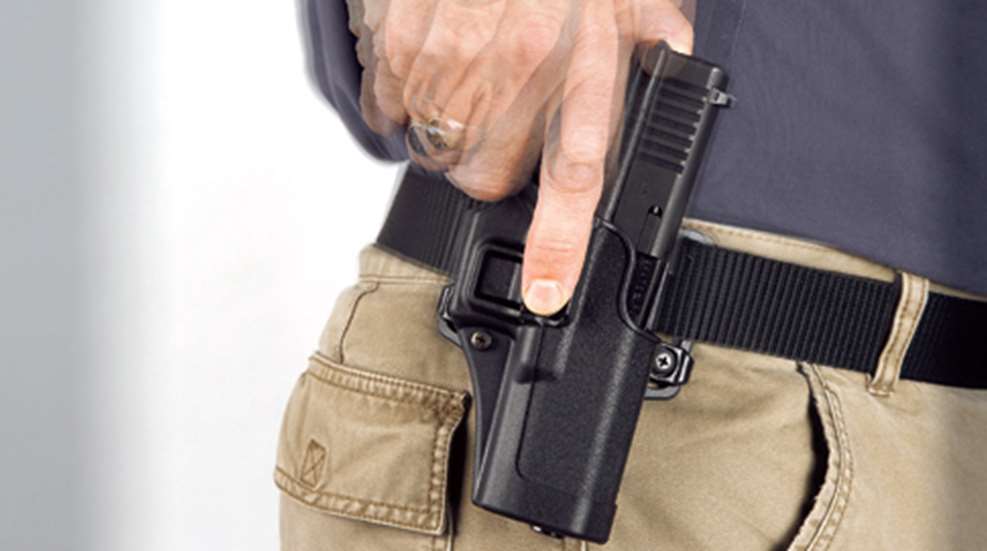
Today, various mechanical locks that secure the gun to the holster until they are opened or undone have become common in many law enforcement and military applications. With the better of those designs, as long as the holster is secure to the wearer, the gun is too. In the past, many of these devices were handicapped by their complexity. That is not the case anymore.
Following are examples of the latest retention holster designs from Blackhawk, Galco, Uncle Mike’s and Safariland. Others are available from such makers as Gould & Goodrich, Fobus Holster, and Blade-Tech Industries. All offer convenient-to-operate, mechanical “locking” devices for law enforcement and civilian applications.
The bottom line is that, if you carry a gun for any reason, you would be well-advised to check them out.
Check out the latest retention holster designs:
Blackhawk
Galco
Uncle Mike's
Safariland
Most Popular