10/16/2012
Smith Enterprise, Inc., of Tempe, Ariz., has established itself through its M14 rifle modernization projects for various U.S. military units and through component sales and gunsmithing services aimed at the civilian market for semi-automatic clones.
More than 20 years ago, the company produced semi-automatic M14-type receivers—machined by Ron Smith and his father, Richard, from forged billet and investment cast 8620 steel—that became highly regarded among highpower service rifle competitors.
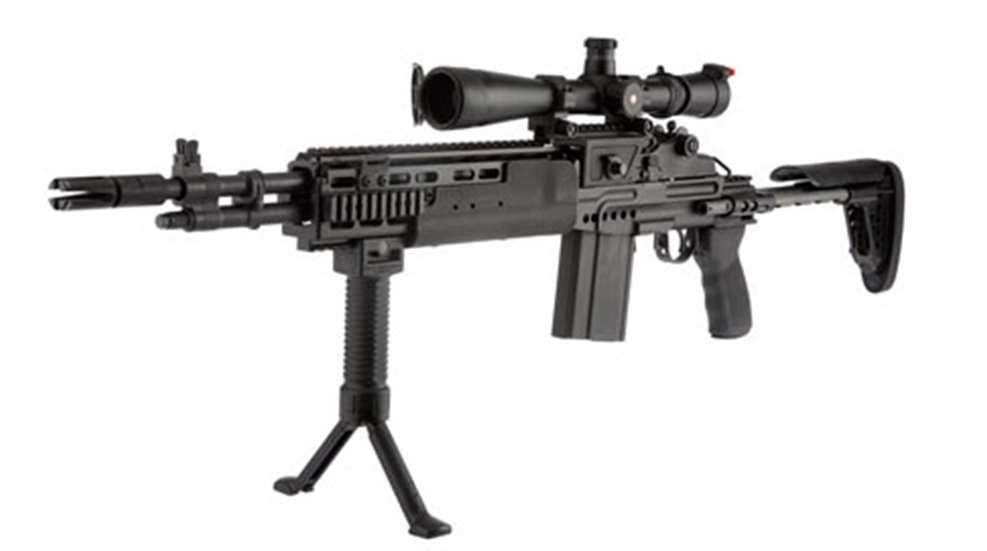
Recently SEI returned to the market with a receiver machined from 8620 steel bar stock. Rather than sell complete guns, Smith decided to distribute receivers through R-Guns, giving customers the flexibility to enlist its expertise in building rifles to individual requirements. We evaluated a Smith-built rifle that mated its new receiver to an SEI standard-weight 18-inch barrel. It was mounted in a Sage Int’l, Ltd. Enhanced Battle Rifle aluminum chassis stock and fitted with a U.S.-military-specification SEI steel scope mount along with the company’s heavy duty steel rings to hold a Leupold Mark 4 3.5-10X 40 mm riflescope. The resulting package, although weighing 13 pounds, was nonetheless extremely sturdy and reasonably compact.
Exemplifying Smith’s approach to offering features and processes not typically available, the barrel featured four-groove, 1:10-inch twist rifling with a chamber cut specifically for M118LR match 7.62x51 mm NATO ammunition. But in addition to that load’s 175-grain bullet, it was still able to safely and accurately handle M80 ball and commercial loads. The barrel was treated inside and out with a magnesium phosphate finish and was fitted with an SEI combination gas cylinder lock/front sight base that allows the use of standard-height front sights. We chose the company’s tritium bar stripe unit to complement its rear non-hooded National Match sight that offered 1/2-m.o.a windage and elevation adjustments. The muzzle was capped with SEI’s proprietary Vortex flash suppressor, an open-prong design that greatly reduces the gun’s flash signature.
Enhancements to the gas system included an SEI gas piston made from 420 stainless steel that was hard-chromed and cryogenically treated for toughness and lubricity along with a gas plug manufactured from 420 stainless steel that was also treated to resist corrosion.
The only original U.S.G.I. components used in the build included a TRW bolt and a Winchester trigger housing containing a Springfield hammer. Otherwise, even the trigger group’s pins and hammer spring—made of hardened S7 tool steel and silicon-chrome, respectively—were upgrades supplied and installed by Smith.
We fired the Smith rifle with a variety of ammunition including 110-grain Hornady TAP and 175-grain Federal Gold Medal Match, and achieved sub-1-inch five-shot groups at 100 yards with each. The rifle exhibited no malfunctions during several hundred rounds of testing, and spent cases were ejected in a consistent pattern.
The SEI extended bolt stop allowed shooters to chamber the first round with the weak hand while keeping the firing hand on the pistol grip. And although the rifle’s weight made handling rather sluggish, its adjustable length of pull and cheekpiece, along with its expanses of Picatinny rail, allowed for quick customization of fit and accessories to individual shooter preferences. Of course a customer seeking a lighter gun could specify a more conventional stock, including the old standby U.S.G.I. fiberglass unit.
Therein is the attraction of having a rifle custom-configured by experienced builders working with their own high-quality components: a high degree of performance in a configuration ideally suited to the customer’s needs.
In the case of Smith Enterprise, its receiver, components and services are not inexpensive, but are among the best available at any price.
Contact: Smith Enterprise; (480) 964-1818; www.smithenterprise.com.
Most Popular