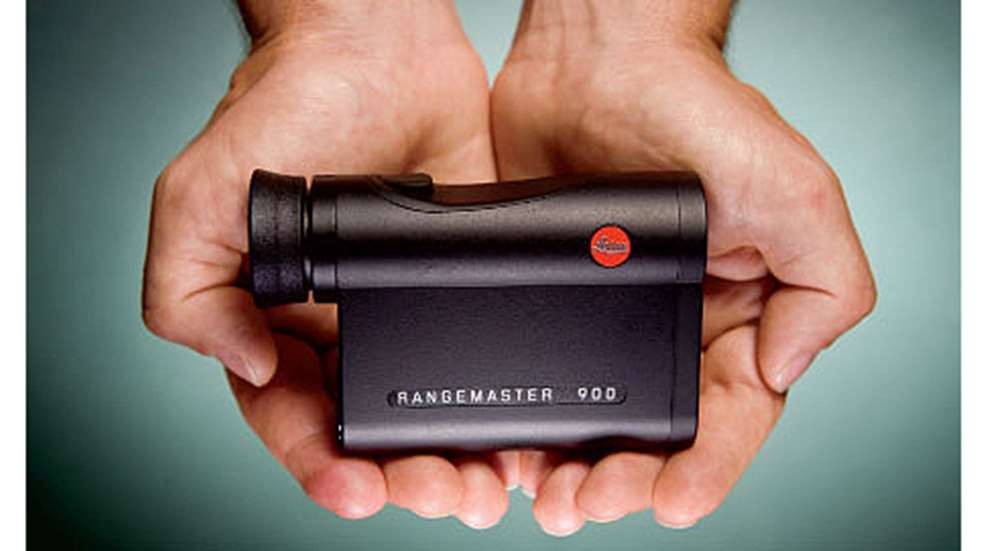
Its background in developing laser-based surveying instruments and a century of expertise in grinding glass lenses for binoculars, microscopes and cameras more than prepared German optics manufacturer Leica to enter the sporting market with the LRF 800 monocular rangefinder in 2000. Since then, the company's circular red medallion has graced a series of progressively smaller, lighter, more sophisticated units. The latest are the Rangemaster CRF 900 and 1200, which differ from previous Leica models in that they rest vertically rather than horizontally in the hand during use.
The CRF 900 became a handy companion during an early-June plains-game safari in the southwestern African country of Namibia. The unit's size-little more than a deck of playing cards-and smooth contours made withdrawing it from the breast pocket of a shirt quiet and effortless. The non-slip exterior coating allowed a secure hold even when hands were stiff from the early morning cold. Equally convenient was the compact Ultravid 8x32 mm binocular that hung from the evaluator's neck. During the 10-day hunt, the package served exactly as Leica Sports Optics Vice President Terry Moore suggested it would-"not so much as a necessity, but as an enhancement of the African safari experience."
As is often the case when hunting bushveldt terrain, none of the shots from a Winchester Model 70 Classic .375 H&H were long-the farthest being 139 yards on a blue wildebeest. In addition, the factory Federal Premium Vital-Shok, carrying the 260-gr. Nosler Accubond bullet's ballistic coefficient of .473, made holdover calculations unnecessary. Nonetheless, of the four animals taken, including a 1,200-pound eland, an average-size impala and an average-size warthog, none required guessing as to exactly how far the shots were likely to be, when setting up on a watering hole beforehand, or how far they had been, when ranging the distances afterward for the purposes of confirming bullet placement and evaluating bullet performance.
On several occasions, while spotting for a hunting partner, we called out precise range measurements that aided his shot placement on small, distant animals, such as jackals. Using the CRF 900 couldn't be simpler. Adjust the eyecup and diopter setting to the preferred positions, and look through the 7x monocular. A single press of the top-mounted Distance Measurement Release Button activates the laser, which is reflected off the target and read by the unit. A small, red aiming square simultaneously appears in the center of the lens. A second press displays the distance in yards below the aiming point.
The rest is up to the shooter, as the CRF series units do not incorporate trigonometric software for angle compensation. They do, however, incorporate a scan mode. Simply hold down the release button during the second press and distances automatically re-register as the unit's beam reflects off various targets. Most hunters understand the benefits of using binoculars in combination with laser rangefinders. And it stands to reason that the convenience gained by the latter's compactness, light weight and simplicity equate to more unhindered glassing time through the former for trophies. Any piece of equipment as small and light as the Leica CRF 900 that can do that reliably and conveniently is worth its weight in gold.
Most Popular