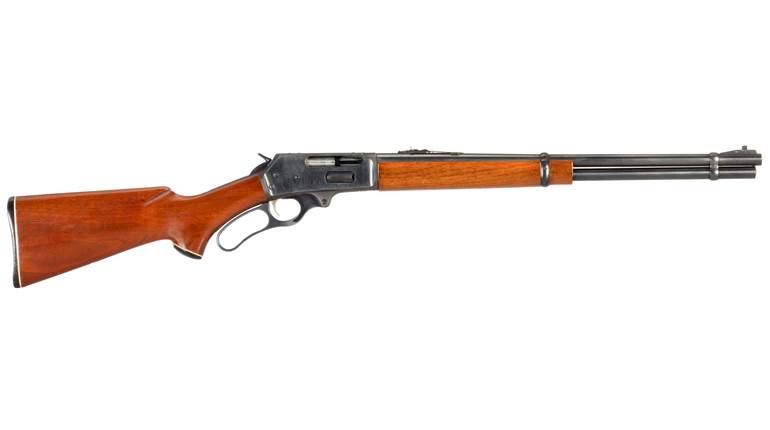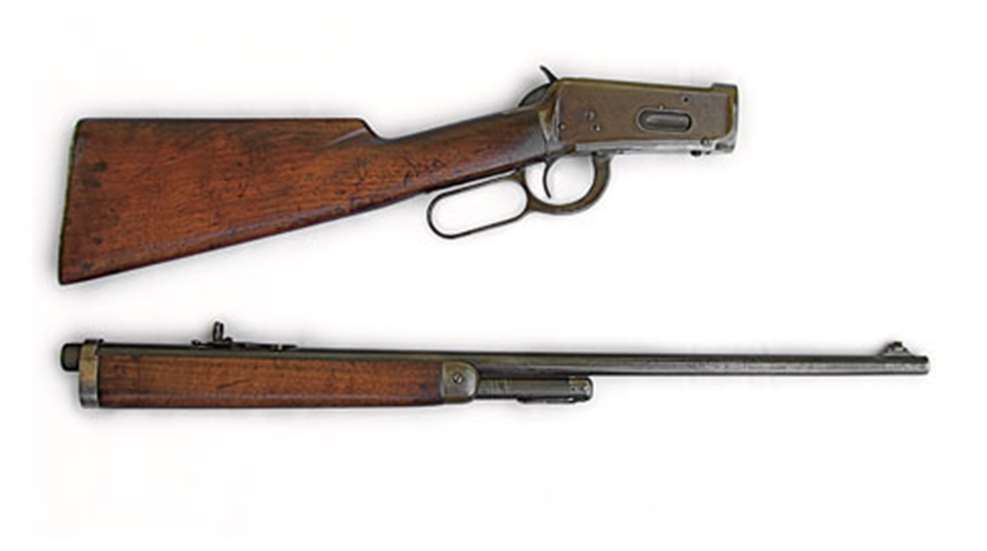
Winchester had a winner with its Model 1894, the first rifle made for smokeless propellant cartridges. But by the early 1920s, with the Wild West giving way to “urban wilderness,” the role of the Model 94 was being redefined as more outdoorsmen were traveling by motorcar and railroad in addition to horseback.
Thus, while the handy Model 94 carbine remained a favorite, the longer-barreled rifle was losing sales. Consequently, in 1924 Winchester introduced an “updated” version of the Model 94 rifle. The company dubbed it the Model 55 (not to be confused with the Winchester Model 55 top-loading, single-shot .22 rimfire of later years), in keeping with a similar policy for the Model 1892, which had become the Model 53.
The Winchester Model 55 was a rifle with a 24-inch barrel, an integral ramp front sight and a half-magazine that held three cartridges. It was initially chambered only in .30-30 Win., but .25-35 Win. and .32 Win. Spl. were added in 1926. For the first few years, the Model 55 carried its own set of serial numbers; however, in 1926, around serial number 2,865, the Model 55 reverted to serial numbers within the already established Model 94 range.
The earliest guns were made as takedowns, a nod to the popularity during that era of storing guns in closets or trunks or transporting them via bicycle or in suitcases. In 1930, solid-frame Model 55s were made available. Extra-order options, such as shorter or longer barrels, double-set triggers and half-octagon barrels, are known to exist. In 1932, with approximately 20,500 guns made, the Model 55 was discontinued to make way for the Winchester Model 64. There were enough spare parts in Winchester’s inventory, however, to keep the Model 55 in production until 1935, even though it was no longer catalogued.
This early Model 55 Winchester takedown is one of those guns I wish could talk. Its four-digit serial number puts it in the second year of manufacture, and although it shows signs of long, hard use, it has been taken care of, with no serious rust or pitting (although the link pin stop screw is an original replacement). The bore, too, remains shiny, and the rifling is sharp. As it came out of a ranch in Montana, no doubt it could tell tales of many deer hunts. It is a classic example of an early 20th century hunting rifle that, while still serviceable, is also increasingly collectible.
Gun: Winchester Model 55 (takedown)
Caliber: .30-30 Win.
Serial No.: 16XX
Condition: NRA Good (Modern Gun Condition Standards)
Manufactured: 1925 (note: 1,847 Model 55s were made that year)
Value: $1,250 to $1,450
Most Popular