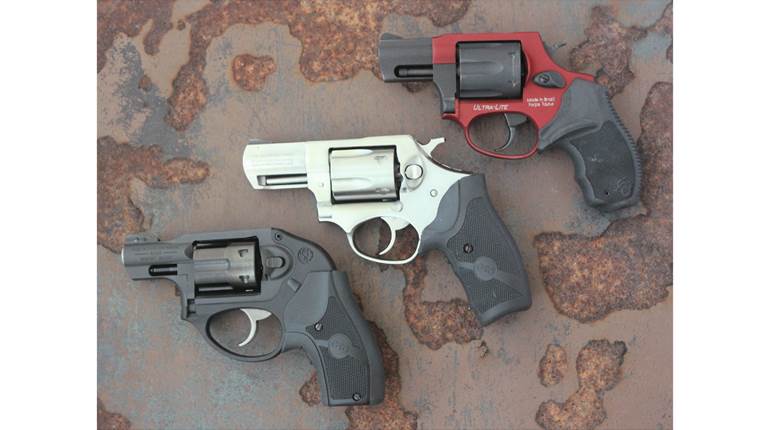
Multi-caliber revolvers capable of firing .410 shotshells are not a new idea, but in recent years the concept has picked up real momentum in the shooting community. In the early ‘90s, MIL, Inc. released the Thunder 5 revolver, but it wasn’t that successful. Fast forward to the year 2007. Taurus rescues the idea of a .410-capable revolver from total shooting obscurity with the release of the Judge. Taurus transformed the clunky, oversized and generally unattractive concept of a .410 revolver into a trimmed-down and familiar format that has been a hot-ticket item ever since. It's become clear that this kind of handgun is not just a fad, so Smith & Wesson has used its considerable revolver-building experience to enter the .410 handgun market with the release of the Governor.
At first glance, with its matte-black finish, scandium frame and stainless-steel cylinder, the Governor appears to be the latest addition to Smith & Wesson's Night Guard series. However, there are a few notable differences. The most obvious is the Z frame and extended cylinder to facilitate the use of 2 1/2-inch .410 shotshells. The Governor has a no-snag fixed rear-notch sight and a more traditional dovetailed Tritium front night sight instead of an XS sight system. The grip options are different as well. The Governor arrives with either Hogue's synthetic rubber bantam grip or a bantam Crimson Trace Lasergrip.
As with other revolvers in this class, the Governor has a rifled barrel and will chamber .45 Colt loads. Smith & Wesson puts a unique twist on the gun by installing a six-shot cylinder, instead of the more common five-shot configuration. And the company has added a third, more-common and less-expensive caliber option by milling the cylinder and ejector star to allow the use of .45 ACP ammunition in moon clips.
The overall appearance of the Governor may give the impression that it's too big of a gun for concealed carry. But its moderate weight of 29.6 ounces, the standard six-shot thickness of the cylinder, the 2.75-inch barrel and the K-frame sized grip places the Governor in line with other duty-size revolvers and semi-auto pistols. Essentially, barrel length was traded out for cylinder length, and the weight is kept at a reasonable level by the scandium frame. If you already carry a duty-size gun, then the Governor will not be much of a stretch.
The fit and finish of the Governor is excellent. The single-action trigger broke at a crisp 4-pounds, 8-ounces of pressure, with the smooth, clean, double-action trigger that Smith & Wesson is famous for. Despite the bulky appearance of the longer cylinder and frame, the revolver has good balance and pointability. The Hogue bantam grip is compact, but provides just enough length for a full three-finger grip. Shooting the Governor, even with .410 shotshells, is not the punishing experience that might be expected. Recoil is similar to shooting a 4- or 5-inch barrel single-action chambered for .45 Colt.
Expanded Range Testing
A multi-caliber revolver like the Governor requires some special considerations when it comes to testing it on the range, especially when one of the rounds it feeds is the 2 1/2-inch .410 shotshell. Instead of testing three loads of one caliber at 25 yards, I chose to flex the gun's broader range by testing .45 Colt, .45 ACP, birdshot, buckshot, slugs and .410 specialty rounds. This variety of projectiles requires the use of more than one size of target and the adjustment of shooting distances, since no one measuring stick would be meaningful for all of them. Before discussing the specifics of the test results, it should be noted that the Governor ran flawlessly with every variety of ammunition fired.
.410 Birdshot Loads
The idea of using birdshot for personal protection is a major contributor to the controversy surrounding .410 defensive handguns. Some folks recommend the use of fine birdshot for self-defense in tight quarters, such as elevators, ATM kiosks or when attacked by carjackers. Other shooters reject this idea because of the birdshot's low level of strike energy and penetration per pellet. Wherever you stand on the birdshot debate, this is the important point to remember: Birdshot spreads rapidly, very rapidly, from short-barreled revolvers. The Governor is no exception.
Birdshot spreads and loses energy too quickly to be measured at 25 yards. Winchester Super X .410 loads, including No. 9, No. 7 1/2, No. 6, and No. 4 birdshot, were test fired at the viper-sniping distances of 6 and 10 feet using smaller 8 1/2 x 11-inch targets. At 6 feet, the targets showed pattern retention of 85 to 96 percent over the entire sheet of paper. All four loads would devastate a snake that's about to bite. At 10 feet, the patterns spread considerably, with pattern percentages dropping to 47 to 59 percent for three loads, with the best pattern produced by the No. 6 load at 85 percent. Again, that's at a distance of 10 feet. Informal tests at 15 feet showed patterns in the 15- to 24-percent range, and 20-foot tests did not produce a reliable pattern.
As of this writing, only one birdshot shell on the market is labeled as a self-defense round: the Federal Premium .410 Handgun No. 4 Shot load. In keeping with its intended purpose, the shell was tested using a 12x18-inch silhouette target. At both 6 and 10 feet, 100 percent of the shot formed an 11- to 11 ½-inch group. But just like the sporting loads, the pattern dissipated quickly in the 15- and 20-foot range.
If birdshot is only effective at 6 or 10 feet, then what is it good for? It has a place for up-close-and-personal situations where a wide pattern is useful, shallow penetration is acceptable and a quick loss of pellet energy is desirable. Birdshot is ideal on the trail for poisonous snakes or feral dogs that suddenly get too close for comfort, but where a solid projectile might miss, ricochet or keep on trucking for a long distance past the target.
Birdshot offers a first-shot option for home defense that reduces the chances for over penetration of thin walls or of the assailant. As with other shotshell-loaded guns, the first round of birdshot can be followed by a second round of something more potent. However, birdshot is handicapped by that exceptionally limited 10-foot effective pattern range. And even within that range, it’s possible for the light shot pellets to be defeated by heavy clothing or a drug-induced resistance to pain. Even though a spot-on head shot will put 50 percent of the shot pellets on target, the other 50 percent of the pellet payload will travel past the target to do unintended damage to people and objects close by. It's important to carefully consider the circumstances in which you will be carrying birdshot before loading up with this round.
.410 Buckshot Loads
Not long ago, there was only one 2 ½-inch .410 buckshot load that could be readily found at the local sporting goods store, namely, Winchester's Super X 3-Pellet 000 Buckshot. Recently, Federal Premium has joined in with its .410 Handgun 4-Pellet 000 Buckshot, and Remington has added its HD 4-Pellet 00 Buckshot load to the mix. Buckshot also spreads rapidly from short-barreled revolvers, but not as rapidly as birdshot. Test targets were pushed from the 6- and 10-foot range out to the more generally accepted self-defense distance of 7 yards. The tightest patterns, across all of the .410 handgun platforms I have tested, have been produced by the Federal Premium load. The Governor was no exception, producing consistent 4-inch groups at 7 yards.
.410 Specialty Loads
You might think birdshot and buckshot just about cover it for .410 loads, but two companies have decided to change the rules. Winchester has released a defensive round called the PDX-1. The mixed payload of this shell contains three copper plated defense discs on top—think of them as pre-flattened buckshot pellets—followed by 12 copper-plated BB-size pellets. The defense disks form a tight, hard hitting central group while the BB pellets spread out to create a wider strike area. Test targets had to be moved up close to capture the fast-spreading BB shot. At a distance of 10 feet, the Governor produced 1-inch groups with the defense discs, and 7.5-inch groups with the BB shot.
The other unique entry for .410 defensive shotshells is Lightfield's Less Lethal 4-Ball Rubber Buckshot. The hard .41-caliber balls fly fast and hit hard, but drop their energy very rapidly to reduce the damage to an assailant or to household materials. This round also produces an exceptionally low level of recoil. The goal is to give home defenders a first-shot option that is in harmony with their local regulations, or to protect other members of the household from over penetration of heavy lead shot through walls. In the Governor, Lightfield’s rubber buckshot produced 8-inch groups at 7 yards.
.410 Slugs
Readers have expressed curiosity about slug performance from .410 revolvers compared to .45 Colt loads, and in the case of the Governor, .45 ACP loads. In short, they don't. Remington and Winchester slugs perform swimmingly from long-barreled smooth-bore shotguns. However, these .41-caliber projectiles rattled down the Governor's short .45 caliber barrel to produce 6- and 7-inch groups at 7 yards, and to wander all over the targets set out at 25 yards. Add to the slug shell’s lack of accuracy a sun-bright flash and loud report, and it's time to move on.
.45 Colt & .45 ACP
Some folks complain that you can't hit the broad side of a barn with .45 Colt loads fired from a .410 handgun. This is an exaggeration, though short-barreled defensive handguns will not produce cloverleaf patterns at 25 yards. Combine a shorter barrel with a longer cylinder, which increases the travel distance of the bullet before it hits the rifling of the barrel, and you are going to lose some performance. This is one of the trade-offs of being able to shoot .410 shotshells in a handgun.
The Governor produced solid defensive accuracy at 7 yards with .45 Colt loads. Groups ranged from 2 inches to 3.15 inches, with the best five-shot averages produced by Winchester's PDX-1 225-grain jacketed hollow points at 2.5 inches. At 25 yards, groups opened up into the 5- to 6-inch range. Once again, the Winchester PDX-1 produced the best five-shot averages at 5.25 inches. This is another reminder that .410 handguns are for short-range defensive applications.
I was curious to find out how the .45 ACP rounds were going to perform. It was interesting to see the shorter rounds produce results that were just as good as the longer .45 Colt loads. Of the .45 ACP loads tested in the Governor, Black Hill's 230-grain jacketed hollow points beat out the competition with 2.25-inch groups at 7 yards, and 5-inch groups at 25 yards. The use of .45 ACP provides less-expensive practice fodder and an important defensive option if .410 shells or .45 Colt become overly expensive or hard to find.
Final Thoughts
As a defensive handgun category, .410-capable revolvers continue to be hotly debated. With only about five years of successful sales behind them, these guns seem to have the same kind of effect on the shooting community as summer blockbusters do on movie goers. Despite the fact that critics reject them, saying they have no redeeming features, shooters keep buying these revolvers hand over fist. Even though the critics don't take them seriously, the demands of .410 revolver fans are just too much for attentive gun manufacturers and ammunition companies to ignore.
If you like the .410 revolver concept then the Smith & Wesson Governor offers another choice with an excellent feature set. This revolver is well made, reliable and it has the Smith & Wesson qualities that revolver fans are looking for. The six-shot cylinder is only ¼ inch wider than the five-shot cylinders of the Judge. That's hardly a sacrifice for an extra shot, a third caliber and night sights, all presented in a package that weighs the same as the Judge standard steel-frame models. The Governor costs around $125 more than the average Judge, but with the added features, it’s well-worth considering.
Manufacturer: Smith & Wesson
Model: GOVERNOR (Z Frame)
Action: Double-Action Revolver
Caliber: .410 2-1/2” Shotshell, .45 ACP, .45 Colt
Material: Scandium Alloy Frame/Stainless PVD Cylinder
Finish: Matte Black
Front Sight: Dovetailed Tritium Night Sight
Rear Sight: Fixed
Grip: Hogue Synthetic Rubber or Crimson Trace Lasergrip
Barrel Length: 2.75 Inches
Overall Length: 8.5 Inches
Height: 5.5 Inches
Weight: 29.6 Ounces
Width: 1.75 Inches
Capacity: 6 Rounds
Twist: RH 1:15"
Rifle Grooves: 6
Other Features: 2-Round and 6-Round Moon Clips Included For Use with .45 ACP
Suggested Retail: $679, With Laser Grip: $899
For compiledshootingresults on the Governor and other .410 handguns, go to 410handguns.com.