Attend any decent-size gun show and chances are you’ll come across an 1873 Trapdoor Carbine (the only version to sport a stacking swivel) or subsequent variations, which include the Models 1877 (the first with a two-piece cleaning rod in the butt), 1879 (with buckhorn rear sight), and 1884 (with Buffington rear sight). Although trapdoor rifles were also produced, the 22-inch-barreled .45-70 Gov’t carbines command the most interest and value, due to their association with the U.S. Cavalry and the taming of the American West. Trapdoor carbines were also used in the Spanish-American War, and refurbished arms were issued to National Guard units as late as the 1920s.
To replace the Army’s 1861 and 1863 muzzleloading rifle-muskets, Erskine S. Allin, master armorer at Springfield Armory, perfected a forward-hinged breechblock that swung open like a trapdoor, earning its everlasting nickname. Commensurate with this was the development of the .45-70 Gov’t cartridge, a gun and ammunition combination literally made for each other. Due to the carbine’s lighter weight and shorter barrel, reduced-load cartridges containing 55 grains of blackpowder were issued for it. Nonetheless, the carbine’s sights were optimistically calibrated to 800 yards.
Carbines were fitted with a stock-mounted bar and saddle ring, to be hooked to a leather sling worn diagonally across a trooper’s body, thus curtailing accidental loss from the saddle. Numerous changes were made to the carbine during its 20-year service in the Army, encompassing triggers, lockplates, breechblocks, stampings, hammers, and rear sights. Befitting military guns, parts were interchangeable and today it is rare to find a trapdoor in “as-issued” condition. Plus, many rifles were made into faux-carbines in later years.
There were 60,912 carbines made from 1873 to 1893. Those with serial numbers below 43,700 are known as “Custer Guns,” as there is a possibility they saw action at the Little Big Horn, but easily swapped parts mean “buyer beware”—authenticated guns are rare. Nonetheless, values of any carbine in decent condition have risen dramatically in recent years.
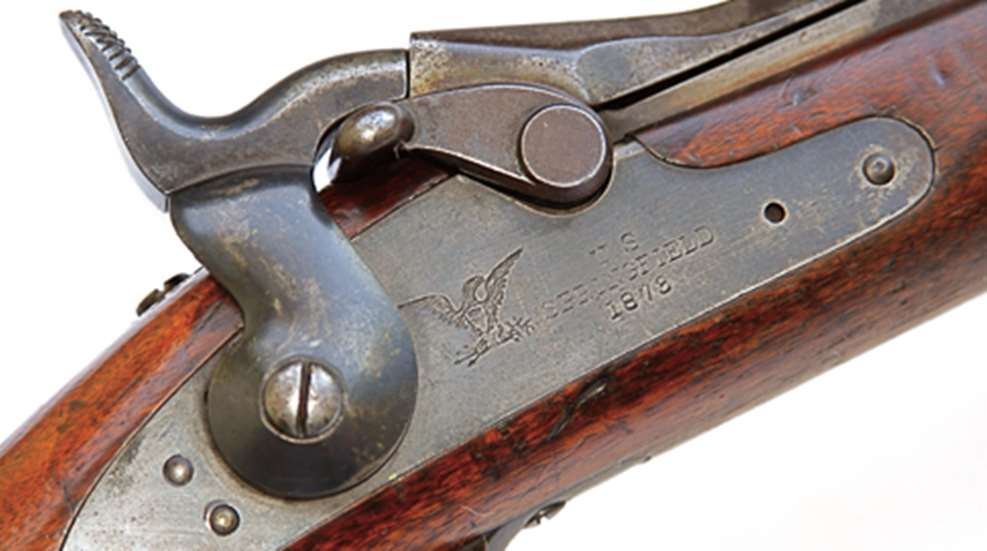
This Model 1879, serial number 177,XXX, was manufactured in 1881. A five-pointed star stamped after the serial number indicates an arsenal rebuild. Research shows this carbine was reissued in 1898 to the 13th Colorado Volunteers. A properly fitting lockplate, visible inspector’s cartouche, and pristine bore make this an above-average example worth $2,250 to $2,500.
Gun: Springfield Model 1879 Trapdoor Carbine
Caliber: .45-70 Gov’t
Condition: 60 percent - NRA Fine (Antique Firearm Standards)
Manufactured: 1881
Value: $2,250 - $2,500
Most Popular