Ever since the .500 Smith & Wesson Mag. came on the scene in 2003, there have been folks trying to figure out how to cram the cartridge into a rifle-especially a lever-action rifle. It’s an American obsession dating back to the cowboy days: A guy “needs” to have a lever-action rifle chambered for his handgun cartridge. Whether that need is real or not can be debated elsewhere, but the perception remains steadfast. Most of the popular revolver cartridges-from the .32-20 to the .45 Colt-have been placed in a lever-action rifle. However, when it comes to the .500 S&W Mag. there are a few dimensional problems in getting that cartridge to fit into an established platform.
Enter Greg Buchel and Dan Brown. Buchel has a background in architecture and engineering, and Brown is a master machinist. Both are gunners. About five years ago they partnered up to figure out how to marry the .500 S&W Mag. to a handy lever-action rifle, calling the new company Big Horn Armory (BHA). One of the most successful lever-actions chambered in handgun cartridges is the Winchester Model 92. This super-slick brainchild of John Browning took its wildly popular pappy-the Model 1886-and shrank it proportionately to accommodate smaller pistol cartridges. But, alas, the Model 92 is just too small for the big S&W cartridge.
Buchel, an accomplished engineer and Autocad designer, and Brown decided to upsize the Model 92 to harness the new chambering. The net result amounts to a 50-percent increase in size and mass throughout the rifle. One regular complaint about the ’92 is the dinky loading gate. Larger cartridges, like the .44-40, .44 Spl./Mag. and .45 Colt, can be downright painful to load in the magazine more than a couple of times a day. Since the .500 S&W Mag. is nearly as long as the .44 Mag. case, Buchel and Brown decided to adapt the loading gate design on the Model 1886 to the new action. Loading is not as challenging as it can be with a ’92, but after a day of loading some 70 rounds, my thumb is a bit sore and there are two groves on the end of my thumbnail from pressing cartridges through that port.
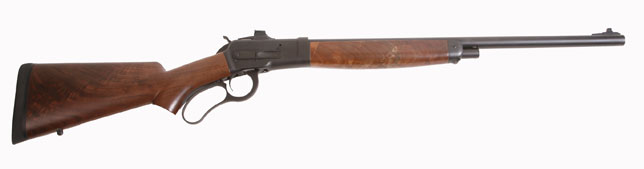
What Buchel and Brown ended up with is a rifle about halfway between the size of an 1886 and an 1892 Winchester, hence the moniker Model 89. Parts for the rifle are made by stock removal on CNC machinery. There are no investment cast parts in this rifle, nor are there any forgings. As the company gets on its feet parts are made by an outside contractor located in the United States. The walnut for the stock comes from Missouri. Everything about this rifle is American designed and made.
Just as there can be with established manufacturers, there have been some birthing pains in getting this rifle to market. Delays in parts availability, along with questions as to whether the parts delivered are exactly up to specs, combined with an enthusiastic customer base have made getting the rifles out the door on a timely basis a challenge. It was three years ago when I first saw a prototype Model 89 at the SHOT Show Media Day; I only received my test sample less than a month ago-and, mind you, Big Horn Armory is less than 10 miles from my home. Buchel told me that most of the issues have been worked out, and now the turnaround time from order to delivery is about two months.
In terms of real-world practicality the Model 89 is something of a niche rifle. It most certainly is not the all-around deer, elk and pronghorn rifle so popular in the west now. Rather, it is a rifle designed to deliver a solid punch to feral swine and bears at moderate range-say 200 yards or less. My range time showed me that a careful shot with superb eyesight might be able to stretch that to as much as 300 yards, but for most of us mere mortals two football fields should be considered max. I was able to hit an 18-inch square gong at 300 yards about four shots out of 10 from a benchrest. A better shot with better eyes probably could pick up perhaps a few more of those dingers at that range.
My sample Model 89 showed excellent workmanship throughout the metal and wood. I had some initial concerns that the curved lever might prove painful under the stout recoil of the big .50-cal., but those concerns proved meaningless. There’s plenty of room even for my bratwurst-sized digits in the loop, and the pistol grip helps greatly in controlling the rifle. The otherwise traditional look and lines of this rifle are melded with a couple of modernizations to help in its handling.
First, the traditional two-piece walnut stock is shod with a one-inch-thick Pachmayer Decelerator recoil pad. As a traditionalist, I tend to favor the old crescent-style steel buttplate-wickedly beautiful and equally wicked on the shoulder. Here is where good sense trumps tradition; the substantial recoil pad allows one to run this rifle without bludgeoning one’s shoulder into a massive hematoma. Too, a Marble receiver-mounted aperture sight replaces the traditional buckhorn or semi-buckhorn sight usually seen on a lever-action. This one is threaded in case you want to add a smaller, more precise peep to it, but the ghost-ring sight picture is perfect for this kind of rifle.
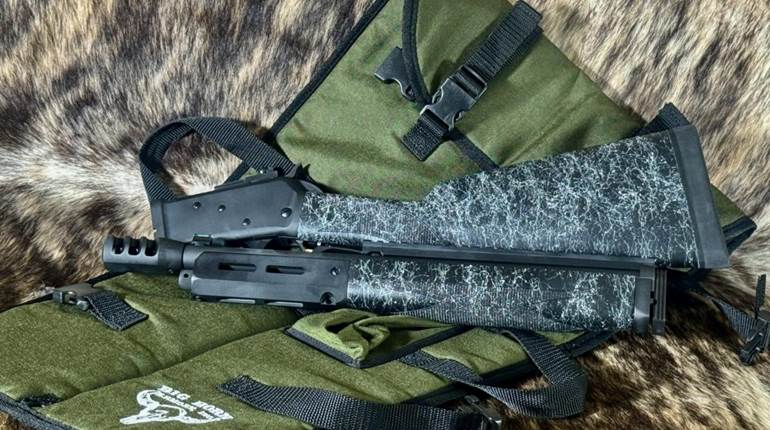
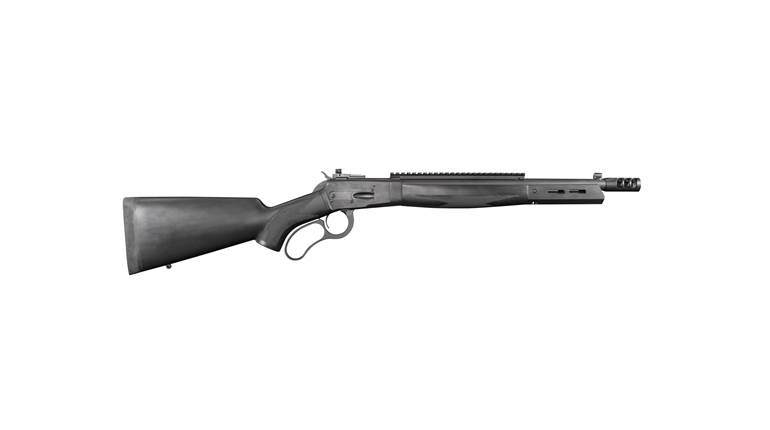
There are two basic versions of the Model 89-rifle and carbine. Interestingly, because the rifle has a half magazine, while the carbine magazine is full length, the carbine holds two more rounds than the rifle. On the company’s website, BHA offers a plethora of options and upgrades. Buchel even showed me a prototype receiver with color casehardening for those customers who demand the most beauty in their guns.
I divided my range time into two sessions, primarily because the wind blew me off the range on the first one. My plans were to include at least three loads to wring out the rifle, but one proved too dangerous to shoot. Cor-Bon loads the Barnes 325-grain DPX bullet in the .500 S&W Mag., and in the revolver it is a fine load. But the pointed hollowpoint would sit squarely on the primer of the next cartridge in the tubular magazine, which is a major no-no.
It would be unrealistic to expect sub-m.o.a. groups with a rifle of this type. Range limitations include the eyesight of the shooter and his or her tolerance for and ability to control recoil. I would not characterize the recoil as punishing, but you do need to hang on to this rifle and control it in order to extract all of its inherent accuracy. As lever-actions go, the stock on the Model 89 is straighter than on most other lever-guns-noticeably straighter than on a Model 94 Winchester, for example-and this helps with recoil handling. The drop at the comb is only 3/4 of an inch. If I had to complain-and this is really nit-picking-I’d say that the drop could be reduced another 1/8 to 1/4 inch because of the relatively high aperture sight mounted on the receiver. The centerline of the aperture is 1 1/4 inches above the centerline of the bore-nearly as high as most scopes-and I found it a bit difficult to get a firm cheek weld with a good sight picture. Nonetheless the Model 89 turned in a respectable average of 3 1/2-inch groups at 100 yards. That’s plenty good for the brush buster where 100 yards is a very long shot.
The 7 1/2- to 7 3/4-pound weight isn’t too much of a burden to pack, considering the power this rifle delivers. If I were traipsing around bear country in Alaska, the stainless-steel version would be a very comforting companion. This is not a cheapie “everyman” gun with a base price of $2,289, but quality doesn’t come at bargain-basement prices.
Manufacturer: Big Horn Armory; Bighornarmory.com; 307-586-3700
Caliber: .500 Smith & Wesson Magnum
Action Type: Lever-action
Receiver: Blue or stainless steel
Barrel: 22” (rifle); 18” (carbine)
Rifling: 1:24” RH
Magazine: 5 (rifle); 7 (carbine)
Sights: Rear aperture adjustable for elevation and windage; brass bead front
Trigger Pull: 6 lbs., 7 oz.
Stock: American black walnut
Overall Length: 41” (rifle); 37” (carbine)
Weight: 7 lbs., 14 oz. (rifle); 7 lbs., 10 oz. (carbine)
Accessories (available at extra charge): Hot wood maple stock or laminate stock available; sling swivels; fiber-optic front sight; buttstock cheek piece
Suggested Retail Price: $2,289 (rifle or carbine)