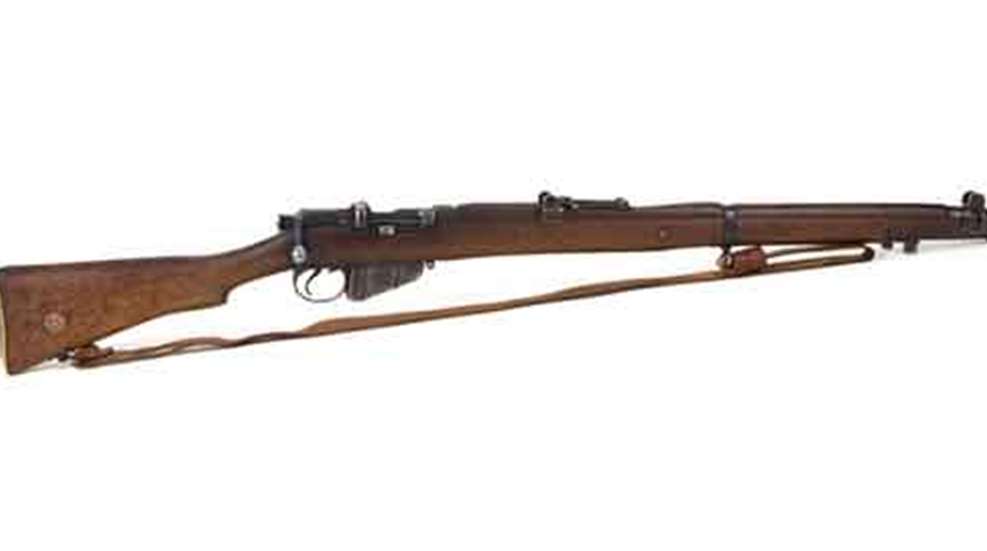
Tonight on MidwayUSA's Gun Stories you can see interviews and high speed-I mean really high speed-videography of my favorite military rifle of the early part of the 20th century. That rifle, of course, is the Lee-Enfield. In particular, the Short, Magazine Lee-Enfield, Mk III. If ever a rifle was ideal for the war it would fight, it was the SMLE and World War I.
Based on designs by American inventor James Paris Lee, the SMLE gets the "M" in in its name from its 10-round-capacity detachable box magazine. Lee had success with Remington adopting his magazine in 1875, but that rifle really went nowhere. In 1888, the British combined Lee's magazine with shallow polygonal, Metford rifling, but later changed the barrel over to five-groove deeper Enfield rifling. Thus, Lee-Enfield. Even though it was not intended to be used as we use magazines today-that's what stripper clips were for-it could be removed for cleaning and maintenance.
The Lee-Enfield's cock-on-close action is one of the slickest handling ever. Aside from a Krag-Jorgensen or a mannlicher-shoenauer, there is none smoother. And there is plenty of room for dirt, mud and debris to go out of the mechanism when it is cycled. The .303 British cartridge headspaced on the rim, and allowed for some slop, and there was plenty of the latter in the trenches of France and Flanders. The bolt handle was perfectly placed for easy manipulation, and its stock well design, particularly at the wrist. The rifle, although somewhat ugly, had excellent ergonomics and sights well suited for both long-range target work as well as close in snap-shooting. And it was handy.
The "S" comes from its mid-length barrel. Most armies in 1914 had long rifles-think 30" barrels for infantry; and short-barreled carbines, sometimes less than 16", for cavalry. After being shot to pieces by burghers with clip-loading Mausers in the Anglo-Boer War, the British learned their lesson. Outranged cavalry with carbines morphed into mounted infantry with rifles too long to be wieldly from horseback. Thus, the Short, Magazine Lee-Enfield made its debut.
Another lesson the British learned was the value of marksmanship. Great Britain's "contemptible little army" of 1914 was one of the best trained force of rifleman the world has ever known. Although small, each man could fire 15 aimed shots in a minute with his SMLE. How good were they? Ask the Germans. The British Expeditionary Force shot them to pieces, so much so the Germans thought they were facing massed machine guns. The British did not have enough machine guns to mass in 1914. What they had was the Lee-Enfield and men who knew how to use it.
My friends Michael Bane and Tim Cremlin, the producers of Midway USA's Gun Stories asked me to be part of the Lee-Enfield show this week, and an hour and half into the interview, Michael had to leave to catch a plane. His final words? "Keefe, why do you know all that?" Rugged, robust, reliable and in service to the British Empire for nearly a century, the Lee-Enfield was simply the best military rifle a century ago when the world went to war. Its story is one that needs to be told.
Most Popular