Q: I know the M1 carbine was issued in large numbers during World War II but that it was considered to be under-powered. It seems our military would have been better served by a firearm of this type that had better performance. Why wasn’t this done?
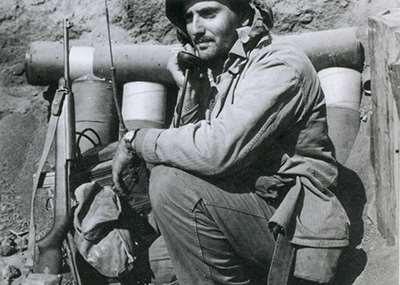
A: The question must be asked, “under-powered” compared to what? The M1 carbine was initially developed to provide a firearm that could be carried by personnel such as ammunition carriers, machine gun and mortar crews, communication and administrative personnel, etc., whose duties precluded the issuance of the standard service rifle. Normally, such individuals would be armed with handguns, but the early success of the German Blitzkrieg and airborne tactics meant that such personnel could conceivably be confronted by hostile units at any time, so the Ordnance Dept. issued specifications for a “light rifle” that could be easily carried by such personnel but would be more effective than a handgun.
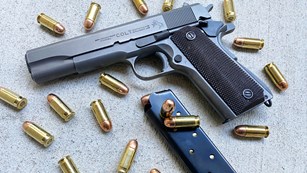
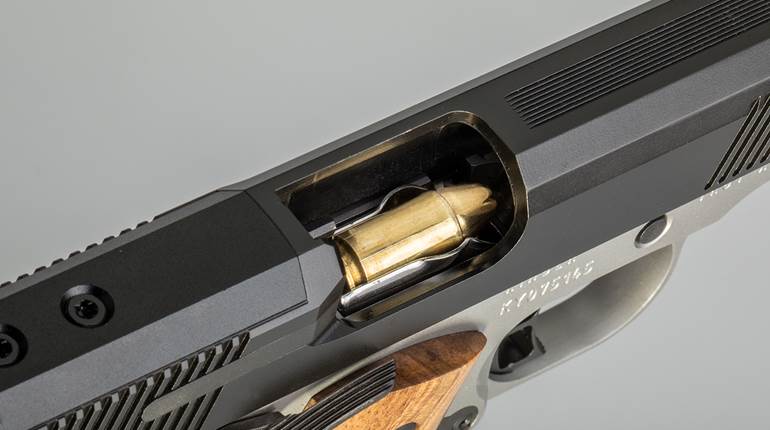
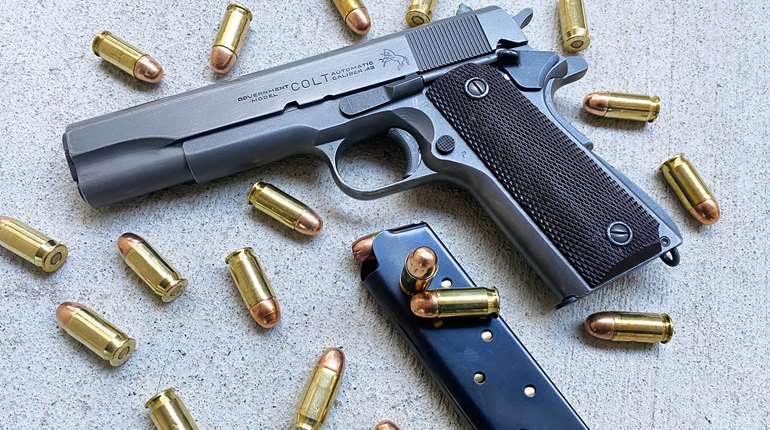
The specifications mandated that the weight of the firearm not exceed 5 lbs., yet have an effective range of at least 300 yards. Thus, the “light rifle,” which morphed into the M1 carbine, was developed, in large measure, as a substitute for the .45-cal. pistol. Except in very close-range encounters, such as two adversaries in the same foxhole, there is no doubt the carbine was the superior arm in regards to both accuracy and firepower. It is true that the .30 Carbine cartridge did not possess the close-range “stopping power” of the .45 ACP, but at ranges exceeding 25 yards, the .45’s close-range potency was essentially irrelevant, since the odds of a typical soldier hitting a target beyond that range were quite slim. On the other hand, at ranges up to 300 yards, the carbine was adequately accurate in the hands of anyone with a modicum of marksmanship training, while the .45 pistol would be absolutely useless.
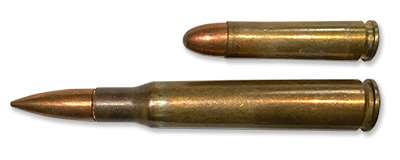
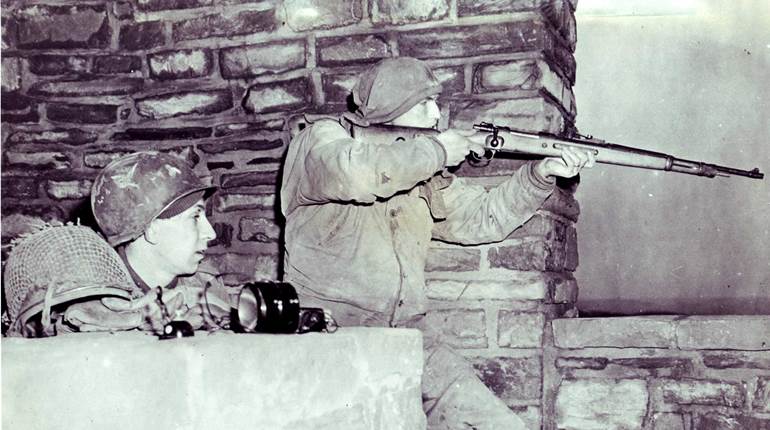
The M1 carbine proved to be a very popular firearm and was manufactured in greater numbers than any other American small arm of the war. It was eventually used by many front-line infantrymen who appreciated its light weight, handiness and firepower as compared to the much heavier M1 Garand chambered for the powerful .30-’06 Sprg. cartridge.
It is worthy of note that the overwhelming majority of complaints against the carbine by the men who used it was that it was not as accurate or powerful as the M1 rifle. There is no doubt this was the case, however, it is rather unfair to condemn a firearm because it was used in a role for which it was neither designed nor intended. Complaining that the M1 carbine didn’t have the power, accuracy or range of the M1 Garand is akin to denigrating a Ford F-150 pickup truck because it doesn’t have the same hauling capability as a Freightliner 18-wheeler tractor-trailer rig. Certainly, the carbine had its limitations, as do all firearms, but it did a very credible job if used within the parameters for which it was designed.
Most Popular