12/19/2012
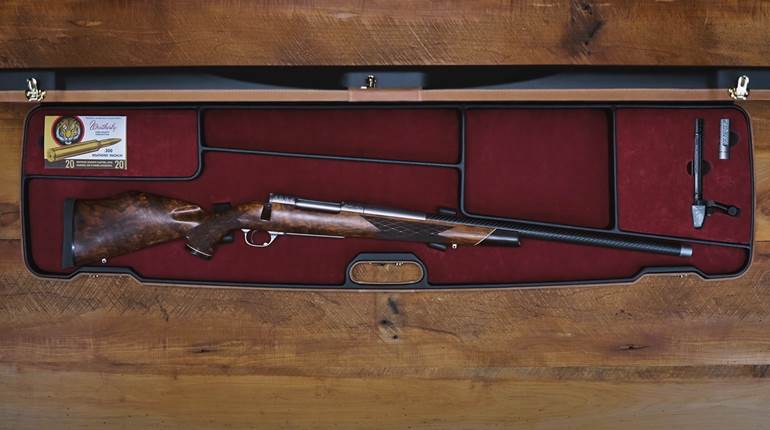
Since the 1940s, Weatherby has had a reputation for building accurate rifles. As a complement to the Mark V, in the early 1970s the company introduced the value-price Vanguard line of hunting rifles that continued that tradition. In 2011, the Series 2 was unveiled to update the Vanguard line.
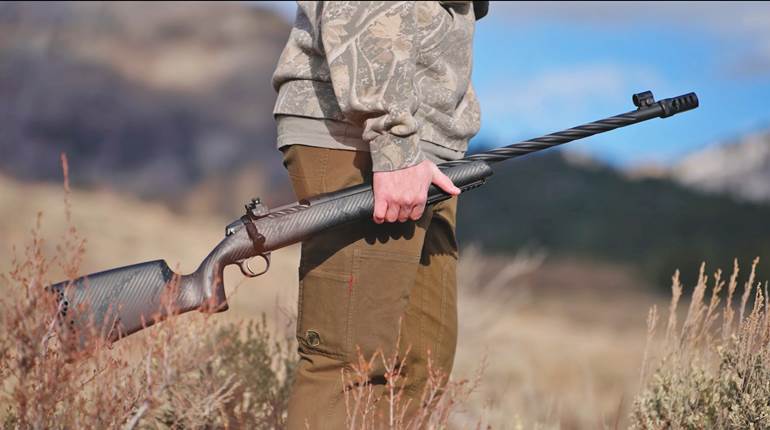
Vanguard Series 2 Synthetic rifles vary from their predecessors in small, albeit important, ways; however, the basic features remain unchanged. Take the bolt, for example. Like the original’s, the one-piece bolt has dual-opposed locking lugs with an M16-style extractor and a plunger-type ejector. Fluting on the bolt body reduces surface area and provides debris a place to migrate, preventing the bolt from binding, while three ports enable gas to escape in the event of a ruptured case or pierced primer. Knurling on the rearward-sweeping bolt handle enhances purchase. Additionally, the bolt has a fully enclosed shroud and a cocking indicator.
Regardless of the chambering—16 options are available from .223 Rem. to .338 Win. Mag.—Series 2 Synthetic rifles feature 24-inch bead-blasted blued, cold hammer-forged barrels ending in recessed crowns. The No. 2 contour—measuring a scant 0.62 inches at the muzzle—ensures light weight and easy portability, but also results in rapid heating. Stainless variants are available in the Series 2 Synthetic Stainless models, but command a premium. Weatherby guarantees the rifles to produce a three-shot group of 0.99 inches or less using Weatherby or other premium ammunition. Because iron sights are not provided, the receiver is drilled and tapped to accept scope bases.
The redesigned polymer Monte Carlo-style stock is medium-grey in color and weighs 2 pounds, 3 ounces (sans barreled action), no doubt contributing significantly to the rifle’s 7-pound, 4-ounce (short-action) or 7-pound, 8-ounce (long-action) weight. It has strategically placed rubberized “Griptonite” inserts at the fore-end and pistol grip for sure handling, particularly in wet conditions or when the hands are moist. The slight palm swell is also a nice touch. Finishing out the stock are two sling swivel studs and a pliable rubber recoil pad.
The Series 2 is equipped with a three-position action-mounted safety; the rearmost position is “safe”; the middle position enables the bolt to be cycled for unloading while still in the “safe” mode; and fully forward allows the rifle to be fired. “S” and “F” represent the former and latter positions, respectively, while a line designates the middle condition. The rifle is fed from either a three- or five-round-capacity staggered-column internal magazine, with a hinged floorplate enabling rapid emptying of said rounds. The magazine-release button is located on the front of the trigger guard; being recessed, it’s unlikely that it would be hit inadvertently. The trigger guard itself is generously sized to accommodate a gloved finger.
Perhaps the most noteworthy change is newly designed two-stage trigger, which is factory preset at slightly more than 3 pounds, yet can be adjusted down to 2 pounds, 8 ounces. On the test rifle, the trigger broke cleanly at 2 pounds, 9.9 ounces, exhibiting no discernible overtravel. This was, undoubtedly, a significant improvement over the trigger design of the original Vanguard.
For testing, we topped the .240 Wby. Mag.-chambered Vanguard Series 2 Synthetic with a Nightforce 12-42X 56 mm NXS scope, then attached a Harris bipod for stability. The rifle, as tested, weighed a hefty 10 pounds, 5 ounces. With a typical hunting optic, however, the overall weight should be markedly less. To determine the accuracy potential, we first fired groups from a bench at 100 yards, then shot prone out to 300 yards. At 100 yards, all of the loads averaged around 1 m.o.a.; sub-m.o.a. groups confirmed the rifle met Weatherby’s accuracy guarantee. At 300 yards, however, the test rifle revealed its true capabilities. The largest three-shot group at 300 yards measured 1 m.o.a., with the others being around 0.85 m.o.a. Considering this was achieved from a $649—suggested retail price—hunting rifle using factory ammunition, the results were all-the-more spectacular. As can be imagined, the relatively thin barrel heats rapidly, so time must be provided for it to cool.
It was noted during testing that there was a noticeable zero shift between the lighter bullets (85 and 87 grains) and the heavier one (100 grains). This shift was much as 2-inches high and 1-inch left at 100 yards. If switching between different bullet types, be prepared with appropriate dope for both loads.
During the evaluation phase, the only issue encountered was that the front action screw worked loose; however, the problem was quickly remedied via retightening. Feeding, extraction and ejection were smooth and occurred flawlessly, as they should given that the basic operation/features mimic those of its proven predecessor. In addition to accuracy, the evaluators were particularly impressed with the rifle’s feel, a testament to the new stock design, as well as the .240 Wby. Mag. chambering. Concerning the latter, the cartridge’s combination of low recoil and external ballistics were a wonderful surprise.
The Weatherby Vanguard Series 2 Synthetic represents a clear improvement over its predecessor and, given its affordable price, should prove to be just as successful.
Manufacturer: Howa Machinery Co., Kiyosu, Aichi, Japan
Importer: Weatherby, Inc.; (805) 227-2600; www.weatherby.com
Model: Vanguard Series 2 Synthetic
Caliber: numerous from .223 Rem. to .338 Win. Mag.; .240 Wby. Mag. (tested)
Action Type: bolt-action center-fire rifle
Receiver: steel
Barrel: 24" cold-hammer forged
Rifling: 1:9.5", 1:10" (tested), 1:12" or 1:14" RH
Magazine: internal staggered-column with hinged floorplate; three-or five-round capacity
Sights: none; drilled and tapped for scope bases
Trigger: two-stage; 2-lb., 9.9-oz. pull
Stock: Monte Carlo-style synthetic: length of pull, 135⁄8"; drop at comb, 5/8"; drop at heel, 1"
Overall Length: 44" (tested) or 44½"
Weight: 7¼ lbs. (tested) or 7½ lbs.
Accessories: owner’s manual, safety lock
Suggested Retail Price: $649
Most Popular