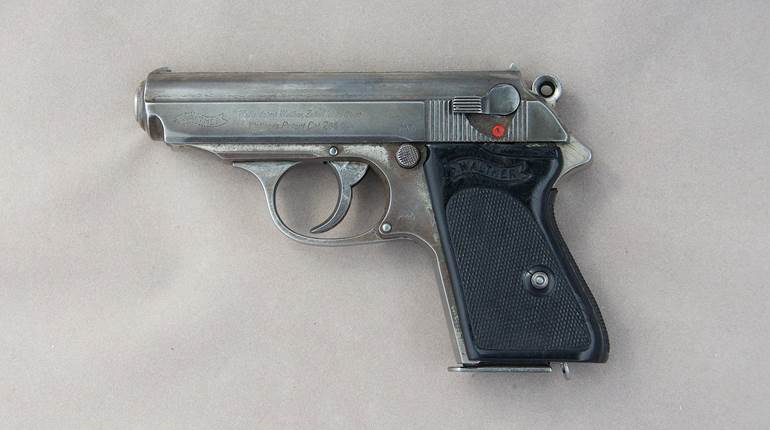
Bond. James Bond. If a fictional character has more brand awareness in firearms than James Bond and his Walther, I am unaware of it. Dirty Harry and his Model 29 have long since retired, but Ian Fleming’s 007 turns 60 this year and shows no signs of slowing down. Bond has starred in 23 movies and now even has his own “James Bond 007 Fragrance.” And he still has his Walther. The relationship between Bond and Walther dates to Ian Fleming’s 1958 novel Dr. No in which 007 relinquishes his Beretta “ladies gun” and starts carrying a Walther PPK in .32 ACP. In more recent years, Bond has appeared on screen with the Walther P99.
It is odd to me that the company founded in Zella-Mehlis in 1886 by Carl Walther and his son Fritz and that introduced the first successful double-action, semi-automatic pistol, the Polizei Pistole or PP and the subsequent 5/8-inch shorter Polizei Pistole Kriminal or PPK, is perhaps best known for its role in pop culture. This is the company that made the first double-action 9 mm Luger pistol with a decocker, the P.38 (replacing the vaunted Luger as the sidearm of the Wehrmacht in 1935), the company that developed the G41 rifle, the TT Olympia pistol and countless other designs, and still it is best known for its use by a secret agent that never lived. But part of Walther’s parent company’s early success had to do with another fictional character: Sherlock Holmes. We’ll get to that in a minute.
When it comes to Walther in the United States, the firm that handled it for most of the post-World War II era was Interarms starting in the early 1960s. Remember, the factory was destroyed during the war, and Zella-Mehlis was on the wrong side of the Iron Curtain. Walther resumed operation in Ulm in West Germany in 1953. But after the death of Interarms’ founder Sam Cummings, the company became a shell of itself, and Walther importation ceased by the Alexandria, Va., firm in 1999. Smith & Wesson partnered with Walther starting in 2002, and it was a relationship that included not only importation, distribution and marketing of Walther guns made in Ulm, but American production of the PPK and PPK/S, which was shifted to S&W’s Houlton, Maine, plant. Smith and Walther even collaborated on a variant of the Walther P99 pistol designed to compete in the United States, the SW99. Aspects of the Smith/Walther partnership ranged from extremely successful to struggling at best.
The Walther Line
There are really three distinct and different areas of focus for Walther. The first is on the competitive shooting circuit-airguns and competition-specific rimfires previously brought in by Champion’s Choice or Earl’s Repair Service and now imported by Walther Arms-then the police and personal-protection market and, finally, the fun or recreational side of shooting. The latter two areas are our focus here. Those guns are handled by a new company, Walther Arms, set up in Fort Smith, Ark., in January, which was already home to Umarex USA. The $7 million expansion will bring up to 120 new jobs to the area. Umarex, together with Walther, is owned by the PW Group in Arnsberg, Germany. Here is a brief run-down of the guns imported or sold by Walther Arms.
P22-Walther’s .22 Long Rifle plinking or training rimfire made in Ulm with either a 3.42 inch or 4.5-inch barrel and 10-round magazine. It is scaled to be a three-quarter-size, blowback-operated version of its big brother, the P99. The magazine release and takedown are similar to those of the P99. There are six models-including some with threaded barrels (many Walthers have that feature) and laser sights-ranging in price from $379 to $579.
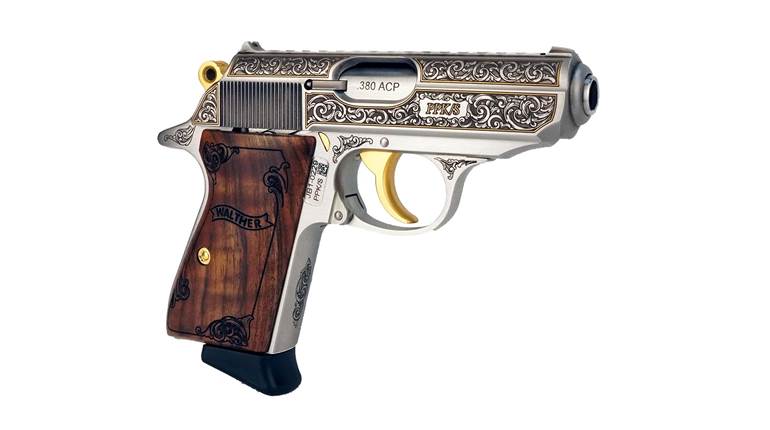
PPK/S-This is the PPK slide mated to a PP frame and is offered only in .380 ACP. Available in blue or stainless steel, the guns are made by S&W for Walther in Houghton, Maine. This is the classic, blowback-operated gun with a slide-mounted decocker and is priced at $629.
PPK/S .22-Made by Umarex for Walther in Arnsberg, this is a 10-round-capacity .22 Long Rifle version of the PPK/S offered in blue or nickel that has the same size, controls and weight as the center-fire PPK/S. Priced from $399 to $429, there is more on this gun below.
PK380-This recoil-operated, hammer-fired .380 ACP has double-action/single-action lockwork and shares the polymer grip frame design of the PK22. The frame is easy for those with small hands to grip securely, and the slide is one of the easiest for those without a lot of upper body strength to manipulate. PK380s are offered in black or two-tone, and there is a laser-equipped variant. They run from $389 to $489.
P99AS-The P99 was likely the most fully featured polymer-frame pistol of its day, and it has been updated with an integral accessory rail. Made in Ulm, it is a recoil-operated, striker-fired design with flush-fitting decocker. In 9 mm Luger, it has a 15-round magazine capacity and in .40 S&W it holds 11 rounds in the full-size 4-inch barreled versions. It is also offered as the P99AS Compact with a grip frame shortened by a full inch and with a 3.5-inch barrel. Magazines are available with up to 20-round capacity in the 9 mm, as well as with collars for the extended magazines. Ergonomically, the pistol is excellent, and it is priced at $599.
PPS-The Polizie Pistole Schmal (small) is polymer-frame, dedicated carry gun with a single-stack magazine and an articulated blade safety in its trigger. The recoil-operated, striker-fired PPS isn’t quite an inch wide, has a 3.2-inch barrel and is only 4.4-inches high. With its single-stack magazine, it holds 10 rounds of 9 mm or eight of .40 S&W. It, too, is priced at $599.
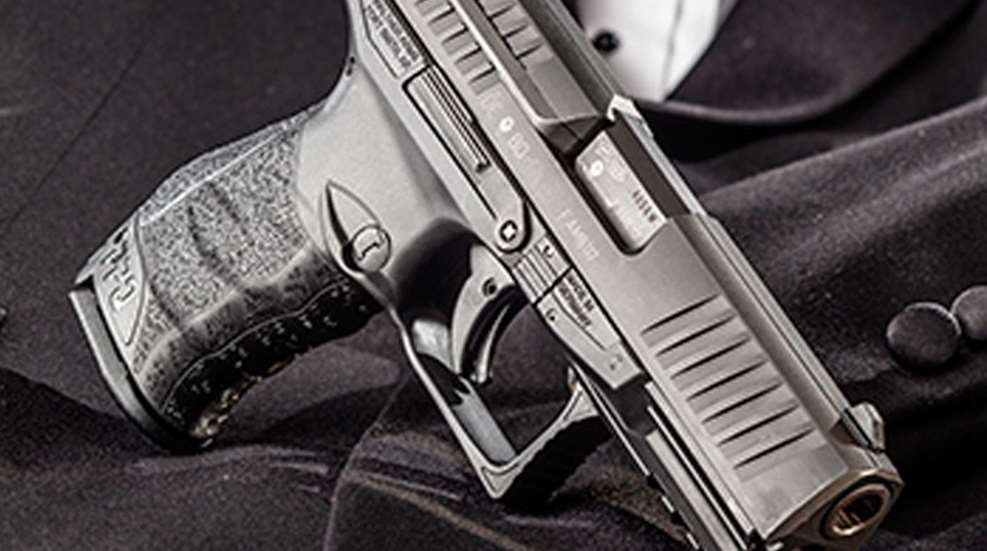
PPQ-Introduced in 2011, this pistol is the most modern iteration of the Walther personal-protection or duty pistol. A full-size, Ulm-made gun, the polymer-frame, striker-fired PPQ M2 has the take-down system and bilateral slide lock of the P99 combined with an articulated blade safety in the trigger and a new grip design with the magazine release behind the trigger guard on the frame. Offered in 9 mm or .40 S&W, there is more below on this gun. It is priced from $599 to $699.
PPX-A new design from Ulm intended specifically for Walther Arms and the United States, the PPX is a polymer frame, double-action-only hammer-fired pistol with the hammer partially pre-cocked by slide movement. It is a tall gun, but one with a grip frame that small hands can wrap around easily, as much of the frame bulk for the operating parts is above the grip. Offered in 9 mm (16 rounds) or .40 S&W (14 rounds), it is priced aggressively from $449 to $499. There is not enough room here to adequately describe the PPX, so look for a “Dope Bag” review soon.
So What Is Umarex?
There’s that name again. On my first trip to the Internationale Waffen Ausstellung or IWA Show in Nuremberg, Germany, I stood in wonder at the largest booth in the room; a red and black gleaming edifice climbing to the ceiling. Umarex? What in the heck is Umarex? It could well be the largest firearm company you have never heard of-and that is because it makes much more than firearms.
For a guy who decided to get out of the gun business in the early 1970s, Wulf-Heinz Pflaumer and his company sure make a lot of guns. In fact, you might have a firearm-or perhaps an airgun-made or imported by the company run by Pflaumer and partner Franz Wonisch. And that is a multi-generational partnership now, as Eyck Pflaumer and Martin Wonisch today are managing partners of the company founded 41 years ago but changed its name to Umarex Sportwaffen GmbH & Co. in 1981.
Wulf-Heinz Pflaumer has a bit of the showman in him. Think of him as part P.T. Barnum, part Roy Weatherby, part modern industrialist and all entrepreneur. Umarex sells, in many ways, the dream of firearms. In 1972, the laws for gun ownership in Germany changed dramatically. Licenses to own handguns in particular became quite restricted, but gas, blank and alarm guns had always been popular in central Europe and were unaffected. One such gun was the Perfecta Model G1 as made by Mayer & Reim; ironically, designed by Walther employee Walter Reim as an alarm pistol in his spare time.
After growing up in the gun business and becoming a trained gunsmith, Pflaumer eventually moved on to the catalog company Neckermann, and later went to work with Karl Mayer of Mayer & Rheim. Blank and alarm guns could still be sold over the counter, and they saw an opportunity. While Wonisch was on the engineering and finance side, Pflaumer handled marketing and promotion, and he is a man who understood branding. Align your product with a powerful brand, and your odds of success are much higher. Remember the previous reference to Sherlock Holmes? Pflaumer tracked down the descendents of Sir Arthur Conan Doyle, and licensed the fictional detective’s name to go with a blank-firing revolver inside a book-shaped package, together with a magnifying glass. For each set sold, 25 cents would go to the family, and the pattern for a business model was established. That was in 1979, the same year Wonisch had the idea to build a blank-only version of the PPK, the Reck PK800.
Another big break came when the Berlin Wall came down. In those formerly communist nations, firearms were prohibited, but air and alarm guns could be purchased over the counter. One industry veteran described stores in the former East Bloc as crammed and as garish as “Radio Shack, except for filled with airguns and alarm pistols.” And they sold, and sold well. How well? Enough for Pflaumer and Wonisch to purchase the first name in German firearms, the financially struggling Carl Walther, which they did to the shock of many in the firearm industry in 1993.
The Umarex business model of licensing and partnering is a fascinating and extremely successful one. Why compete with a company when you can partner with it? It began with realistic-looking and -feeling replicas and airguns, and Umarex has currently or has had licensing arrangements with a who’s who of gunmaking, including Beretta, Colt, FN Browning Hammerli (now owned by PW), H&R, H&K, IWI, Magnum Research, Mauser, Ruger, S&W and, of course, Carl Walther (before purchasing it). As the leading maker of replicas, Umarex makes and sells airguns, air soft guns, paintball guns and even offers a line of “Tactical Rimfires”-firearm replicas of other firearms, including a .22 replica of its own PPK/S.
Pick Two, Any Two
I elected to pick only two of the guns offered by Walther Arms to add some empty brass to what was starting to look wholly like a company history story. Those guns are the PPK/S .22 made in Arnsberg and the PPQ M2 in .40 S&W made in Ulm, as they represent two of the almost incongruous paths taken by Walther today. One of the company mantras is Franz Kafka’s “Paths are made by walking.” And indeed there are two distinct paths represented here. The fun of recreational shooting with the .22 and the serious business of a sidearm designed for law enforcement use and personal protection with the .40 S&W.
The nickel-plated PPK/S .22 follows the layout of the original, but it is rendered a mix of materials. Umarex’s engineers use steel, aluminum, die-cast metal and polymer; a common theme in all their guns. For example, the slide is polished aluminum yet the actual breechblock dovetailed and pinned into it is steel. The frame is polished die-cast metal, which gives the gun a weight-24 ounces-similar to its center-fire cousin. The frame’s rear has the more generous beavertail contour that protects the web of the shooter’s hand from the recoiling slide. The barrel in the blowback-operated pistol is fixed, and like the original, acts as the recoil spring guide. The barrel is a thin rifled liner surrounded by a steel shroud that is pinned into place. A decocker is on the slide’s left rear, and depressing it drops the hammer and moves a block between it and the rear of the firing pin.
The double-action-trigger pull was noteworthy in that it was 14 pounds, 2 ounces. In its defense, it was consistent all the way through its travel with no stacking. Who am I kidding? It was still 14 pounds. The single-action pull at 3 pounds, 8 ounces, was much better, and that is how the accuracy testing and most function firing were conducted. Based on that of the P22 pistol (and discontinued G22 bullpup carbine), the magazine holds 10 rounds of .22 Long Rifle and is one of the best features of the design. In more than 700 rounds of testing for accuracy and function firing, there were three failures to fire, all ammunition-based as firing pin hits were clean and consistent.
I visited the Arnsberg factory as these guns were rolling off the line. From the outside, it appears to be the very epitome of modern, industrialized Germany. Not only did it look like a plant that makes medical machinery, but it was clean enough that there could have been an operating room next to the rifling machines. I watched the rifling of barrels, CNC machining, quality control operations and assembly of the guns, and saw the government proofhouse where each and every firearm is proofed. This is the gun that I fired far more than was requisite. It sells the dream of Bond’s pistol, but is an affordable delight to shoot.
An evolutionary gun, the PPQ draws the majority of its design features from the P99-a gun that was one of the best by far in its generation-but there have been improvements and updates to the P99. There were enough changes from even the latest P99s for the American market to warrant a name change to PPQ M2. The style and location of the magazine release (which is reversible) for example, has moved from the paddles on the trigger guard to the frame.
The polymer frame has the heavily stippled grip with interchangeable backstraps of the P99 D, and there is an integral accessory rail on the dust cover. There are generous and useful grasping grooves cut on both the front and rear of the slide, and the long bilateral slide lock of the P99 has been retained. There are two drop safeties as well as a passive firing pin safety. Lock-up of the recoil-operated pistol is of the Browning linkless style, and the recoil spring and its guide are in the familiar location under the barrel. Disassembly is like that of the P99.
The trigger has an articulated blade safety within its front face, much like the PPS and P99QA (Quick Action), and the striker is pre-cocked. The PPQ’s trigger pull length (0.4 inches) and weight are the same for each shot, but the distance the trigger must be released before the striker resets is quite short-the manual states 0.10 inches -so the shooter never needs to release the trigger its full length of travel. Pull weight is 5 pounds, 2 ounces, but the length of travel and reset are reduced so dramatically that the PPQ has perhaps the finest trigger of its type. It even has its own name, Quick Defense.
The PPQ is offered in 9 mm Luger or .40 S&W with 4- or 5-inch barrels. There is even a Navy Tactical model, in the event your duty gun ends up in the drink a lot. On the range, the 4.1-inch barreled .40 S&W shot well with no malfunctions, was ergonomically excellent and demonstrated that this pistol has a bright future among American pistol buyers.
Another Day
It appears that the company kept in the public eye by a fictional secret agent is poised for a much bigger and more aggressive presence in the United States, and the new guns introduced by Walther Arms are sure a sign of that. But the Bond tie still remains strong, despite anti-gun rants by some of the actors who have portrayed him. I attended Wulf-Heinz Pflaumer’s 70th birthday party last year in Arnsberg, and part of the celebration was a personal video birthday message from none other than Bond number six, Pierce Brosnan. Oh, and the PPK in actor Daniel Craig’s hands in lobby cutouts for the movie “Skyfall”? It wasn’t a firearm at all, but a replica made by … you guessed it, Umarex.
Most Popular