This article appeared originally as "Top 10 Infantry Rifles" in the September 2008 issue of American Rifleman. To subscribe to the magazine, visit the NRA membership page here and select American Rifleman as your member magazine.
Because soldiers in general and infantrymen in particular operate as part of a combined-arms army, where armor, artillery and aircraft contribute so much to the outcome of a battle, it would be hyperbole to say that a rifle won a war or changed the outcome of a battle. And while effective small arms of all types are essential, their effect on the battlefield is hard to quantify. They are, nonetheless, essential to victory primarily because combat is, above all, a test of wills, and ineffective small arms spread defeatism like rats spread the plague.
How can you close with the enemy if you are afraid your rifle will not work at the critical moment? Better to just stay in your hole. Why shoot at the attacking enemy when you know you can’t hit anything with your rifle? Better to just run away. Soldiers that are confident in the performance of their rifles are more energetic on the attack and more resilient in defense.
Given that, the effectiveness of infantry rifles is a slippery question and rating one against the other is certainly a subjective one. Our choices are based on a number of factors; innovation, effectiveness, service life, impact on history and small-arms development. These are the choices of our editors, no doubt you have your own, perhaps better choices. We don’t expect it to be definitive and hope only to spark debate and interest among our readers.
Omissions from the list will no doubt provoke the most questions, so I will try to explain the absence of some of your, and our, favorites. Some innovative wonder guns like the Stoner 63 and the FG42 were dropped because of their limited service history.
One of our personal favorites, the M14, was dropped because we decided that when two comparable contemporary guns were on the list, like the M14 and the FN FAL, the tie had to go to the gun with the greater historical impact and longer service life, rather than the gun we liked best. Even if, when all is said and done, some of us would rather go into harm’s way with the M14.
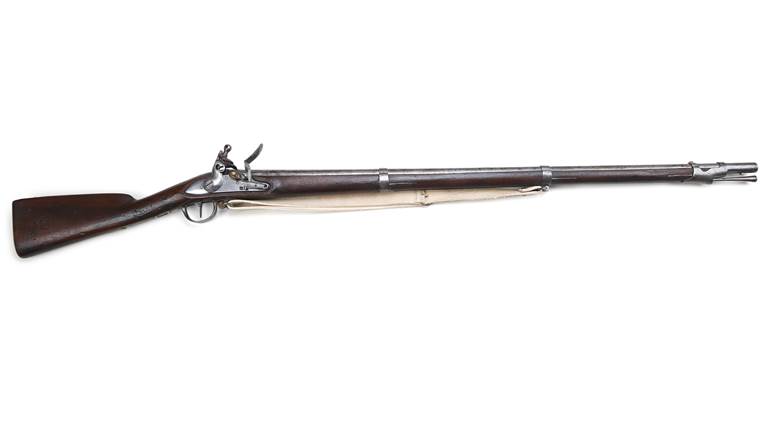
The M1 carbine and the Brown Bess were dropped from consideration because they were not rifles. The M1 carbine is more of a personal defense weapon or sidearm and not a proper rifle. If you don’t like that answer, take it up with Gen. James Gavin. The Brown Bess was an even tougher call. It is historically significant—a tool of empire and an infantry shoulder arm of transformation as well. Armies dropped swords, pikes and other pole arms as primary weapons only after development of the flintlock. But we were hemmed in by our own criteria. It is not a rifle, but rather a smoothbore musket.
Among the top 10 infantry rifles, the top five choices were clear: The only debate was about the order in which they were placed. Votes for the bottom five were all over the place, and I fear that they reflect our prejudices more than anything else.
Had we opened up the list to other shoulder-fired small arms, the voting might have become even more chaotic. How do you compare a BAR to an MP40 or a trench shotgun? As far as I am concerned, when that debate starts, it’s time to put cotton in your ears and go to bed.

No. 10: The Henry Rifle
The lever-action Henry rifle, by all measures, was a commercial failure. During its seven-year production run only 14,000 were made, and the U.S. Government purchased only 1,700 Henrys during the Civil War. This is hardly a ringing endorsement when tens of thousands of other rifles saw far greater service in the hands of the infantry. Yet it is on this list and for good reason.
This 9-pound repeating rifle changed history in many ways during its short but storied lifespan. It was the invention of Benjamin Tyler Henry and patented in October 1860 and was the first “successful” breechloading, repeating rifle that fired a self-contained metallic cartridge. Most importantly—and a reason it is on this list—is that it is considered the first Winchester and it is responsible for all those that followed bearing that venerable name to this very day.
This 16-round “horizontal shot tower” was also known as the rifle “you can load on Sunday and shoot all week.” It introduced the self-contained metallic .44 rimfire cartridge to the world and provided the owner of the New Haven Repeating Arms Company, Oliver Winchester, with a basis to build his manufacturing empire.
Of all the guns in the collection of the Smithsonian Institution in Washington D.C., (more than 7,000) only one has had the honor of receiving a solid gold National Treasure medal from the NRA’s Gun Collectors Committee, and that is Henry Repeating rifle serial number 6, a presentation piece to President Abraham Lincoln.
Of the rifles examined here, each possesses numerous qualities that earned it a spot on this list. It is not enough for a rifle to have graceful lines and a positive locking lug system, each of these rifles was not only found to be superior at the time it was made, but also served to inspire innovation and further development in the field of technology.—Philip Schreier

No. 9: Dreyse Model 1841 “Needle Gun”
Invented by Johann Nikolaus Von Dreyse in an era when many nations still relied on muzzleloading smoothbores, the “needle rifle” made several technological leaps at once when it was adopted by Prussia as the Zundnadel Infantrie Gewehr Modell 1841.
It was the first widely adopted rifled, breechloading, military turn-bolt long arm chambered for a self-contained cartridge. The bullet, with its priming compound and blackpowder charge behind it, was encased in a paper cylinder called a Treibspeigel. The rifle fired a .608-inch bullet, and the Treibspeigel measured .638 inches and acted as a paper patch over the .535-inch conical bullet.
When the trigger was pulled, the firing “needle”—a long thin pin or striker—pieced the back of the paper and drove through the powder charge to set off the priming compound. Before the bolt could be opened, its thumb piece had to be moved rearward. The bolt was then rotated up and drawn to the rear, the cartridge inserted and the bolt closed. The needle still needed to be manually cocked by pressing the thumb piece forward before the rifle could fire. Like all early breechloaders, there were issues with gas leakage.
The Dreyse gave the Prussians a decided technological and tactical superiority during the Second Schleswig War against Denmark in 1864 and the Seven Weeks War against Austria, and it played a crucial battlefield role in German unification. The Dreyse—although by then inferior to the French Chassepot Modele 1866—was used during the Franco-Prussian War of 1870-1871.—Mark A. Keefe, IV

No. 8: FN FAL
The Belgian battle rifle designed by Fabrique Nationale’s Dieudonne Saive and Ernst Vervier, the Fusil Automatique Leger (Light Automatic Rifle), came to dominate the non-communist world in the opening decades of the Cold War. It employed 20- or 30-round detachable box magazines and was initially designed around the .280 cartridge adopted by the British for the bullpup EM-2 rifle.
With NATO’s adoption of the American-designed T65 cartridge, it was then redesigned for the then-brand new 7.62 NATO cartridge. The FAL had excellent ergonomics for a full-size “battle rifle” and a rear-locking tilting bolt and carrier system. The gas-operated FAL employed a robust piston, had an adjustable gas regulator and was capable of selective fire.
Adopted by 66 counties ranging from Abu Dhabi to Venezuela and produced by Fabrique Nationale in Belgium and under license in seven other countries, the FAL came to be called the “free world’s right arm.”
Firearm historian, author and publisher R. Blake Stevens, said it was “The right gun at the right time, and it had to work well. And it did.” More so than other rifles on this list, the FN FAL was a creature of its time. “It was a good gun to start with and available to ministries of defense when they needed a new rifle,” said Stevens, “so it built up a head of steam.”
More than 1.5 million FN FAL rifles, carbines and light machine guns were produced between 1953 and 1980 in both “metric” and “inch” patterns. Thankfully, it never served in a world war but acquitted itself well on both sides in the Falklands and in innumerable smaller conflicts.—Mark A. Keefe, IV

No. 7: StG44
MP43, MP44 and StG44 were different names for what was essentially the same rifle, albeit with minor changes. The gun’s numerous names were the result of the German army’s need to keep the guns a secret from Hitler who was opposed it development.
While the StG44 had less range and power than the more powerful infantry rifles of the day, exposure to masses of Soviet troops armed with PPsh 41 submachine guns forced German commanders to reconsider the adequacy of the standard Kar 98k rifle and begin development of a fully automatic service carbine.
Pre-war studies had shown that most combat engagements occurred at less than 300 meters with the majority within 200 meters, but most of the full-power rifle cartridges were developed prior to the Great War when military theorists expected masses of infantrymen to engage each other in long-range volley fire.
Consequently these rounds had more power than most soldiers could use and far more recoil than necessary. German military researchers proposed the adoption of an intermediate cartridge that would provide the controllable firepower of a submachine gun at close quarters with the accuracy and power of a Karabiner 98k bolt-action rifle at intermediate ranges.
In 1943, 10,000 of the selective-fire rifles chambered for the new 7.92 mm Kurtz round were quickly shipped to the Eastern Front, where their tactical potential was immediately evident. More than once that winter, German troops fought their way out of encirclement with the aid of the new rifle.
The guns were surprisingly accurate, even on full-automatic. The StG44 was made for rapid production, and 500,000 were made in the last year of the war. It was the first arm of its class, and the concept had a major impact on modern infantry small arms development.—Glenn M. Gilbert

No. 6: Lee-Enfield
Based on a bolt and magazine system designed by American inventor James Paris Lee, the Lee-Enfield family of rifles began in 1888 with the .303 “Magazine Lee-Metford Rifle Mk I.” Seven year later, sharper five-groove Enfield rifling was substituted for Metford rifling, thus the “Lee-Enfield.”
In 1903, a 25.2-inch barreled “Short, Magazine Lee-Enfield” was adopted for both cavalry and infantry. In its variations or marks, the Mk III and Mk III* being the most common, and total SMLE (renamed the No. 1 rifle in 1926) production is estimated at more than 5 million rifles.
The Lee-Enfield has dual-opposed locking lugs toward the rear center of the bolt body and a separate, detachable bolt head. The action cocks on closing, has a short length of bolt travel and a 60-degree bolt throw.
It is one of the smoothest bolt-action rifles ever made, and proved utterly reliable in even the most horrible combat conditions. Fed by five-round stripper clips, the SMLE had a detachable, double-column, 10-round-capacity box magazine. During World War I, highly trained British riflemen fired their Lee-Enfields so rapidly the Germans believed they were facing machine guns.
A new rifle with manufacturing improvements and an aperture rear sight was developed in 1931 but not adopted as the “Rifle No. 4, Mk I” until 1939. Changes were made to the receiver, bolt, stock, sights, barrel, nose cap and bayonet.
The No. 4s were produced in Great Britain, the United States and Canada. In sum, more than 4 million No. 4s were made. Lee-Enfields in 7.62x51 mm served well into the 1980s, and more than 9 million guns were produced in total. —Mark A. Keefe, IV

No. 5: British Pattern 1853 Enfield Rifle-Musket
The Pattern of 1853 rifle-musket stands clearly above all others during its period of use. During its heyday, 1854-1865, it was considered by most of the Western world to be the superior rifle of its day. It was .577-cal. firing a 530-grain bullet and weighed just slightly under 9 pounds. As a rifle-musket, it combined the speed of loading of a smoothbore musket with the accuracy of a rifle.
In British hands it saw its greatest use during the Crimean War (1854-1856), but it is better known to Americans as the “Confederate Springfield.” More than 300,000 were imported by the Confederate States of America during Civil War (1861-1865), and an additional 400,000 were imported by the Union during the same period.
It became a favorite of both sides. Its rugged reliability and accuracy helped it account for more than its share of the 650,000 casualties suffered during the war. It was the last and best of the percussion muzzleloaders to become a standard service arm for a major military force. The era of the breechloading, self-contained cartridge dawned and rendered it obsolete some scant 11 years after its adoption.
Many might argue that the Springfield Model of 1855 or 1861 was as good—if not better than the Pattern 1853, But the Enfield makes this list because it introduced the American Method of Manufacturing to Europe.
During the Crimean War, the Robbins & Lawrence Company of Windsor, Vt., accepted a contract to supply Pattern 1853 rifles to the British. The machinery produced the Pattern 1853 with completely identical parts. When it arrived in the England in 1856, Enfield Lock became the first factory in Europe to produce anything on the interchangeable parts method of manufacturing, fueling the industrial revolution. —Philip Schreier

No. 4: U.S. M16
The M16 was the product of an effort to bring features and capabilities of the infantry rifle in line with the realities of modern combat. Chambered in 5.56 NATO, the M16 is a small-caliber, select-fire rifle fed from a detachable box magazine.
Its rotating bolt and cylindrical bolt carrier were derived from the M1941 Johnson rifle, while its system of gas operation was inspired by the Swedish M42 Ljungmann rifle. The M16’s aluminum receiver, composite plastic stock and handguards, and direct impingement gas system made the gun very light.—just 6.5 pounds.
In 1964, the U.S. Army adopted the M16 for overseas service. Shortly afterward, the U.S. Army and Marine Corps fielded large numbers of XM16E1 rifles in Vietnam. Standardized as the M16A1 in 1967, it remained the primary infantry rifle of the U.S. military until the early 1980s, when it was gradually withdrawn in favor of the M16A2.
By the middle of the 1970s, other NATO armies were also looking at 5.56 mm service rifles and light machine guns. Starting in 1977, NATO conducted a number of performance tests on a variety of small-caliber projectiles and cartridges.
In 1982, the U.S. Marine Corps adopted the heavier 62-grain NATO along with the longer-range M16A2 rifle. The M16 is ubiquitous, it is the most commonly manufactured 5.56 NATO rifle in the world.—Glenn M. Gilbert

No. 3: Mauser 98
Germany’s Paul Mauser struggled for years to develop a bolt-action repeater, working his way through several earlier variants, and was even rejected by the German Rifle Testing Commission.
Mauser didn’t miss a beat, and he continued to make improvements on his Model 1871. He secured several patents in 1889 that were incorporated into a Belgian military rifle. It was his first successful smokeless-powder gun and his first with dual, horizontally opposed front locking lugs.
In the half-dozen years that followed, Mauser improved the 1889 with his famous non-rotating claw extractor, a staggered-column magazine, a three-position safety and a bolt sleeve gas flange. The German army adopted his design with all the above improvements on April 5, 1898.
The Model 98 has proven to be so sound in design that nearly every major military or sporting bolt-action since that time has been largely an improved version of it. Even the U.S. Springfield Armory, when tasked with developing our country’s own combat bolt-action, the Model of 1903, chose to improve the Mauser 98.
The Model 98’s gas handling in the event of a ruptured case head or pierced primer, it simplicity of design, its comparatively massive and nearly jam-proof, non-rotating claw extractor, its rather inelegant yet simple and effective safety, and its absolute soldier-proof qualities all combine to make it the best firearm of its type.
And the Model 98 was made with only the best technology of the day. Its receiver was milled from a single drop forging as was its bolt/handle. Many military Mausers and virtually all of the sporters were impeccably finished. Only when the exigencies of wartime demanded did Model 98s begin to leave the Mauserwerks and other German factories in a roughly finished condition.
All of the Model 98’s inherent strengths combined to see it through stellar service in two world wars and later make it the prime candidate for several generations of home gunsmiths and custom gunmakers. Even today, many experts claim there is no better bolt-action rifle than a true Mauser 98.—Brian C. Sheetz

No. 2: The AK-47
Both rudimentary and revolutionary, Mikhail Kalashnikov’s AK-47 is one of the most enduring and ever-present firearm designs today, roughly six decades from its introduction in the late 1940s.
Kalashnikov, having already tinkered with firearm design, took his experience from World War II and developed what would become the most prolific military firearm design in the world, with estimated world-wide production numbers hovering in the 80- to 100-million mark.
It was developed for the 7.62x39 mm, a .30-cal. intermediate cartridge that combined the power of a conventional rifle cartridge with the rate of fire and controllability of a submachine gun.
The gas-operated, detachable box magazine-fed AK-47 is simple, straightforward and basic—almost to the point of fault from a Western mindset. The AK is extremely easy to learn to operate as well as exceedingly reliable under adverse conditions.
This simplicity also extends to its design and manufacture, with the first version and subsequent AKM variants featuring a lightweight, stamped steel receiver that made the rifle both cheaper and easier to manufacture—no doubt contributing to the rifle’s nearly inexhaustible availability in the world today.—Michael O. Humphries

No. 1: The M1 Garand
Designed by Canadian-born John C. Garand, an employee of the U.S. Armory at Springfield, Mass., the M1 Garand is a gas-operated, semi-automatic rifle fed from an eight-round en-bloc clip. At the time of its adoption in 1936, the M1 was truly the most advanced weapon system ever fielded.
It was the first successful design capable of firing a full-power rifle cartridge via semi-automatic operation. As such, it can be argued that the M1 represented the first time America sent its boys to war with the best infantry rifle in the world, as the United States was the only nation to fully arm its troops with a self-loading design. Simply stated, the M1 was without equal on the battlefields of World War II.
By the time Germany and Japan had surrendered in 1945, more than 4 million M1 rifles had been produced by Springfield Armory and the Winchester Repeating Arms Co., and with good reason, for the M1 represented a quantum leap forward in engineering from the venerable old ’03 Springfield.
The semi-automatic design reduced the effects of felt recoil on the shooter, making it possible to train soldiers in less time than ever before. The sights were the best ever put on an American rifle up to that time. The rifle could be disassembled for cleaning and maintenance easily while in the field, a huge advantage over the Springfield.
But most importantly, the M1 had a much higher rate of fire, delivering 50 to 60 shots per minute by the average rifleman, which amounted to three times as much firepower than was possible with the Springfield. While our enemies fielded bolt-action rifles, the M1’s increased firepower simply enabled American soldiers to bring more to the fight.
By the end of the M1’s service life, another 2 million rifles would be produced, a testament to Garand’s genius in creating a rifle that lent itself to a complex, time-consuming manufacturing process. In that regard, the M1 is a shining example of America’s war effort, representing the very best of American manufacturing at its height.
Forged in blood, coveted by friend and foe alike, the M1 won its admiration on many fronts. No less than Gen. Douglas MacArthur said, “The Garand rifle … is one of the greatest contributions to our Armed Forces,” while Gen. George S. Patton boldly declared, “In my opinion, the M1 rifle is the greatest battle implement ever devised.”
To an entire generation of fighting men, John Garand is a hero. Garand, the man who shaped wood and forged steel into their sword; and they, the courageous souls who charged into enemy fire from Normandy to Iwo Jima—their lives in his hands.
It’s John Browning who is most often recognized, deservedly so, as the greatest firearm designer of all time. But in this case, it was John Garand who caught lightning in a bottle and harnessed into an earthbound version of the hammer of Thor, the M1. And it was this, the greatest infantry rifle of all time, that helped change the course of human history.—Chad Adams