9/18/2012
Thompson/Center Arms Co. sprang to life in 1967 when Warren Center’s design for a switch-barrel handgun met with the manufacturing capabilities of K.W. Thompson Tool. The merger produced a new paradigm in high-performance hunting and silhouette competition handguns, which begat other single-shot, switch-barrel firearms; for starters the Contender carbine, with a buttstock and longer barrel; then the TCR 83 single-shot rifle, released in 1983; and the Encore pistol/carbine, released in 1996. In the early 2000s, the Contender was redesigned and called the G2. Along the way T/C also made a name for itself in the muzzleloading world and even produced a unique single-shot switch-barrel in that arena, too. A couple years ago, the company branched out from its roots when it began producing bolt-action, center-fire repeaters—the Icon, Warlord and Venture.
This year the company released another bolt-action repeater—the Dimension, a nod to those very same roots. Unlike the Icon and Venture, which share design elements, the Dimension is new from the ground up. Think of it as the “Contender” of bolt-action rifles.
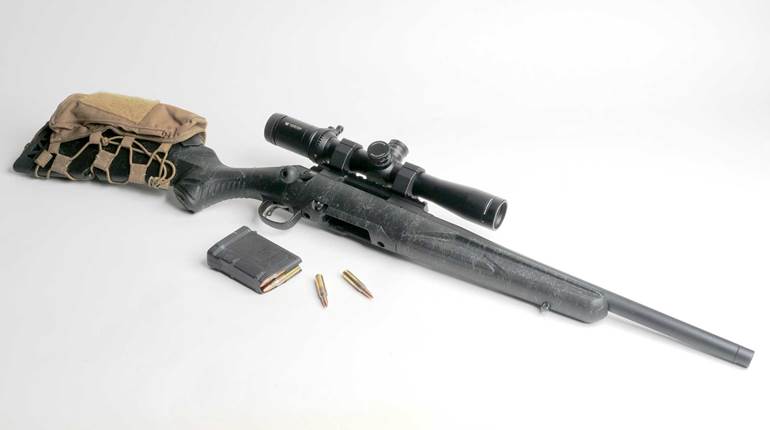
The Dimension is, as T/C likes to say, really more of a system than merely a rifle. Using what the company calls its Locking Optimized Components, users can switch not only barrels but just about everything else on the gun. T/C personnel envision different stocks and barrel contours for the future. For now, 10 different chamberings are available in standard configurations. Every caliber works with the same receiver and stock and, if the user desires, the same scope.
Barrel
At the heart of the Locking Optimized Components lies a system of interchangeable barrels designed to be switched out by the end-user with a simple tool; it’s made all the more simple by nomenclature.
Cartridge-group parts—the steel barrels and bolts, and polymer magazine kits—are identified by a letter: “A,” .204 Ruger, .223 Rem.; “B,” .22-250 Rem., .243 Win., 7 mm-08 Rem., .308 Win.; “C,” .270 Win., .30-'06 Sprg.; and “D,” 7 mm Rem. Mag. and .300 Win. Mag. To switch from one cartridge group to another, users need the entire group of parts. But switching within letter groups requires only a barrel. So switching from .204 Ruger to .223 Rem. is pretty quick. The system is fairly foolproof, too. Components for caliber families are labeled with their appropriate letters; different letter group components will not work with one another.
Complete caliber interchanges can be made in minutes with a bit of practice. The secret lies in the use of a barrel nut, the same system used on the AR-15. The sight of a barrel nut was made famous on sporting rifles by Savage in the 1950s. It’s inexpensive, repeatable and it works fabulously. When Savage introduced the barrel nut, it smoothed its lines, essentially hiding it. Thompson/Center eschewed the practice, choosing instead to make the barrel nut large and knurled.
The barrel is screwed into an extension that slides into the receiver; it indexes when a pin in the extension engages a notch in the receiver; it’s secured by tightening the barrel nut around the receiver. Clearly, this means the barrel is free-floating, which aids accuracy. What’s more, the extension is mated to the chamber and bolt with such tight tolerances that every bolt of a given cartridge family will headspace correctly. So while 10 chamberings are presently offered (and numerous others may be offered in the future), only four different bolt sizes are needed to serve them all.
Closing the bolt engages three locking lugs against shoulders in the barrel extension. That arrangement makes for a bolt throw of about 60 degrees. A conventional recoil lug is replaced by a robust slot/lug system with a bedding block that mates the barrel to the stock; the pieces are drawn together through the receiver with a torque wrench (included with the purchase of every complete gun) that tightens the front action screw. This slot/lug system also indexes the barrel precisely every time it’s removed then replaced.
The blued, chrome-moly barrels fit right- and left-handed receivers (yes, left-handed Dimensions will be available soon). Standard-caliber barrels are 22-inches long; magnums measure 24 inches; all have 5R rifling. All are standard taper for now, but the company envisions various profiles offered as options in the future.
Lock
Since no stresses bear on the receiver upon firing, it’s machined from aluminum. It weighs a mere 12 ounces. Its top and bottom are rounded, and it measures 7 5/8-inches long and 1 1/2-inches in diameter, large enough to accommodate even larger-diameter cartridges in the future should demand warrant them. As it’s an aluminum cylinder with rather thin walls, the additional metal left in the final cut adds rigidity, which reduces the effects of torque during recoil and thus aids accuracy. An ejection port is cut only on the right or left side (depending on whether it’s a right- or left-hand rifle); it measures 3 1/8-inches long and 11/16-inches high. I experienced no failures to eject spent cases when firing hundreds of rounds through various prototype and early production rifles during the past year-plus.
Bolt length and diameter is the same for all cartridges, but bolt travel is modified for short (A), medium (B), long (C) and longest (D) cartridges with a groove in the bolt body. Bolts are one-piece. Only the diameter of the bolthead varies among the four families. Each is fitted with a Sako-style extractor and plunger ejector. Each is fluted and the same diameter as the locking lugs. To remove the bolt, pull it rearward, and while depressing a release on the left rear of the receiver, rotate it clockwise, turning it upside down before removing it completely from the receiver.
The single-stage trigger, borrowed from the Icon, is user-adjustable from 3 pounds, 8 ounces to 5 pounds. The pull weight on our test unit averaged 4 pounds, 2 ounces from the factory. It uses a two-position safety; the bolt can be worked with the safety engaged.
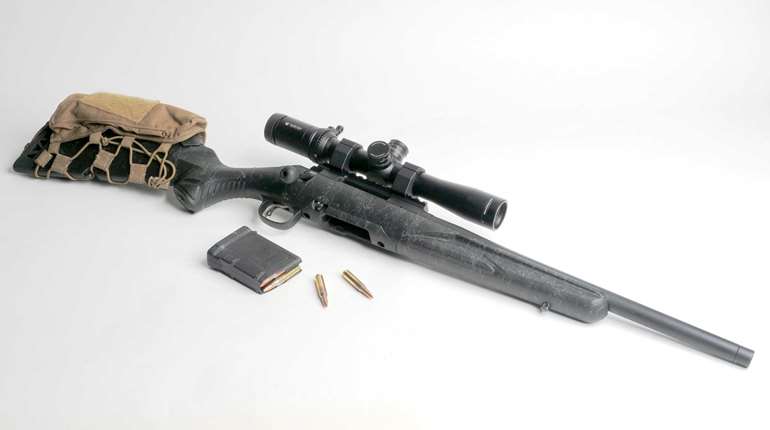
The detachable magazine is polymer. It’s a single-column design that holds three rounds in all calibers. Magazines are adaptable to different calibers with the use of an insert (think “magazine well”). One is included with the purchase of every new barrel, though users need different ones only when switching between caliber families. I experienced no problems with feeding from the polymer unit.
Stock
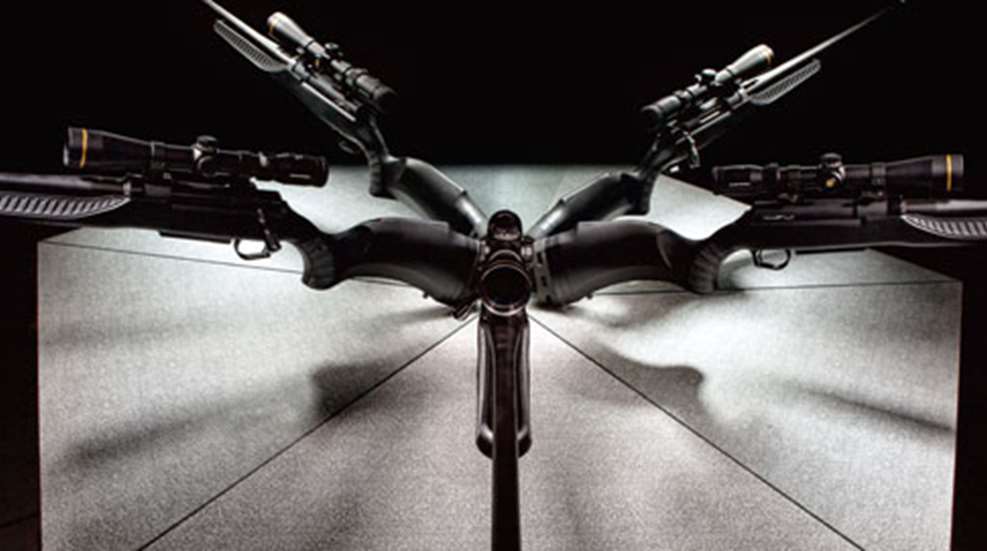
Thompson/Center envisions an optional stock as part of the Dimension system in the future. I’ve heard about a green synthetic version with a straight comb. That would be a good alternative. I have to admit that I do not like the present stock, a black synthetic unit with a high comb and a scallop that runs the length of the buttstock’s underside from pistol grip to heel. I’ve never been a fan of the Monte Carlo design. This stock takes the look to new limits, conjuring images of Molly Hatchet album covers. Still, I need to note that it’s not all about appearance; the high comb is necessary given the large-diameter receiver that positions a scope a bit higher than optimal on an otherwise similar rifle.
Recoil is not unlike that in any other gun when shooting the “A,” “B” and even the “C” calibers. But I noted something “special” when shooting the “D” calibers. Recoil is not unbearable in the Dimension. It will only become a problem if larger calibers (perhaps the .375 H&H Mag.?) are released with the same stock design. In that case, I’d like to see the alternative on the drawing board at T/C headquarters.
The barrel channel at the fore-end is wide to accommodate all barrel contours, both present and planned, which might be offered for the rifle. That eliminates the need to design multiple stocks for various caliber groups with different barrel contours. It’s so wide it reveals the mold marks even from afar—and could collect water and snow in inclement weather. That channel reveals plainly that the barrel is free-floated, which isn’t an altogether bad selling point.
A molded trigger guard and steel sling swivel studs are integral to the stock. Rubber panels on the pistol grip and fore-end provide purchase for a shooter’s hands. They’re pliable but not too squishy, and their bullet-shaped, raised ribs complete the gun’s overall industrial look. A generous rubber recoil pad covers two synthetic plates that are removable to adjust length of pull between 12 1/2 and 13 1/2 inches.
Scope Mounts
Complete Dimension rifles come with two-piece, Weaver-style scope bases installed on the receiver. When changing calibers the scope stays with the receiver. Of course points of impact will differ between chamberings, so users need to check zeroes when changing barrels, though in range tests I noticed remarkably close groups thanks to the barrel lockup system that ensures repeatability.
Alternately, users may choose to buy separately a bridge-style scope mount ($88) that makes the Weaver bases and rings obsolete. Its front end clamps to a dovetail in the barrel. Its rear end is split vertically; one half attaches to the receiver via two machine screws that tap into the receiver. Picatinny-style slots atop the bridge mate to rings available separately (steel 1-inch rings are available from T/C). With this system the scope stays with the barrel; T/C claims subsequent groups to return within an inch of zero.
It should be noted, however, that the large-diameter receiver combined with the bridge mount positions a riflescope a bit higher than is customarily optimal for a hunting rifle. With that in mind, the high comb isn’t such a bad idea.
Make a Switch
To switch calibers on the Dimension all you need is the torque tool, which comes in two parts that enable it to function as a torque wrench and simple Allen wrench. With it you’ll never wonder about applying the right amount of pressure to the action screws or barrel nut; it clicks when enough torque is applied.
Remove the bolt by retracting it to the rear, depressing the bolt release, rotating the bolt 180 degrees clockwise then sliding it from the rear of the receiver. Use the torque wrench to break loose the rear then front action screws; then use the Allen head to unscrew the action screws. (All screws on the Dimension are captured, so there is no fear of losing them). Lift the barreled action from the stock.
Loosely screw the V-shaped portion of the torque tool through the bottom of the receiver into the barrel shank then insert the shaft of the tool into the hole of the torque wrench block marked “L” for “loosen” then tighten the torque wrench snugly. Engage the teeth on the barrel nut with those on the tool’s gear. Be sure the torque wrench is inserted so it and the Allen wrench function like a pair of pliers. Squeeze the two pieces together in your hand to break loose the barrel nut then loosen it further by hand.
Separate the action from the barrel. Exchange the barrel with another; hand-tighten the barrel nut then install the torque tool, inserting the shaft of the wrench into the hole of the torque wrench block marked “T” for “tighten.” Tighten until a “click” is heard; the correct amount of torque has been applied.
If you are switching between cartridge-group families, you will need to also switch magazine kits. Simply lift out the previous unit from the top of the stock and drop in the replacement that corresponds with the nomenclature on the barrel.
Use the torque tool to tighten the front action screw then the rear action screw. When an audible “click” is heard the proper torque has been applied. Lastly, be sure to insert the proper bolt corresponding to the appropriate caliber family.
Accuracy Results
Thompson/Center guarantees the Dimension to be a three-shot, one minute-of-angle gun, but shooting five-shot groups opens up things a bit. In range sessions with a .300 Win. Mag. fitted with a Leupold VX-R 3-9X 40 mm riflescope, I shot nine different loads for function testing and selected three different bullet weights for the accuracy evaluation, firing five, five-shot groups with each. The best load, a Hornady 150-grain GMX, produced two groups that measured a scant 1.25 inches. A 180-grain Winchester XP3 printed three 2-inch groups. The Remington Premier load, with its 200-grain Swift A-Frame, is the one I subsequently took moose hunting. It produced one 1.5-inch group and two 2-inch groups. Keep in mind these are all five-shot groups; overall size would have been smaller had they been only three shots. I have no qualms about T/C’s three-shot, one-m.o.a.-guarantee—it can be handily met with the right ammunition.
Impressions From The Field
I first laid eyes on a Dimension in summer 2011 at an event T/C reps held in Illinois for select members of the media. During a range session, in which I fired four different calibers in four different families, I noted function, repeatability and accuracy were present in spades. After a tutorial, all of us were disassembling and reassembling individual rifles in different calibers with aplomb. Every part mated to the gun seamlessly. The directions printed herein may seem confusing, but after you see the process once it’s a simple matter to go from .204 Ruger to .270 Win. in minutes.
Last fall I took a .300 Win. Mag. Dimension to Newfoundland, Canada, for a moose hunt. I’d shot several prototype iterations already, and I’d shot this unit numerous times in preparation for the hunt. But a week-plus in the bush provided some final notes.
Remember that stock I complained about? Its design actually settles nicely into what I call the “frontier” cradle, wherein I carry the gun in the crook of my weak-side elbow and grip the gun with my weak-side fingertips beneath the pistol grip. On easy ground I can merely keep the tip of one finger on the bottom of the pistol grip to keep the gun balanced. Rifle stocks with shallow pistol grips don’t work well for this, but the Dimension’s grip is so pronounced I never lost my hold on it in wind, rain and snow. Because of the stock’s polymer construction, the elements can do their worst, and the Dimension is none the worse for wear. The gun points nicely, too. There’s no denying the high comb positions your eye quickly.
The three-lug design demands a bit of force to rotate the bolt, so be sure to practice with the rifle before you expect fast times in rapid fire. The large bolt knob is easily found, though, and it’s not easy to lose one’s grip on it. It should appeal to those who don’t like to search for the controls.
You won’t have to search for the safety, either. It’s large, lies along the right rear of the receiver where the bolt exits and is easily pushed fore and aft. Hold it between your thumb and forefinger when disengaging it in the presence of game to silence it.
I wish I could tell you that with the Dimension I felled a 50-inch bull moose at 300 steps; that the rifle’s accuracy astonished even the crustiest Canadian guides. But alas, my bull fell at perhaps 6 yards. It wasn’t a giant bull, either. But it was meat for the freezer. I shared it with my hunting partner and many folks ate well over the winter.
Make no mistake, the Dimension does not hide its appearance, and such looks aren’t for everyone. Then again, it’s entirely possible the addition of another stock in the Dimension lineup may change the rifle’s lines altogether. In the meantime remember looks aren’t everything. Consider that the cost of a second barrel for many switch-barrel rifles costs more than some complete rifles. This “bolt-action platform” breaks that mold. Its retail price is $679. That’s right, the entire rifle costs less than some extra barrels from other systems. What’s more, additional barrels cost $250, and each one comes with a new magazine kit appropriate to the caliber-family of the barrel. Bolts are $162.
Now hunters and shooters can buy one gun—a stock with adjustable length of pull, a barrel, bolt and detachable magazine—in one caliber and outfit it for nine other calibers with the purchase of extra barrels. The whole shebang is not only reasonably priced, but it works flawlessly. Eli Whitney would be proud.
Manufacturer: Thompson/Center Hunting, Smith & Wesson Holdings; (866) 730-1614; www.tcarms.com
Mechanism Type: bolt-action, switch-barrel, repeating, center-fire rifle
Caliber: .204 Ruger, .223 Rem., .22-250 Rem., .243 Win., 7 mm-08 Rem., .308 Win., .270 Win., .30-’06 Sprg., 7 mm Rem. Mag., .300 Win. Mag. (tested)
Receiver: machined aluminum
Barrel Length: 22" or 24"
Rifling: 5R; 1:9"-1:12" RH twist depending on caliber
Weight: 7 lbs. (empty)
Overall Length: 413⁄4"-433⁄4"
Magazine: three-round detachable box, single-stack, polymer
Trigger: single-stage, pull weight adjustable from 3 lbs., 8 ozs., to 5 lbs.
Sights: none, Weaver bases factory-installed
Stock: Monte Carlo style synthetic; length of pull, adjustable from 121⁄2"-131⁄2"; drop at heel 9/16";drop at comb, 3/4"
Accessories: torque tool, Weaver scope bases
Suggested Retail Price: $679