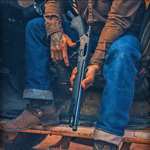
Four British paratroopers moving through a shell-damaged house in Oosterbeek to which they had retreated after being driven out of Arnhem (above). They are armed with a pair of Sten Mk V submachine guns, a Browning 9 mm Hi-Power pistol and an Enfield No. 2 .38/200-cal. revolver. Their objective had been to take the bridge over the Lower Rhine River at Arnhem, Holland (l.).
Following the breakout from the Normandy beachhead in July 1944, Allied armies drove forward much more swiftly than had been anticipated. General George S. Patton’s 3rd Army quickly overran Brittany, Allied forces liberated Paris on August 25 and from there, the British Second Army surged through Belgium to the Dutch frontier. Although they had penetrated deep into German-held territory with stunning speed, as Sept. 1, 1944, approached, Allied armies were still being supplied from the Normandy beaches 300 miles behind them. As lines of supply grew longer and longer, major logistical problems began to haunt the Allies.
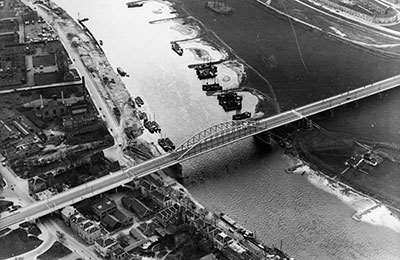
In early September, British Field Marshal Bernard L. Montgomery approached Gen. Dwight D. Eisenhower, the Supreme Commander of the Allied Expeditionary Force, with a plan to push the northern flank of the Allied front forward to secure the channel ports of the low-countries—Belgium and Holland. The move would, in theory, open those ports, shorten the lines of supply and make it possible for the British XXX Corps to force the right flank of Germany’s defensive line, cross the Rhine River and drive into the heart of the Reich. The boldness of the plan even contemplated a swift capture of Berlin and a swift end to the war. Eisenhower remembered that, “Montgomery suddenly presented the proposition that, if we would support his Twenty-first Army Group with all supply facilities available, he could rush right on into Berlin and, he said, end the war.” Although it meant slowing Patton down, Eisenhower approved Montgomery’s plan.
To secure the way for the overland thrust toward the Rhine, Montgomery recommended the use of Lt. Gen. Lewis H. Brereton’s 1st Allied Airborne Army. According to the Montgomery plan, these divisions would be dropped in broad daylight as much as 64 miles behind enemy lines in Holland, where they would have to seize objectives critical to the success of the battle. Codenamed “MARKET,” the 1st Allied Airborne Army’s role in the operation would be to secure bridges over major waterways in the vicinity of the cities of Eindhoven, Nijmegen and Arnhem.
With those bridges securely in the hands of Allied airborne forces, the British XXX Corps would advance from its front lines along the Albert Canal in Belgium, first to Eindhoven, the southernmost of the three cities. From there, XXX Corps would continue north to the city of Nijmegen and finally on to Arnhem where it would cross the farthest bridge over the Lower Rhine River.
Because of where they were based in England, the British 1st Airborne Division and the Polish Independent Parachute Brigade were best positioned for the assault on Arnhem. Since Maj. Gen. Maxwell D. Taylor’s 101st Airborne Division was based at a series of airfields west of London, it was assigned the southern bridges near Eindhoven. The job of securing the bridges in the center was given to the 82nd Airborne Division, under the command of 37-year-old Maj. Gen. James M. Gavin. As the day of battle approached, Allied sky soldiers, tankers, engineers and infantrymen prepared for their rendezvous with destiny among the dykes and levees of Holland, and young Brits, Poles, Canadians and Americans would confront their enemy with the guns that made World War II famous.
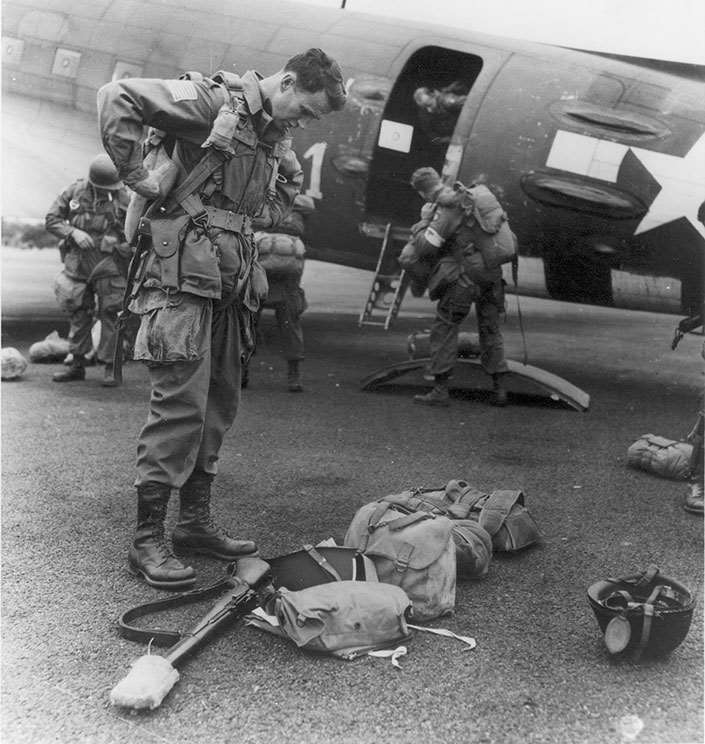
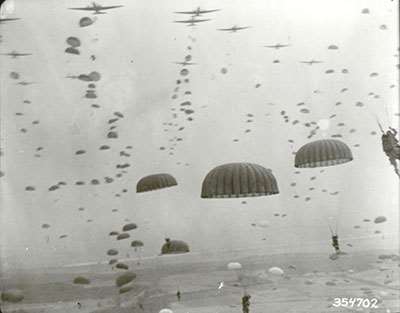
In the morning on Sept. 17, 1944, a total of 1,545 Douglas C-47 transports and 478 gliders departed from 24 airfields in England. After taking off and forming up, the transport formations proceeded out over the English Channel under the protection of 1,130 fighter escort aircraft. At 1 p.m., the men of the 82nd Airborne Division’s 505th Parachute Infantry Regiment began jumping. On Maj. Gen. Gavin’s C-47, all 18 men went out the door “without a second’s delay.” In his World War II memoir On To Berlin, Gavin described his Holland jump vividly:
“We seemed to hit the ground almost at once. Heavily laden with ammunition, weapons and grenades, I had a hard landing while the parachute was still oscillating. At once we were under small arms fire coming from a nearby woods. I took my .45-caliber pistol out of its holster and laid it on the ground beside my hand.”
The M1911A1 .45 ACP pistol was a gun that came in handy for a number of soldiers that day. Remembering how paratroopers in Normandy had needed an arm that was ready to fire immediately upon landing, a number of 505th men drew their .45s and began firing at Germans on the ground as they drifted downward under their open parachute canopies. Although the men engaging the enemy with their pistols could not have expected their fire to be particularly effective, they must have been pleasantly surprised when most of the Germans broke and ran.
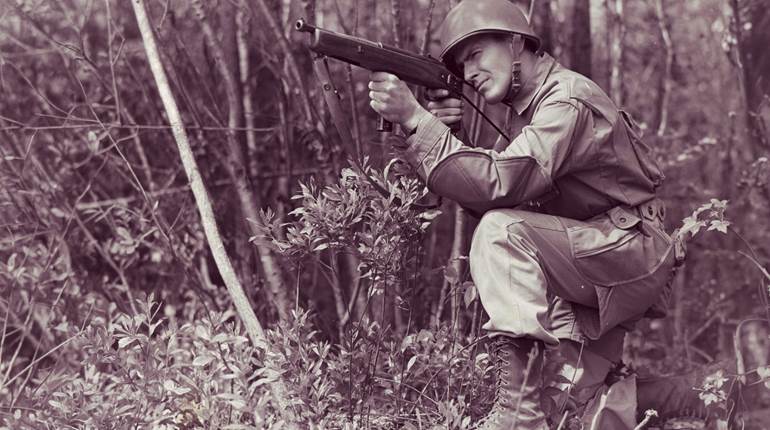
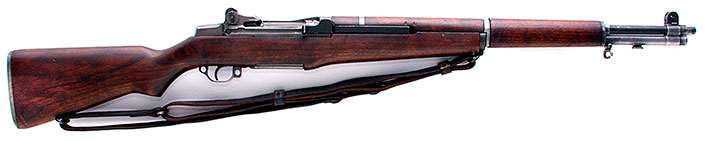
While most high-ranking airborne officers jumped armed with M1A1 Carbines or pistols, Maj. Gen. Gavin jumped that day just as he had for Normandy—armed with the 9 ½-pound M1 Garand rifle. Nearby, Sgt. Dick Wolch of the 508th Parachute Infantry swore as he threw himself out the door of his C-47. Descending under an open canopy, Wolch turned his attention to the ground below when he heard the unmistakable “sharp barks of M1 rifles.” He then watched as seven German anti-aircraft gunners attempted to flee across the DZ toward the shelter of the trees beyond it. Moments before they had been firing anti-aircraft shells at low-flying troop carrier aircraft, but now they were attempting to escape with their lives from a score of 508th paratroopers who had already landed and were beginning to deliver accurate rifle fire. Bullets from the barking M1s quickly stopped the fleeing German gunners and they “fell to the ground and lay still.” Although the M1903 rifle was still in use in the U.S. Army at that time—even in the airborne—it was the M1 Garand rifle that armed most of the Americans in Holland.

Once on the DZ, Sgt. Wolch swiftly retrieved his personal arm—the rugged M1A1 Thompson submachine gun. Designed for, but never used in, the trenches of World War I, the .45 ACP “Tommy Gun” continued to serve the U.S. Army in the autumn of 1944 despite the availability of the M3 “Grease Gun.” As Wolch moved off the DZ, he found that he had landed near a German 20 mm anti-aircraft gun. Both its barrels were “shattered” by hand grenades and the crew lay nearby dead—the “All Americans” had arrived and were already fighting like lions.
Thirty-nine miles to the south, near the Dutch city of Eindhoven, the paratroopers of the 101st Airborne Division were fighting heroically as well. At about the same time that Dick Wolch and the men of the 508th Parachute Infantry were locked in a vicious battle to secure their DZs near Nijmegen, the “Screaming Eagles” were up against heavy German opposition in the Zonsche Forest near the town of Best. The division’s assigned mission called on it to seize and hold nearby bridges spanning the Wilhelmina Canal, but the opposition was not about to give it up easily. German units streamed up from Eindhoven to attack the Americans the following day, Sept. 18, and a pitched battle swiftly developed in front of H Company, 502nd Parachute Infantry Regiment, leaving the unit’s 2nd platoon surrounded by an enemy force of superior size.
In an urgent attempt to slow the enemy assault, a 22-year-old scout, PFC Joe E. Mann, grabbed a bazooka and crept within range of a supporting German field gun. After knocking out the gun and its supply of ammunition with a pair of rockets, PFC Mann then reached for the greatest battle implement ever devised: the M1 Garand rifle. From his isolated position well out in front of the platoon’s foxholes, he directed a continuous stream of accurate Garand rifle fire at the enemy in complete disregard for the great danger involved. As the German onslaught continued to intensify and PFC Mann continued to burn through en bloc clips of .30-cal. cartridges, he ultimately reached a point where he could no longer hold them off single-handedly. He soon received four serious wounds—two of which were to his arms—so the fearless young paratrooper was returned to his platoon and patched up by a medic.
Although unable to use his arms due to extensive bandaging, PFC Mann refused evacuation and insisted on standing guard on the line overnight. At first light on Sept. 19, the Germans launched another attack that pushed to within a few feet of H Company’s foxholes. Grenades soon began to fly as the assault was pressed home, and one of them landed in the foxhole occupied by PFC Mann and several of his comrades. Without hesitating, Mann acted: since he could not throw it back at the enemy because of his field dressings, he yelled “grenade!” and rolled his body over on top of it. The explosion that inevitably followed moments later ended Joe Mann’s life, but his selfless sacrifice saved the lives of the men nearby. That action also resulted in a posthumous award of the Medal of Honor.
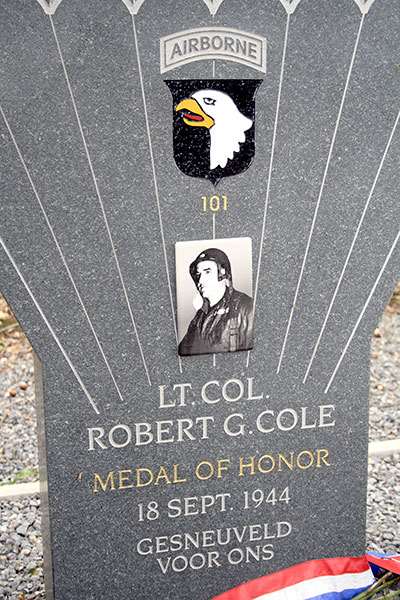
But acts of bravery were commonplace in the Zonsche Forest at the beginning of Operation MARKET GARDEN. Less than two miles away from the spot where Joe Mann’s life was cut short, Lt. Col. Robert G. Cole was leading his battalion in an epic fight against powerful German counterattacks. Commanding the 3rd Battalion of the 502nd Parachute Infantry Regiment, Cole was finding it challenging to coordinate air support for his rifle companies in the dense woods. When it became necessary to put out recognition panels to mark the position of the battalion headquarters, he elected to do the job himself. From 300 yards away, a shot suddenly rang out and a bullet struck Lt. Col. Cole in the temple, killing him instantly. He left behind a wife, a 2-year-old son and a reputation for fearlessness.
Three months earlier in Normandy, Cole had led a daring bayonet charge down a causeway leading into the city of Carentan. Because of the exceptional combat leadership he exhibited on that day, Cole had been recommended for the Medal of Honor, but the award had not yet been approved. In the weeks that followed his death in Holland, the approval finally came through, and the medal was presented to his family in a ceremony at Fort Sam Houston, Texas. Robert G. Cole had earned the Medal of Honor in Normandy, and he never even knew it. Instead, his life was brought to a violent and early end near a little Dutch farm by a German sniper.
An especially well-equipped fighting force, the Third Reich fielded a number of scoped rifles capable of functioning as effective sniping platforms. The legendary Mauser kar.98k was fitted with several different types of telescopic sights from several different manufacturers using a variety of mounting systems. Despite the fact that the kar.98k was not designed for scopes, more than 130,000 were ultimately fitted-out with them during the war. These rifles were quite effective, as were the Gew43 semi-automatic rifles that were also modified for precision shooting. It was one of these type rifles that killed Robert Cole in the Zonsche Forest on Sept. 18, 1944.

In addition to sniper rifles, German infantry units brought other excellent examples of handheld firepower to bear against the Allies in Holland. Of course, the kar.98k in its standard version was there in abundance, as well as the MP40 submachine gun and the MP44 Sturmgewehr. In addition to those firearms, Third Reich machine guns, such as the MG34 and the MG42 also fought the battle for southern Holland. Going back all the way to the invasion of Poland in 1939, the German military had been particularly characterized by its widespread use of lightweight, belt-fed, automatic arms that could be moved around on the battlefield with ease and operated by a single gunner if necessary. They opened the door to an entirely new world of versatility for military small arms and they showed other armies the value of highly mobile firepower.
When the war started, the U.S. military had nothing like the MG34. Both the M1917A1 water-cooled and M1919A4 air-cooled machine guns could be depended on to provide reliable and accurate fire, but they required the use of a tripod. The M1918A2 Browning Automatic Rifle could advance with an attacking echelon, but had the shortcoming of feeding from 20-round box magazines only. The U.S. Army Infantry Board, therefore, sought to adopt a belt-fed light machine gun comparable to the ones being used so successfully by the Germans. The process began six months before Pearl Harbor when the board recommended modifying the existing M1919A4 machine gun design by adding a bipod and shoulder stock.
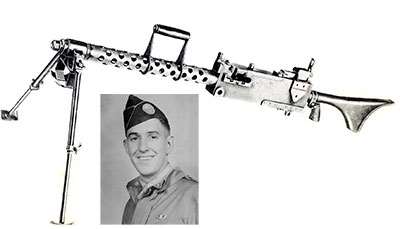
During the next year and half, the Army’s new light machine gun underwent a period of design development that ultimately produced a substitute standard the Infantry Board designated M1919A6. The Saginaw Steering Gear Division of General Motors placed the A6 in production in July 1943, and a few examples reached the fighting front in Italy later that year. Although a sufficient number of the new light machine gun was not available to equip the Army’s two airborne divisions in time for Operation Neptune/Overlord (the Normandy invasion), the M1919A6 was to be an important part of Operation MARKET GARDEN. Hundreds of sky soldiers brought this new version of the .30-cal. air-cooled machine gun to Holland, finding it the perfect answer to the special portability needs associated with the airborne infantry’s vertical envelopment mission.
One of the men who jumped into southern Holland with an M1919A6 light machine gun was 19-year-old PFC Carl D. Beck. Born in Avondale, Mo., in 1925, Beck lied about his age to join the Army as a 17-year-old. After basic training, he volunteered for the parachute infantry and was subsequently assigned to the 3rd Platoon of H Company, 501st Parachute Infantry Regiment, 101st Airborne Division. He survived his introduction to combat during the Normandy campaign only to find himself in the thick of the action once again in the fighting north of Eindhoven. He remembered Sept. 17 as a “beautiful sunshiny, Sunday afternoon,” while descending under an open parachute canopy over the 501st Drop Zone near the village of Eerde Southwest of Veghel. In addition to his individual equipment and supply load-out, and a rigger-made leg bundle, Beck carried the 32-pound weight of his M1919A6 light machine gun. He landed safely and immediately went to work alongside the other troopers of H Company/501st in the struggle to seize and hold the corridor for the XXX Corps push to the Rhine.
Private First Class Beck saw almost constant combat in the days that followed, during which time his new A6 was called on to deliver a steady volume of fully automatic fire in several firefights. Just a few days after coming to the Holland, H Company was moving up to fill a gap in the lines when it collided with an element of German paratroopers. In the melee that followed, Beck and the other H Company men began to exchange fire with the Germans in a vicious engagement. With his A6 laying down devastating bursts of fire in a skirmish that was “hot for awhile,” PFC Beck poured it on for almost two hours and “got a mess of them.” When it was all over, he recalled that there were “dead krauts laying all around” and estimated that he had been responsible for at least 35. Despite the fact that it had been fathered by necessity and rushed into production, the new M1919A6 light machine gun was clearly an arm not to be trifled with.
With the road clear through Eindhoven and beyond, lead elements of XXX Corps continued to the northeast and entered the 82nd Airborne’s sector near Grave on Tuesday, Sept. 19. Just eight miles farther up the road, the overland drive toward Arnhem had reached a stalemate at Nijmegen. Although the 82nd had fought effectively since landing two days earlier, strong German counterattacks had thus far prevented the division from capturing the Waal River Bridge located there. Late that afternoon, Maj. Gen. Gavin had a commanders’ conference with British Lt. Gen. Frederick M. Browning, Deputy Commander of the First Allied Airborne Army. During the meeting, Browning had warned Gavin with the words, “the Nijmegen bridge must be taken today—at latest tomorrow.” By then, Gen. Robert F. Urquhart’s British 1st Airborne Division had been cut off in Arnhem for three days, and yet the Nijmegen Bridge was still in enemy hands. If the XXX Corps was going to get through to relieve the 1st Airborne Division, that bridge had to be taken.
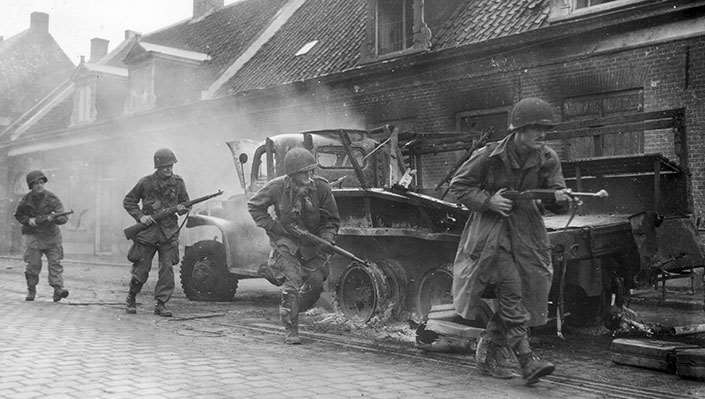
To break the deadlock, Gavin came up with a bold plan: a force of parachute infantrymen would cross the Waal River in engineer boats borrowed from the British under the cover of a smoke screen. Upon reaching the opposite bank, the force would then attack the Nijmegen Bridge from the rear, outflanking its defenders. Capturing the bridge would allow XXX Corps to resume its advance toward Arnhem. Gavin ordered the attack for the following day, Sept. 20, and selected Col. Reuben Tucker’s 3rd Battalion/504th Parachute Infantry to lead it.
The night was spent locating and assembling the engineer boats that would carry the 504th troopers across the Waal. Only 26 of the flimsy craft were available, arriving only 20 minutes before the attack was due to kick off. At 2:00 p.m., someone yelled “Go!” and the paratroopers wrestled the boats down to the water’s edge and launched them one mile west of the bridge. Each 19-foot boat carried 13 troopers from I Company/504th PIR and three troopers from C Company/307th Airborne Engineer Battalion. There were 416 men in the first wave. As the boats entered mid-stream, the smokescreen blew away revealing their position to enemy guns on the opposite bank. Simultaneously, the Americans began to experience difficulty maneuvering the boats in the river’s strong current, so they began to use the M1 Garand rifle for something that its designer probably never imagined—a boat paddle. Despite withering German automatic weapons fire, the troopers managed to reach the opposite shore, where they immediately deployed for action. The enemy’s fire was so destructive that, out of the twenty-six boats that carried the first wave across the river, only eleven returned. The human cost was high too: 48 men from the 504th and the 307th were killed during the crossing. Despite the losses, the paratroopers had momentum that carried them on to the objective and they overwhelmed the German defenders. With the Nijmegen Bridge open for traffic, the British Guards Armored Division crossed the Waal River and began the drive north toward Arnhem where the British 1st Airborne Division was fighting for its life.
The MARKET GARDEN plan had called for the British to land by parachute and glider west of Oosterbeek near the town of Wolfheeze. After assembling on the ground, various elements of the division would then fight their way eastward across six miles of enemy-held territory toward the highway bridge over the Lower Rhine River. It was expected that they would encounter light opposition and that the bridge would be seized before sundown on the Sept. 17, but that proved to be an overly optimistic expectation. Intense German counterattacks began to strangle the British around Arnhem almost immediately, and the plan began to come apart at the seams. Lt. Col. John Frost, commanding the 2nd Parachute Battalion, managed to make it to the bridge with 745 lightly armed men, but elements of the II.SS-Panzerkorps quickly surrounded them. The Polish 1st Independent Parachute Brigade landed on a DZ on the south bank of the Rhine at the end of the day on Sept. 21, but it was not able to reach the men of 2 Para in the city before they were overrun and forced to surrender. As of Friday the 22nd, the main body of the 1st Airborne Division occupied a shrinking defensive perimeter near Oosterbeek where the casualties were mounting. By that time the division had been locked in vicious combat with the enemy for five days without resupply or reinforcement. Although the heaviest armaments available to them were 75 mm howitzers and a few anti-tank guns, they continued to fight. Although running short on ammunition, they continued to resist the enemy onslaught.
The outstanding small arms that it brought were, in large part, responsible for the 1st Airborne Division’s ability to continue putting up a fierce defense against overwhelming odds. Automatic arms like the Vickers water-cooled machine gun and the incomparable Bren light machine gun provided the suppressing fire that was continuing to hold off relentless German attacks. The standard-issue rifle of British forces, the long-serving .303 British-cal. Lee-Enfield rifle, in its No. 4 variant, was abundant during the battle. A sprinkling of No. 4 Mk I (T) rifles provided the 1st Airborne Division with a precision sniping platform second to none.
For combat at closer ranges, there were pistols like the venerable Colt 1911 in .45 ACP (no Browning 9 mm Luger High Powers manufactured in Toronto, Canada by John Inglis and Co. had been delivered yet), the Enfield No. 2 .38/200 revolver, and of course submachine guns. The Sten fought this battle in its newest version—the Mk V, easily recognizable thanks to its wooden pistol grip, fore-grip and buttstock. Although the Mk V improved on the ergonomic features of the old Mk II Sten, a replacement was already under development. Earlier that year, the British Army called for a lighter and more accurate submachine gun to replace the Sten, and Sterling Armaments Co. submitted a design that had promise. Created by George William Patchett, it fired the 9 mm Luger cartridge from the open bolt using Sten magazines and weighed a pound less than the Sten. But Patchett’s experimental submachine gun was still in development at the time, and only six prototypes had been produced up to that point. For many years it was thought that a few Patchetts fought with the 1st Airborne Division in Holland, but it is now known that all six of the existing prototypes remained in England throughout Operation MARKET GARDEN and that the Sten was the only British submachine gun involved in the Airborne part of the battle.
The same guns used to defend the perimeters at Arnhem and Oosterbeek were also fighting their way north with XXX Corps as it pushed across the flat plane stretching between the Waal and the Lower Rhine. As the British and Americans clashed with German units along the road leading north from Nijmegen—a road sardonically nicknamed “Hell’s Highway”—the momentum of Operation MARKET GARDEN bogged down irretrievably. On Sept. 23, the Germans greatly complicated things for the Allies by continuing to throw troops and vehicles against the Poles, against Oosterbeek, and against the “Hell’s Highway” corridor. The intense pressure built to a point that, on the following day, Sept. 24, the Allies shifted over to the defensive. Then the 1st Airborne was ordered to withdraw across the Lower Rhine on Sept. 25. It had held on for nine days without support and had, in the process, lost more than three-quarters of its strength. When what was left of the division escaped across the river during the night of Sept. 25, the bold ambitions of Operation MARKET GARDEN flickered out once and for all.
Although fighting would continue in Holland for many months to come, Montgomery’s audacious plan to capture Berlin swiftly and hasten the end to the war had failed. But that failure was not for a lack of heroism, because Operation MARKET GARDEN proved that Allied soldiers were willing to fight tenaciously toward the objective of liberating the Netherlands. With the guns of Enfield, Inglis, Saginaw, and Springfield, they fought an epic battle that pitted the aggregate strength of the free world against the forces of totalitarianism. The guns of Operation MARKET GARDEN gave us tales of extreme bravery that continue to provide inspiration almost 70 years later.