Light and easy to manipulate, the .410-bore shotgun was—and still is—a gun most often associated with beginning shotgunners. Sometimes a tool for advanced competitive shooters, the skinny .410 shell drops a fair amount of light game every year and powders its share of clay birds. In the scheme of things, this is where the .410 shotgun comfortably and traditionally fits.
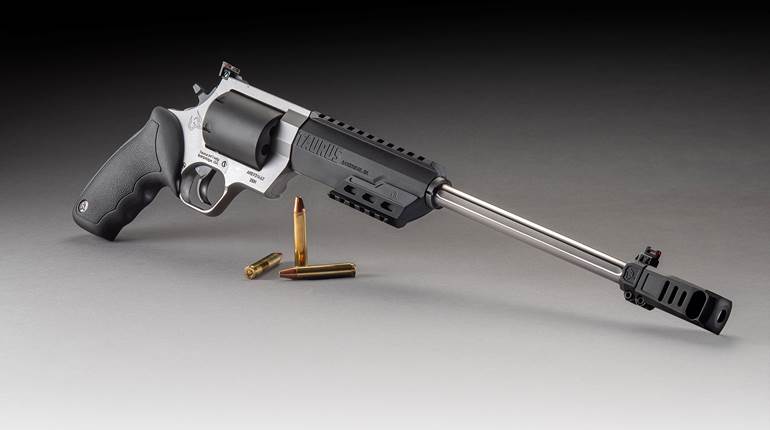
But the traditional role of the .410 was rather abruptly reconceived several years ago when the Judge revolver appeared on the market. Developed by Taurus Int’l of Miami, Fla., and Porto Allegre, Brazil, the new gun was a close-range defensive handgun chambered for the Frontier-era .45 Colt cartridge. It has exploded in popularity because Taurus designers extended the frame and cylinder far beyond what is required for a big-bore revolver cartridge, thus creating a sound platform that will fire both.45 Colt and .410-bore ammunition. Since the barrel is rifled, the gun does not fall into the heavily restricted short-barreled shotgun classification.
There are several models of the Judge revolver in production, including stainless and blue-steel versions, and lightweights with either aluminum or polymer frames. While their appearance is decidedly unorthodox, they sell briskly and they have become deservedly popular as defensive sidearms.
A personal-defense situation typically occurs at very close range, so the need for normal handgun accuracy is moot. The advantage of a shotgun shell at close range is the dispersion of pellets over a greater portion of an attacker’s body, greater than what a single handgun projectile can offer. This tends to render a different kind of fight-stopping trauma because the kinetic energy developed by several pellets is transmitted to the target—broadly and instantaneously.
For a variety of uses that I have already mentioned, the ammunition makers have been loading .410 shells for many years. In doing so, they typically have used most of the common shot sizes, ranging from No. 9 to No. 4. In recent years they have also made a few loadings with larger pellets of buckshot. But when the Judge came along, there was a quick demand for as much payload as possible, and Federal, Remington and Winchester went to work on what could be described as “Judge loads.” That is what we are talking about here—newly developed shotshell loads for .45 Colt/.410-bore handguns.
Understand that this new .410 ammunition will work in any shotgun chambered for it—from the farmboy’s little break-open single barrel to a Model 42 Winchester—but it has been optimized for use in short-barreled revolvers. There are two distinctly different kinds of such loads, those for 2½-inch chambers and those intended for the full 3-inch-chambered guns. The former will work in the latter, but not vice versa. All of the new loads feature multiple projectiles. There is such a thing as a .410 slug, but it is a .40-cal. Foster-type with a deep hollow base, and it weighs less than 100 grains. If the shooter was looking for a single projectile, he would be far better off using the .45 Colt option, with a 250-grain lead semi-wadcutter.
Federal
Federal Cartridge Co. came out with the first .45/.410 handgun load a couple of years ago, and that line has expanded to four options. The first is a 2½-inch load with four 000 pellets. Buckshot shooters know that a 000 pellet measures approximately 0.357 inches and weighs 72 or 73 grains. Federal’s are copper-plated and leave the muzzle of a short revolver in a long plastic shot cup at a published velocity of 1,200 fps. That is also the velocity of a similar Federal 2½-inch load, this one loaded with 7/16 ounces of No. 4 shot. Understand that this is No. 4 shot (diameter: 0.129 inches) and not No. 4 buckshot (diameter: 0.240 inches). My meticulous wife counted 63 of these little copper-plated pellets in one shell. The third Federal load is somewhat slower (775 fps) but carries five of the 000 pellets. It is a 3-inch load for the long-cylinder version of the Taurus revolver. There is also a 3-inch load featuring nine No. 4 buckshot at 1,100 fps.
Remington
Remington recently added the .410 bore to its list of HD Ultimate Home Defense ammunition. One load uses four 000 pellets atop a short plastic wad. The other has four 00 pellets. Both are 2 1/2 inches. The maker claims muzzle velocities of 1,225 fps (000) and 1,300 fps. (00), both of which are zippy for a .410. Opening a sample shell showed lead pellets that seemed to be formed of a very hard alloy.
Winchester
The designers at Winchester approached the problem of an effective load for the .410 handgun with a blank sheet of paper. Their non-traditional projectile fills the space in the shell more efficiently with cylindrical, rather than spherical, projectiles. Each is 0.400 inches in diameter and 0.240-inches thick and leaves the muzzle at 750 fps. Called “Defense Discs” by their maker, they are not true wadcutter bullets because their edges have a rather pronounced bevel. There are two varieties in the line. The 2½-inch length carries three of the Discs; the 3-inch version has four.
However, there’s a little something extra in both. On the apparent theory that more is better, Winchester added 12 BBs under the three Discs in the 2½-inch load, and in the 3-inch version there are 16 of them. A single BB shot weighs 8.8 grains and measures 0.18 inches in diameter. That means another 106 grains of payload for the 2½-inch shell, 141 grains for the 3 inch.
The basic idea seems to be the same for all three makers. Since a shotgun shell is tubular in shape, using the interior space as efficiently as possible makes great sense. Defensive encounters are invariably at close range. I patterned the loads at 5 yards, slightly short of the FBI-researched standard distance of 7 yards. In a confrontation, the pattern spread from any of the six loads should stay on an NRA-standard Bianchi Cup target. Terminal effect would have to be pronounced, given a centered hit.
There is also the over-penetration factor to be considered; it’s a problem with much of today’s defensive guns and loads. Since this new .410 ammunition is designed to work by means of cumulative effect, there are multiple projectiles, none of which are particularly heavy. Penetration would, therefore, be limited, but the wound would be quite wide. In urban situations, this factor alone supports the .410 handgun concept.
Testing
To evaluate each load’s utility, I fired each in the same exercise. I used the familiar Bianchi Cup target, which has scoring rings impressed into a cardboard backer silhouette measuring 18 inches by 30 inches. The inner scoring area is a 4-inch circle, surrounded by scoring rings 8 inches and 12 inches in width. I fired five rounds of each load from a typical Judge revolver. In my tabulation, I recorded the number of hits in each scoring ring. At 5 yards there were many hits on the cardboard from the plastic shot cups and/or wads. These projectiles have little mass and don’t count. There were some surprises in the course of the shoot, as well as some satisfactory results.
Let’s look at the various loads in the same order I have previously described them. First up was the Federal 2½-inch load with four 000 buckshot. Five rounds onto the R2D2 target produced exactly 20 hits with 15 of those in the center 4-inch circle. The Judge I used patterns this load tightly, essentially in an 8-inch circle at 5 yards and close to the point of aim. The second load had the same velocity, but used 7/16 ounces of No. 4 shot. Here I got a completely different result. There was little centering, but rather a remarkably even dispersion of the 0.129-inch pellets over the entire 18x30-inch target. Remember that there are other uses for the Judge than personal defense. If you are going after pests, this even-patterning load may be just the ticket.
The third Federal load was the 3-inch shell with five 000 pellets. Although more than 400 fps slower than the other big buckshot load, the dispersion was much the same, with 17 of the 25 pellets in the center circle and the other eight inside the eight ring. Even dispersion, indeed.
Remington’s nominal 00 load was the fastest of any tested and produced significant recoil. On the target only three of the pellets found the center circle, but 15 were in the 8-inch ring and only two more strayed outside to the 12-inch circle. This simply means that the Remington offering stays inside the 8-inch circle just like the others, but spreads more evenly within that space. Because of the load’s velocity, it delivers a harder blow than any other load tested.
Winchester Ammunition, you will recall, used a completely different approach when crafting loads for the .410 handgun. It offers two loads in this series, both with a combination of their “Defense Discs” and BB shot. A 2½-inch load works with three discs and 12 BBs, and its 3-inch version uses four discs and 16 BBs. Since the discs are .40 caliber, they are supposed to engage the rifling in the bore and become stabilized, leaving the following column of BBs to spread over a greater area. In my five-round group with each of the two versions, that appears to be exactly what happened. The discs tend to produce small patterns, but the BBs that follow them create an even pattern that is centered around the Discs’ points of impact.
Conclusions
These new .410 loads are a curious development driven by the current interest in ever-more efficient self-defense guns and ammunition. Close-range use of multiple-projectile firearms is a valid concept. As far as the six tested loads are concerned, two are the efficient, 3-inch type. The Judge revolver that takes them is significantly larger and heavier, so some handgunners will choose the shorter, lighter Judge for concealed carry. Of the four remaining, one is better suited to pests than criminals. The three remaining are the ones most likely to be used. There’s one from each maker and they are all effective man-stoppers.
Other makers may be entering the .45/.410 ammunition arena. I have heard of new .410 handgun loads from off-shore makers, but I lacked samples to include in this shoot. It’s also interesting that Smith & Wesson recently announced a .410 revolver called the Governor that also shoots both .45 Colt and .45 ACP with moon clips. It isn’t out in quantity yet. We are bound to see more variations in both guns and ammunition in the future. I would offer one cautionary note: Multiple projectile systems work on the basis of terminal effect, not hit probability. In other words, you shoot in the hopes of striking a decisive blow, not to increase your chances of a hit. For that reason, I like buckshot loads that pattern tightly. But the tighter the group, the easier it is to miss. Hardware, no matter how cleverly contrived, will never make up for sloppy shooting. Shot placement matters.