Many of the best innovations have resulted from gifted individuals pursuing the answer to one simple question: What if…? For the late Jeff Cooper, one such question took seed nearly a half-century ago and ran something along the lines of, “What if you found yourself in dire circumstances and could have only one rifle with which to provide meat for the table and, in a pinch, ensure your own defense?”
Cooper, a retired combat Marine lieutenant colonel and devoted big-game hunter, was uniquely qualified to not only address that question, but to analytically evaluate it. He did so through a series of magazine articles and, in the 1980s, conferences held at the renowned firearm training center he founded in Paulden, Ariz., that today is known simply as Gunsite.
Cooper’s ultimate proposal, cited in his book “To Ride, Shoot Straight, and Speak the Truth,” postulated, “A general purpose rifle is a conveniently portable, individually operated firearm, capable of striking a single decisive blow, on a live target of up to 200 kilos in weight, at any distance at which the operator can shoot with the precision necessary to place a shot in a vital area of the target.” He would eventually dub the platform “scout” after its namesake military operator—an individual dispatched ahead of a main force to reconnoiter an area and who was reliant on his personal skills of evasion and on his equipment for safe return. Of course Cooper knew that a rifle that could serve in that role could just as well serve the civilian hunter, rancher or self-defense-minded individual, and so the requirements he outlined for such an “instrument,” while arguably somewhat arbitrary, were, nonetheless, rather specifically dictated by his considerable experience.
For hunting pursuits, Cooper had long admired the ’94 Winchester lever-action and the Mannlicher carbine for their handiness and natural pointing qualities. So the specifics he cited for inclusion in an archetypical scout rifle are not surprising: an overall length of one meter (39 inches) and a weight of 3 kilograms (6.6 pounds) for handiness; provision for a compact, fixed-power scope of intermediate eye relief mounted ahead of the action for simultaneous situational awareness and fast target acquisition; a facility for rapid reloading and/or extra ammunition capacity for adequate firepower; and, finally, a reasonably powerful chambering, preferably in the form of a short-action cartridge such as the .308 Win., for terminal effectiveness on quarry of 200 kilos (440 pounds).
Origins
In the 25 or so years since those criteria were established, scout aficionados have struggled to build their own “pseudo-scouts”—often at the great expense that typically accompanies custom gunsmithing—just as Cooper did during the platform’s development. And the concept tended to separate a relatively small but enthusiastic band of riflemen who “got it” from the vast majority who simply didn’t—or, for one reason or another, didn’t want to.
Cooper’s experimentation progressed through a series of scout prototypes built on bolt-actions ranging from a Remington Model 600 to a Brno ZKK Mauser action to a Ruger M77 Ultralight fitted with a rib from a Ruger No. 1 single-shot action. Ruger later legitimized the latter configuration as a factory pseudo-scout in the form of its now-discontinued Frontier Rifle, which whetted some shooters’ appetites and laid the groundwork for a more thorough execution. Surprisingly, it has been reported that Bill Ruger, when shown Cooper’s Scout III, the Frontier’s forerunner, was nonplused. Regardless, the Frontier could be considered the forerunner to the company’s latest offering: the M77-based Ruger Gunsite Scout Rifle.
The new rifle is the result of several years of collaboration between Ruger and Gunsite, but according to Ruger Product Manager Mark Gurney, discussions that led to rifle’s development got underway in earnest in November of 2009, only a year before its launch. Initially Gurney and Ruger Media Relations Director Ken Jorgensen met with Gunsite Range Master Ed Head in Arizona to discuss the project. They returned to New Hampshire to iron out the details and create a list of potential features. They later revisited Arizona where both Head and Gunsite owner Owen “Buz” Mills provided key input on the project. Back in New Hampshire, longtime Ruger engineer Roy Melcher turned his creative mind to the project. Melcher had developed the Security-Six revolver series, had contributed heavily to the original Mini-14 project and had designed the 77/22 bolt-action rifle. He had been called out of retirement several years earlier when Ruger re-tooled the Mini-14 production line and product offerings. The Scout Rifle would be his final contribution to the company before his death late last year.
“The Ruger Gunsite Scout is a credible rendition according to Cooper’s concepts,” said Gurney. “It is not an attempt to blindly follow a strict recipe, because Cooper didn’t have a strict recipe. He had guidelines based upon an ideal, and Ruger and Gunsite followed those ideals as best we could while keeping costs and development time reasonable.” Gurney added that Head, too, “did not have a dogmatic, ‘this is the recipe’ approach.”
According to Gurney, Melcher took the laundry list and created the first couple of prototypes. “We initially wanted the gun to take M14 magazines and even thought about making our own M14 mag,” he said. But inconsistencies in how existing magazines presented the rounds for feeding into the action dissuaded the team from that approach. A second prototype had a polymer stock and fed from Accuracy Int’l-pattern magazines guided by modified bottom metal from Badger Ordnance. “We took both—the wood-stocked M14-magazine gun and the polymer-stocked AI-magazine gun back to Gunsite for Ed to wring out,” said Gurney. Both Mills and Head preferred the more substantial feel of the wood stock, and at 7 pounds the team decided that the quarter pound that could be saved by using polymer would actually be detrimental to the rifle’s shooting qualities. “Also [Head] was insistent that the stock have an adjustable length of pull, and doing that in polymer would have cost quite a bit more,” said Gurney.
What finally emerged is both a true scout rifle and one of only three widely available production scouts on the market. What’s more, it neatly fills the void in price and features left between the other two. The Steyr scout, which Cooper personally collaborated on with Steyr of Austria, is certainly more feature-laden with its integrated bipod, multiple sling points and integrated spare magazine stowage, but it is priced at more than double the cost of the Ruger. The only other factory option, Savage’s 10 FCM Scout, while now in its second iteration and featuring that company’s proprietary AccuTrigger and AccuStock, comes standard with only a four-round detachable magazine and is not significantly less costly than the Ruger.
Mechanics
The Gunsite Scout Rifle is based on the proven Model 77 bolt-action that Bill Ruger launched in 1967, marrying his company’s investment casting capabilities with the best mechanical features of the military Mauser 98 and sporting Winchester Model 70. After undergoing a series of refinements in the ensuing years, the Model 77 proved to be strong, trouble-free and adaptable. Most recently it was improved through the Hawkeye line of rifles with trimmer stock dimensions and the LC6 trigger, which has better internal geometry for a crisper let-off.
The Gunsite Scout Rifle possesses the M77’s signature features: a flat-sided, flat-bottomed receiver with a forward-angling front bedding screw secured to the receiver’s integral recoil lug; integral mounts for the included Ruger rings; a one-piece stainless steel bolt and handle; a Mauser-type claw extractor; a receiver-mounted pivoting blade ejector; and a receiver-mounted, three-position safety.
But the new Scout is unlike any Hawkeye: particularly in how it is fed. While Ruger’s decision to use Accuracy Int’l-pattern magazines can’t be criticized from a purely functional standpoint, it is worth noting that it results in the M77’s otherwise controlled-round-feed action performing as a push-feed throughout much of the feeding cycle. It could be argued, however, that the arrangement still offers the Mauser-style claw extractor’s strength and purchase on the case rim and the fixed blade ejector’s facility for manual control of cases.
The M77’s feed lips are removed, allowing the magazine’s feed lips to guide cartridges. Four shallow ledges machined into the corners of the receiver act as abutments for the magazine’s sheet steel body. The magazine is guided by a one-piece trigger guard/magazine well assembly which is made of glass-reinforced nylon. A steel, spring-loaded, paddle-style release lever is secured at the trigger guard’s front with a roll pin. Pushing it forward moves the lever’s top edge backward out of contact with a projection stamped into the magazine’s rear. Both five- and 10-round magazines stamped with the maker’s name, Accurate-Mag, and the stylized Ruger eagle on the floorplate have been available with initial production guns. Ruger is currently testing a design for a proprietary polymer magazine that will function within the AI-pattern platform.
Ergonomics
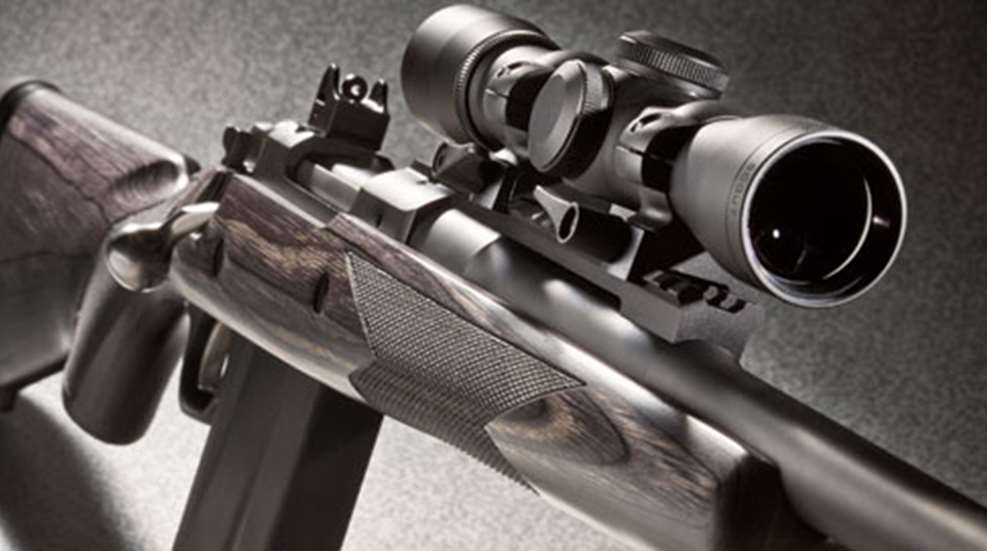
The Gunsite Scout Rifle’s stock is of black/gray laminated wood and is equipped with QD-style sling studs front and rear, bordered-point-style checkering on the fore-end and pistol grip, and no bedding compound in its interior recesses. The adjustable buttstock system that Head insisted on, based on the square-behind-the-rifle stance taught at Gunsite, was borrowed from the Mini-14 Target model and consists of a hard polymer buttplate secured to the stock with two screws and holding two threaded brass inserts. The 1-inch-thick buttpad consists of a polymer insert overmolded with soft rubber and has a ribbed face. Three 1/2-inch-thick hard polymer spacers are supplied with each rifle and can be inserted to achieve the desired length of pull before the Allen-head machine screws are used to sandwich the entire assembly to the stock.
Two crossbolts thread into steel inserts pressed into the left side of the stock. The forwardmost goes through the stock in the area that abuts the receiver’s recoil lug. The rearmost goes through a hole in a solid section of the trigger guard/magazine well assembly. Another Allen-head machine screw passes through the tang at the assembly’s rear under the stock and threads into the tang at the receiver’s rear above it. Finally, another Allen-head machine screw passes through an investment cast steel insert in front of the magazine well, angling upward to thread into the receiver’s recoil lug, which lies in a recess behind the stock’s barrel channel. The insert also clamps the front of the trigger guard/magazine well to the stock.
For reasons unknown, but possibly to prevent interference with an inserted 10-round magazine, Ruger chose not to equip the Scout with an additional sling swivel on the fore-end. Cooper had keyed on the addition of such a swivel for use with what he referred to as the CW sling, a single loop from the front swivel to the rear of the fore-end, or for the later Ching sling, named after former Gunsite instructor Eric Ching, which added a slider and a second strap for use with the rear swivel as well.
Ballistics
The Scout’s 16 1/2-inch hammer-forged barrel features a distinctive stepped profile that measures 1.160 inches for 13⁄16 inches ahead of the receiver ring, 0.943 inches for a 4 1/2-inch section thereafter, and then tapers from 0.887 inches to 0.658 inches toward a 0.760-inch-diameter shoulder behind the front sight. According to Gurney, the 16 1/2-inch length was an edict from Melcher. “Roy was a curmudgeon, and when 18 inches was suggested he insisted, ‘No it’s got to be 16 1/2 inches—the Frontier has one and it handles beautifully.’”
A 6-inch-long strip of Picatinny rail is secured with four screws to the thickest sections of the barrel for the mounting of intermediate (approximately 9 to 14 inches) eye relief riflescopes or electronic dot or reflex sights. Iron sights, adapted from the Mini-30, consist of a rear aperture resting in a base that features cast-in protective wings and is secured to the rearmost conventional scope mounting position with a single screw. It is fully adjustable for windage by way of left- and right-side set screws and for elevation by screwing the aperture itself up or down. The aperture measures 0.90 inches, which results in a “ghost ring” effect when sighting through it to the serrated front blade that is cast as one piece with its protective ears and barrel band. Another part derived from the Mini-14/30, the flash suppressor, is screwed onto the barrel’s 5/8-inch x 24 t.p.i. threads, providing ready adaptability of the rifle for use with a sound suppressor by law enforcement personnel or legally approved civilians.
Shooting results from a number of Scout Rifles indicate that the 16 1/2-inch barrel does little to adversely affect accuracy. Velocity is another matter, but the Ruger still manages around 2,600 fps with some match loads. In addition Ruger kept its standard 1:10-inch rifling twist rate, which is appropriate for stabilizing most heavy .30-cal. bullets. According to Gurney, who reports having routinely engaged steel targets as far out as 1,000 yards during testing, the .308 Win. cartridge is one of the least “sensitive” to reduced barrel length. In addition, he said engineers have experimented with other .308 Win.-based cartridges such as .243 Win. and 7 mm-08 Rem. in the Scout, and reported that they performed well although there are no immediate plans to offer additional chamberings until production can catch up with demand for .308 Win.-chambered guns.
Trials
Late last year Ruger demonstrated its confidence in the new Scout rifle by holding a formal rollout at the scout rifle’s breeding grounds: Gunsite. The event brought together more than a score of the new rifles with as many gunwriters to examine, shoot and critique them with all manner of riflescopes, of intermediate and standard eye relief, and even a few reflex sights. Shooting scenarios included short-range speed work, timed work on the Scrambler—a course in which shooters moved as rapidly as possible from firing point to firing point adopting various positions—and longer-range firing out to 300 yards.
Head and other Gunsite instructors were on-hand to teach the Gunsite way of shooting a short, light bolt-action repeater in rapid fire, stressing the importance of the rifle’s adjustable buttstock, and praising the Model 77’s action as smooth and trouble-free out of the box.
Most participants, many with military or law enforcement backgrounds, found the new rifle quick-handling, practical, accurate and generally appealing throughout the exercises, and some appeared downright convinced not only of the scout concept’s validity but that the new Ruger was the best factory scout to date, especially when price was taken into consideration. There’s no question that a full-size sporting rifle would have been heavier to carry, slower to employ and reload, and less handy to carry and maneuver. Of course a semi-automatic would have served, but with the attendant increased complexity, cost and weight that a self-loader entails. One couldn’t help but realize during the event that, like his methodology of shooting instruction, Cooper’s ideology for the scout platform still remains valid today.
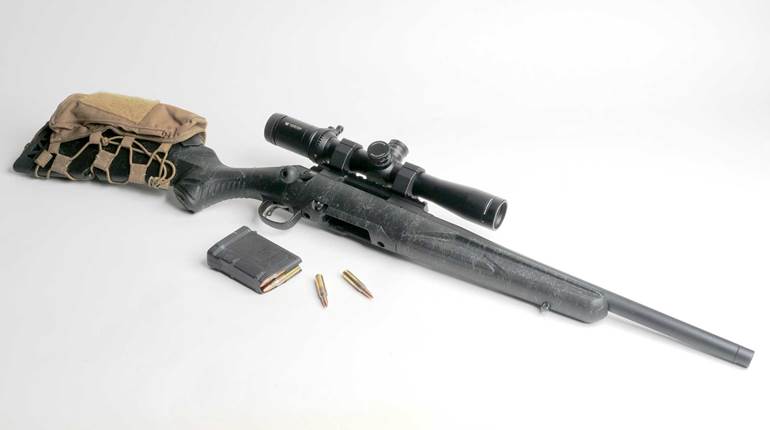
In the months following the Gunsite event, shooting results in the field and on the indoor range at NRA headquarters with more than one Scout rifle have born out the anecdotal evidence observed there—the little Ruger is handy, quick to the target and accurate. With an Aimpoint Micro T-1, Harris S BRM bipod, Bownells Latigo sling with Blackhawk steel swivels and full 10-round magazine—the little Ruger weighed in at 8 pounds, 8 ounces and was still a pleasure to carry and shoot. Throughout hundreds of rounds downrange, the rifles functioned flawlessly.
Assessments
Nearly 25 years ago, Col. Cooper penned these words: “The gunmakers will eventually discover the Scout Rifle, but don’t hold your breath waiting.” Today those who couldn’t bear to take his advice, or who have spent innumerable dollars trying to build their own scouts, can breathe a collective sigh of relief. According to Gurney, sales of the new gun are doing quite well. “Response has been outstanding.” he said. “Demand is beyond capacity, and we are building as many as we can every day.”
The question of whether the scout rifle platform represents a legitimate solution for the rifleman can ultimately be answered only on an individual basis, as it depends as much on an honest assessment of the shooter’s requirements and capabilities as it does on the qualities or characteristics of the rifle itself. The same individual test must be applied in evaluating Ruger’s suggestion that the new Gunsite Scout Rifle is “[T]he one rifle to have if you could only have one.”
From even a cursory study of Cooper’s writings, though, it is likely he would have appreciated the new Ruger for exactly what it is—a well-executed, reasonably affordable scout rifle from a major U.S. factory gunmaker. More importantly it is likely that the Ruger Gunsite Scout Rifle will earn a place among scout rifle aficionados and converts alike who will realize they no longer have to settle for anything else.
Manufacturer: Sturm, Ruger & Co., Inc.; (603) 865-2442; www.ruger.com
Caliber: .308 Win.
Action Type: bolt-action, repeating center-fire rifle
Receiver: investment cast 4140 steel; matte black finish
Barrel: 161⁄2" hammer forged 4140 steel; muzzle threaded 5/8"x24 t.p.i.; matte black finish
Rifling: six-groove, 1:10" right-hand twist
Magazine: 10-round (included) and five-round (available), semi-staggered, tapered column, steel detachable box
Sights: wing-protected, fixed post front; fully adjustable, wing-protected 0.90" aperture rear
Trigger: single-stage, 4-lb., 10-oz. pull
Stock: gray laminated wood with cut checkering, QD sling swivel studs; length of pull, 123⁄4" to 14¼"; drop at heel, 2"; drop at comb, 111⁄16"
Overall Length: 38" to 391⁄2"
Weight: 7 lbs.
Accessories: three buttstock spacers, receiver-mounting scope rings, Torx and Allen wrenches, owner’s manual
Suggested Retail Price: $995
Most Popular