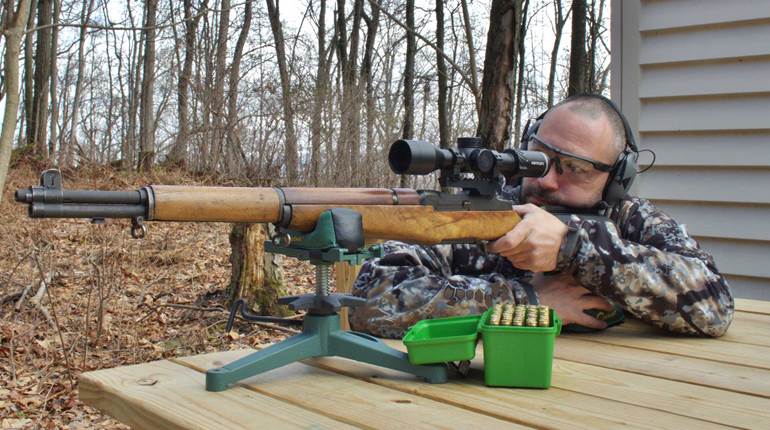
At the time of the M1 rifle’s adoption in 1936, the National Match Model 1903 Springfields reigned supreme on the rifle ranges. Critics of the new-fangled semi-automatic service rifle were convinced that it was not accurate enough to compete with the proven bolt-action match rifles. Some grudgingly admitted that the new rifle might be marginally accurate enough for service use but would never pass muster at Camp Perry and similar venues. As was the case on many other occasions, those who denigrated John Garand’s masterpiece were proven wrong.
While the M1 was designed to be a combat rifle, Garand always had its potential as a match rifle in the back of his mind. This was revealed in an article he authored titled “Grooming the Garand for Perry” in the September 1947 issue of The American Rifleman, in which he gave an interesting glimpse into his thoughts on the subject: “I am confident that [the M1 rifle] is potentially as accurate as any service rifle ever made, and that with the same care that has been bestowed on the 1903 National Match rifles in the past, it can be made to give long-range accuracy that will excel that of any other military arm.”
The demand for rifles during World War II precluded development of a match version of the M1, but this changed in the immediate post-war period. As related by Maj. Gen. Julian S. Hatcher: “The M1 made its postwar debut on the rifle range in the Marine Corps Pacific Division rifle match fired at Pearl Harbor in February, 1946. This was followed by other Marine Corps divisional matches … . These were followed by a similar series of Marine Corps matches in 1947 and 1948 and also by some Army Area matches; all of which gave some indications as to the future target possibilities of the Garand.”
The genesis of the true National Match Garand occurred in 1953 when the chief of ordnance directed Springfield Armory to select 800 M1 rifles for use in the National High Power Matches to be held at Camp Perry in the fall of that year. It is important to note that the regulations for these matches mandated that all rifles fired in the competition be “the service rifle as issued.” This precluded any significant modifications that would prevent the rifles in the matches from (theoretically) being used interchangeably with standard service rifles.
1953-1958 “Type 1” National Match M1 Rifle
The rather extensive modifications required for the M1s to “move to the next level” as competitive match rifles violated the regulations requiring the guns to be essentially indistinguishable from the standard service rifle. The first M1 National Match rifles have been dubbed “Type 1.” While unofficial terms, the various “Type” classifications of National Match M1s can be a useful method of denoting the different variations.
As the first Type 1 National Match rifles saw use at Camp Perry in 1953, Springfield Armory engineers were assigned to work as armorers and gunsmiths on the rifles so they could listen to the various suggestions and complaints heard from competitive shooters. The Armory took this information to heart when planning for the fabrication of the next batch of rifles for the 1954 National Matches.
Although the 1954 National Match M1 rifles were an improvement over those made the previous year, it was apparent from the various complaints heard at the ’54 matches that more care in the selection and fabrication of the rifles was necessary. To this end, the following inspections and fitting of parts for the 1955 National Match rifles were forthcoming:
-Barrels were inspected and their straightness was determined by air gauging -Bolts were selected that exhibited minimum headspace requirements
-Stocks and handguards were specially selected for grain and fit
-Lower bands were selected for tight fit
-Gas cylinders were specially selected for proper fit
-Rear sights were selected to avoid excess looseness or binding.
-Operating rods were chosen for proper fit
-Stocks were carefully selected with attention given to the straightness of the grain, density of the wood, lack of imperfections and proper fit to the receiver
-Trigger groups were selected for fit. The trigger pull was adjusted to eliminate excessive creep and to provide a crisp pull of between 4 pounds, 8 ounces and 6 pounds.
-After assembly, stock bearing points and trigger pull were rechecked
-Rifles were fired 40 rounds to test accuracy and general functioning
-Particular attention was given to the fit and overall appearance of the rifles
These points were over and above the standard assembly procedures and inspections performed on all M1 service rifles. Beginning in 1957, the National Board for the Promotion of Rifle Practice (NBPRP) began to relax the definition of what could and couldn’t be used on National Match rifles in order to remain in compliance with the “service rifle as issued” dictate. As stated by noted researcher Bob Seijas, “In 1958 the first of the special NM parts, a gas cylinder whose rear ring was reamed out to prevent contact with the barrel was included as a specification on newly constructed rifles. It proved to be the ‘nose of the camel in the tent’ and the beginning of the end of the ‘service rifle as issued.’”
In 1958 the NBPRP regulations not only permitted the gas cylinder to be modified, but the component could also be marked “NM.” Prior to this date, the only allowable NM marking on the rifles was on the barrel. Although Springfield Armory reamed out the gas cylinder rings, it is not believed that any were NM-marked in 1958. Since the 1958 NM rifles did not have any NM-marked parts (except for the barrels), they are still generally classified as Type 1 rifles. Most were later upgraded by the addition of newer pattern National Match parts, which makes examples remaining in their original 1953-1957 configuration scarce. Since those National Match rifles were fabricated from new production M1s, all exhibited the same features as service rifles made during that same period.
Except for recognizing the barrel inscribed “NM” between the rings of the gas cylinder, it can be quite difficult to positively identify a genuine unaltered Type 1 National Match from a standard M1 of the same era. Therefore documentation from the government—such as original bills of sale—are highly valued as they can confirm the originality of such rifles. Most of the unaltered original Type 1 NM rifles will exhibit the following characteristics:
-Springfield Armory manufacture
-Except for 1953-1955 production NM rifles, serial numbers will be between approximately 5,800,000 and 6,100,000. The earlier production examples (53-55) will have lower serial numbers, some in the 4.2 million range.
-Markings on right receiver leg: Drawing number, “6528287-SA;” Heat Lot, T 1 to T 10 - Z 5 to Z15
-Barrel: Marked “T” (targeted); “P” (proofed); “SA F6535448” (drawing number); Month and year of barrel production; Heat lot code, “m” (magnetic particle testing) and Defense Acceptance Stamp
-Bolt: “6522887-SA” (with heat lot code)
-Windage Knob: “DRC”
-Elevation Knob: “WCE”
It should be noted that the early production examples (1953-1955) may have different parts from those listed above. The NM rifles made in those years were unavailable to the public until December 1955, when about 50 were sold. The first significant sales of National Match M1 rifles began in 1956 via the Director of Civilian Marksmanship (DCM), and those are likely the only genuine NM rifles in private hands today.
The exact number of Type 1 National Match rifles made is unknown. There is a much-published chart purporting to give a breakdown of M1 National Match production from 1953 to 1963. Nonetheless, Seijas and other researchers have determined that the chart is woefully inaccurate, primarily because many rifles were double-counted. In other words, NM rifles made one year, and rebuilt in subsequent years, were listed as new production in the later years when they were simply “recycled” rifles. Using the flawed chart, it appeared that some 26,638 Type 1 NM rifles were made. In actuality, it has been determined that from 1953 through 1959 a total of 16,032 “new” National Match M1 rifles were produced. However, the bulk of those rifles was not sold. Analyses and calculations of the actual DCM sales figures for the various years indicate that the true number of Type 1 National Match rifles actually sold was less than 4,000.
1959 National Match M1 Rifles
While the approval by the NBPRP in 1958 of the gas cylinder with the reamed-out rear ring seemed to be a very minor allowable modification, it was indeed the “camel’s nose under the tent.” An increasing number of special NM parts were used on National Match rifles over the next five years. After relenting on the modified gas cylinder, the NBPRP permitted special windage knobs and bases for the 1959 National Matches. According to the updated regulations issued Dec. 15, 1958, “NM” should be stamped on the gas cylinder, rear sight base and rear sight windage knob assemblies. The rear sight aperture should be stamped “NM595” and the front sights stamped “NM062.” The latter indicated a smaller 0.0595-inch rear sight aperture and a narrower 0.062-inch-wide front sight blade, respectively. The special NM sights had been fabricated by Springfield Armory and could be used in competition as early as 1957 but had to be installed by the shooter. These sights were first used on new rifles built by Springfield Armory for the 1959 shooting season.
While these modifications helped the M1’s accuracy, one additional feature was desired for the M1 National Match rifle to further enhance its ability: glass-bedding the stocks. The 1959 NM rifle can be considered as something of a “transition” since it had a number of special NM-marked parts, but the stocks were not glass-bedded. Collectors typically differentiate the Type 1 from the Type 2 rifles in that the former did not have glass-bedded stocks while the latter did.
The increased accuracy requirements mandated for the NM M1 and the unrelenting pressure from competitive shooters resulted in the NBPRP finally dropping the fig leaf from the pretention that an ostensibly “as issued” service rifle could perform at the same level as highly modified competitive match rifles.
1960 “Type 2” National Match M1 Rifle
The relaxed specifications expanded the number of modifications incorporated into rifles assembled for the 1960 National Matches. As stated, the salient feature of these “Type 2” rifles, as compared to the Type 1 guns, was the glass-bedded stocks. While there was some variance, the following characteristics are indicative of Type 2 National Match M1 rifles:
Serial Number Range:
Type 2 National Match rifles were made from any serviceable receivers that Springfield had in stock. However, chiefly as a matter of pride, Springfield Armory primarily used receivers made by Springfield. Many of the Type 2 rifles assembled at the Armory were Type 1 rifles still in inventory that were upgraded by adding the latest “NM”-marked parts and glass-bedded stocks. Therefore, Type 2 National Match rifles can, conceivably, have receivers predating World War II to the latest receivers made (6.1 million serial-number range).
The following parts were marked “NM”:
-Gas cylinder (marked “NM” on underside of tang)
-Rear Sight Base (marked “NM” over ”062” on side)
-Front Sight (marked “NM” on side)
-Aperture (marked “NM” over “595” on shank)
-Windage Knob (marked “NM”)
-Barrel (marked “NM” between gas cylinder rings)
Type 2 National Match rifles also had the following identifying characteristics that distinguished them from later NM rifles:
-Glass bedded stock
-Last four digits of serial number marked in white in the barrel channel of stock and on the trigger housing
-Front handguard glued to lower band
-Operating rod not marked “NM”
-Sight aperture not hooded type
Barrels:
Barrels used on the Type 2 (1960) National Match rifles were standard service rifle barrels that were selected for close tolerances and measured by air gauging. Most were Springfield Armory (SA) barrels, but a few Line Material Co. (LMR) and Harrington & Richardson Arms Co. (HRA) barrels have been documented on genuine Type 2 NM Garands.
Beginning in 1959, National Match M1 barrels were required to be stamped with the prescribed annual identification code. The first example was a “Greek Cross.” The code marking used in 1960 was a diamond with flattened points and curved sides, somewhat resembling a four-pointed star. The barrels were also stamped “T” denoting they met targeting requirements and “P,” indicating they had been successfully proof-fired.
Bob Seijas compiled the following table of National Match M1 rifle production from 1958 to 1961:
YearNewRebuiltTotal
19581,295 7312,026
19592,8872,6525,539
1960 - 8,6638,663
1961 - 1,4101,410
There was a large increase in 1960’s numbers because the NM rifles on hand had to be upgraded to the new specifications. It would not be fair to give one competitor a 1960 rifle with all improvements while giving another an older, less accurate, model. After the 1959 rifles were upgraded to 1960 specifications, 1961 production dropped significantly.
1961 “Type 2” National Match M1 Rifle
The National Match M1 rifles made for the 1961 matches were very similar to the 1960 variant and differed mainly in the following:
-The operating rod was marked “NM” on handle and the drawing number “7790722-SA.” Later variations were made by Remington and marked “7790722-RA”
-1961 “triangle” annual code stamped in barrel date area
-Last four digits of the rifle’s serial number were marked on the floorplate
1962 “Type 2” National Match M1 Rifle
The most noticeable change from the 1961 rifles found on the 1962 guns was the addition of a hooded rear sight with a different diameter aperture. Special National Match barrels, drawing numbers “F7791035” and “F7791034” were approved for use in 1962 but there is no evidence any were used that year, and all known 1962 NM rifles were fitted with standard barrels.
Except for the barrel date, 1962 Type 2 National Match M1 rifles were essentially identical to the 1961 variant except for the following:
-Hooded aperture rear sight that permitted half clicks of elevation and marked “NM” on cylinder and “NM” on shank
-Rear sight base marked “NM/2” on side
-1962 Annual Star code “NM” marked barrel
It should be noted that this star annual code (stamped in the chamber area) was unrelated to earlier M1 NM barrels that had a star marking near the muzzle to denote stricter accuracy test.
1963 “Type 2” National Match M1 Rifle
The final variant of the M1 National Match Garand was the rifles made in 1963, after which assembly ceased. Circa 1967, the National Match rifle program, such as it was, shifted to Rock Island Arsenal.
As might be expected, the 1963 NM rifles were quite similar to the 1962 variety. The chief differences between the two variants were:
-The previously authorized, but heretofore unused, “F7791035” match barrels were fitted to the 1963 rifles. The only differences between these two types of barrels were minor variations in the dimensions of the bore and groove diameters. Barrels dated between “11-62” and “3-63” have been observed.
-The “star” code annual marking and “NM” designation were dropped on the 1963 rifles and only the standard T and P markings were present in addition to the standard markings found on all M1 barrels (drawing number, date, “m,” etc.). No “annual code” markings were applied.
-Rear sight base marked “NM/2A”
-The “7790722-R”A drawing number operating rods, marked “NM” on the handle
Otherwise, the 1963 NM rifles were essentially identical to the 1962 variety.
After 1963, M14 NM rifles were produced at the Armory and began to replace the M1 NM beginning with the 1964 National Matches. The number of National Match M14s made at Springfield Armory was far less than the number of M1 NM rifles made between 1953 and 1963.
It is interesting to note that for years there were ordnance armorers’ vans at most of the big competitive rifle matches, and a shooter could have his rifle repaired or even updated to the latest standards for a modest cost. This was how many NM rifles lost their originality. One of the only modifications that would not be performed was glass-bedding stocks because of the time involved.
After the suspension of National Match M1 rifle sales in 1973, the remaining rifles in the government’s inventory were disposed of. Research indicates that 3,564 were disassembled. Additionally, the government of Greece was given a large number of M1 and M1C rifles, along with 5,677 National Match Garands. Apparently, the Greeks considered these as service rifles and most had the special National Match sights replaced by standard sights.
There have been many M1 rifles “worked over” to incorporate numerous types of modifications designed to improve accuracy and used in various competitive shooting venues. However, the term “National Match” is properly restricted to those rifles emanating from Springfield Armory from circa 1953 to 1963. These rifles proved to be capable of excellent performance at the highest levels of competition for many years. John Garand’s prediction years earlier that “in years to come the Garand rifle will take its place as a superbly accurate match rifle” eventually proved to be most prescient.
Most Popular