Without trying very hard, you can start a dandy argument about U.S. Army marksmanship training. The sub-genres include 7.62 versus 5.56, and M14 versus M4/M16. But let’s put aside the hardware for a moment and focus on the most immediate concern: how the Army trains soldiers for infantry combat.
Until recently the infantryman’s primary weapon was a radio connected to an artillery battery, a helicopter gunship or an A-10 Warthog. But in today’s asymmetric warfare, traditional American advantages, such as artillery and air power, have largely been negated. The majority of combat-related casualties are caused by explosives rather than small arms, but in direct combat, riflery matters as never before.
Americans rarely lose rifle fights. It occurs so seldom that it’s considered remarkable. But it can happen. Probably the most-publicized combat action in recent years was the prolonged shootout at Wanat, Afghanistan, in 2008. Seventy-two U.S. and Afghan soldiers were almost overrun by Taliban fighters. After the four-hour battle, 36 of the 48 G.I.s were either killed or wounded versus an unknown number of enemy casualties.
Numerous rifle malfunctions occurred at Wanat, the causes reportedly including worn-out M4s and sustained firing. Nonetheless, soldiers involved in the after-action assessment found the greatest problem was a poorly sited outpost that permitted hostiles to infiltrate the position and launch a surprise attack. Beyond that, observers cited inadequate arms maintenance and faulty magazines. Only air power rectified the grievous situation.
The Army has seldom placed a high priority on small-arms proficiency. In Vietnam, figures sometimes ran 50,000 rounds per enemy killed, but the nature of that war often precluded precise aiming and firing. Widespread suppressive fire ran the round count through the roof, and there were almost no rifle fights in Desert Storm. Consequently, in 2001 the Army entered Afghanistan poorly prepared for long-range engagements against dedicated enemies with a tradition of shooting.
The Army’s default setting is high-volume firepower from infantry arms. Yet most combat-experienced marksmen disapprove of the three-shot burst option, let alone full-automatic fire. Jim Coxen, a Vietnam rifleman and cofounder of Oregon IPSC said, “I would have done at least as well with a scout rifle. You can never train everybody well enough to handle full auto, and you won’t always have enough training time or ammo anyway. It’s a really bad idea.”
Even with competent riflemen, long-range engagements very seldom equal the sniper’s “one shot, one kill” mantra. Clint Smith, proprietor of Thunder Ranch, has trained special operations personnel for decades. He said, “Even with good riflemen, first round hits beyond 400 yards probably drop off about 50 percent for each hundred yards.” That figure tracks with observations from other highly experienced instructors such as John Pepper. A Korean War infantry veteran and inventor of the Pepper Popper target, he said, “In combat, maybe one soldier in 10 will look at his sights and control the trigger.”
The American military usually does an adequate job of teaching marksmanship to large numbers of people. It does less well in teaching large numbers to fight with rifles. Consider no less an authority than Maj. Gen. Merritt Edson, USMC, a Distinguished Rifleman who was awarded the Medal of Honor for his actions on Guadalcanal. He later became executive director of NRA, and during the Korean War he said that the military could not be expected to teach lifesaving marksmanship skills to every soldier or Marine. His advice: If parents wanted their son to have the best chance to survive combat, see that he learns to shoot a rifle as a boy.
History was on Edson’s side. Many of America’s infantry heroes grew up shooting: Alvin York, Sam Woodfill and Audie Murphy to name a few. But in 1940, 43 percent of Americans lived in rural areas. Today it’s about half as much, with attendant diminished civilian marksmanship skills. We no longer have large numbers of recruits arriving with gun handling skills or a basic knowledge of ballistics, let alone marksmanship.
Part of the problem is confusing qualification with training. Decades passed before most police departments made the distinction—often as the result of painful litigation. According to the Army standards and training manual, PAM 350-38 (2009 version), a Regular Army light infantryman should fire about 1,200 rounds a year, assuming he participates in everything: basic marksmanship, day-night qualification, unit live-fire exercises, shooting in NBC gear, thermal and infrared (IR) sights, etc. His Guard and Reserve colleague should expend 660 rounds. But interviews show that almost nobody comes remotely close to that figure. Furthermore, for “plain vanilla” soldiers with access to shooting simulators, and who do not use thermal or IR sights, the specified annual expenditure is 490 rounds for active and 294 for Guard and Reserve.
The manual states that 90 percent of Regular Army personnel assigned a rifle should meet the qualification standards twice a year with primary sight and optics, while only 80 percent of Guard and Reserve will qualify annually. However, the reserve component’s figure remains merely a goal. A National Guard officer said, “We’re supposed to qualify annually but at best only about two-thirds of our people even do that. The others are rescheduled or do not qualify that year.”
It’s especially difficult for National Guard units to meet all training requirements. Retired SFC Derrick Martin is a Double Distinguished Marksman responsible for Arizona National Guard range development. He said, “We have 48 days a year to do everything we’re supposed to do while Big Army has 365 days. It’s just not possible.”
Reservists frequently note that working with “Big Army” is difficult and frustrating—there just aren’t enough facilities to support the entire force structure, and there are always turf wars. That’s why so many states are funding additional ranges, “so we don’t have to go begging to [those] in control of everything.”
The problem is systemic, as noted by Maj. Thomas Ehrhart’s 2009 study, “Taking Back the Infantry’s Half Kilometer.” Ehrhart wrote that the U.S. Army dropped long-range riflery as a primary skill in 1958, deep into the Cold War. Engagement out to 600 meters was replaced by “trainfire,” which emphasized 50 to 300 meters. Ehrhart argued, “While the infantryman is ideally suited for combat in Afghanistan, his current weapons, doctrine, and marksmanship training do not provide a precise, lethal fire capability to 500 meters and are therefore inappropriate.”
In 2010, California National Guard S/Sgt. Jeffrey Wall wrote an influential paper for Small Wars Journal. “A Rifleman’s War” immediately caught the attention of marksmen everywhere. A Distinguished pistol shot and former Marine officer, Wall is intimately involved in Army marksmanship training. He notes that 52 percent of Afghan firefights begin at 500 meters or more, placing a premium on skilled riflemen—especially when supporting arms are limited by rules of engagement.
Wall writes of pre-deployment training, “We are most frequently given one day to present Preliminary Marksmanship Instruction and four or five days on the ranges for all weapons, with one day on the rifle range. According to First Army standards we are to—ideally—train a rifleman going to war with 58 rounds of ammunition— 18 to zero and 40 to qualify on the ‘pop-up target range’.”
The problem is only aggravated by a shortage of facilities or ammunition. In 2005 at Fort Sill, Okla., a deploying helicopter company was unable to qualify with most arms. Said former Warrant Officer Dave Long, “We didn’t have enough pistol ammunition, so we ran around with our Berettas, going ‘bang-bang.’ Although we’re an aviation unit, we had to train for convoy escort but there was no training ammo for the .50 calibers or Mark 19 grenade launchers. So we did like Sgt. Rock, going ‘budda-budda.’ It was laughable and pointless.”
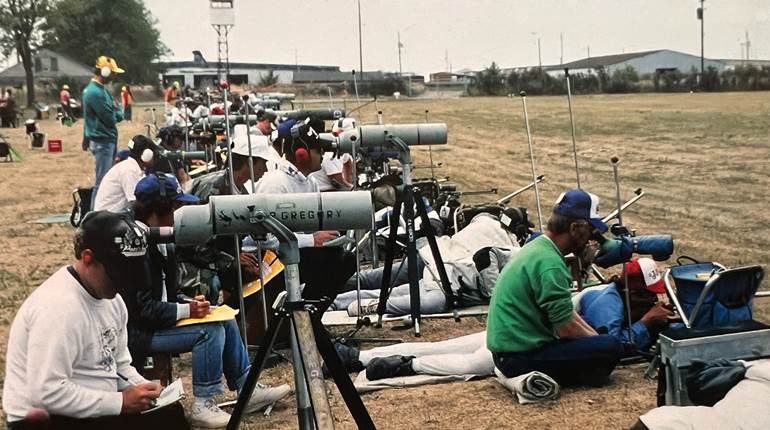
Since the armed forces seldom do an adequate job of teaching people to fight with rifles, the civilian sector becomes more important. After all, that’s why NRA was founded in 1871, and after World War II the association received thanks for its training contributions from President Truman, Gen. Eisenhower and members of the Joint Chiefs. Today, elite forces such as airborne, rangers, SEALs and Marine recon make good use of civilian training schools and instructors, and we need to recall that most advancements in firearm training (and often in design) come from the private sector.
Military personnel sometimes attend club events just so they can shoot military-type arms. In 2005 an Arizona police instructor provided three days of pro-bono small-arms training to a Marine helicopter pilot bound for combat. The aviator had not fired a hand-held small arm in two years.
Seth Nadel is an NRA Patron member, retired federal agent and competitive shooter. He recalled, “At one of our club’s machine gun events, two Army guys showed up to shoot a privately owned M60. Seems they could not get enough time to shoot on duty. They got more trigger time in that one day than they had in the previous few years.”
Despite the problems, the Army does take note, albeit slowly. In 2008 a pilot program began at Fort Benning, Ga., to improve basic knowledge and skills. One colonel said, “Twenty-three hits out of 40 isn’t too good. People train for the test but we need to train them to shoot.”
Instead of issuing one round for each possible target, trainers want to issue more rounds than targets. Some pop-up targets are programmed to fall only after two or three hits, like people. Troops should be taught to stay on the sights until the threat is defeated: “Shoot until the world looks flat.” Other aspects of the program include firing from unusual positions, behind cover, and changing magazines as needed rather than when the range officer says to. Additionally, planned malfunctions occur by placing dummy rounds in each magazine.
Whatever it’s called, the current war with radical Islam will not end anytime soon. From the beginning, the war on terror has been a rifle fight writ large, and that fact is not about to change.
Currently the main combat arena is Afghanistan, with two constants: it’s high and it’s steep. The median elevation in central Afghanistan is 6,000 feet, and anyone who’s been there knows that it’s uphill in every direction. But few training facilities permit troops to shoot long range at severe angles.
Derrick Martin, an Iraq veteran, noted that in combat there’s no such thing as a perfect rifle-range position. “You’re loaded down with a helmet, vest and web gear; you’re hot and tired and scared. You’re not going to make very many perfect squeezes. So you need to know what looks and feels good and what doesn’t. We can teach you that, but we need to do it a lot more than once or twice a year.”
The Designated Marksman (DM) program is generally judged a success, assigning a specially trained rifleman to each infantry squad (for more on the U.S. Army Marksmanship Unit’s DM training, go to www.americanrifleman.org/usamu). The DM carries a modified M16/M4 with optical sight or perhaps an M14. (“We have 20-year-old soldiers shooting 50-year-old rifles.”) The DM fills the ballistic/tactical gap from 300 to 600 meters, where snipers take over. However, the potential trouble is in numbers: three DMs in a platoon might not offset 10 or 20 mujaheddin with belt-fed weapons and mortars on the high ground. It would be much better if more ordinary riflemen knew how to hit at 500 meters.
Obviously it’s high time to prepare the troops for the next rifle fight. But what’s the solution? First, acknowledge that very few people enlist to shoot. Far more are attracted by career prospects and benefits—the Army website says almost nothing about war fighting. (The pull-down menu emphasizes jobs and benefits, while “Being a Soldier” cites musicians and health care providers.)
Secondly, recognize that raising tens of thousands of soldiers to an NRA standard of civilian marksmanship is impossible. Even assuming the institutional willingness—a huge assumption—the Big Army lacks the resources.
Therefore, thirdly: let the shooters shoot. Allow unit commanders to devote extra range time to soldiers with the desire to become as proficient as possible. In combat, they can take the time to hold, aim and squeeze while their friends lay down area fire or at least make noise. The two concepts are not necessarily contradictory.
To summarize: The overall standard of Army marksmanship can be raised by quality, not quantity. The army recruits about 80,000 people a year, so let a few hundred with the interest and ability do most of the shooting. In some remote, desolate battlefield, a few good riflemen can mean the difference between life and death.
Most Popular