The majority of the enduring M1911 pistols generally fall into one of three different style and size variations-full-size, or standard; mid-length, or Commander-style; and compact, with barrel and grip both shortened. Some of the exceptions to that rule show custom gunsmithing at its very best and serve their owners well. But for every accessorized and accurized, special-purpose, limited-use M1911 pistol made in a custom shop, there are 1,000 coming from a factory. We can, therefore, conclude that the majority of American handgunners use stock M1911 pistols, and it’s up to the many makers to fill the special feature demands right out of the factory.
Nobody does it better than Kimber, as its extensive catalog lists no less than 16 different families of M1911 guns. Some of the Kimber M1911 families have as many as a half-dozen members. The effort is obviously to offer the American handgunner every possible combination of features and at a variety of price points. Here, we’ll look at the newest family, dubbed the “Master Carry” series. Master Carry M1911s are an upscale trio of well-equipped defensive pistols bearing the Kimber script logo along the left sides of their slides. The appointments are very similar on all three variations.
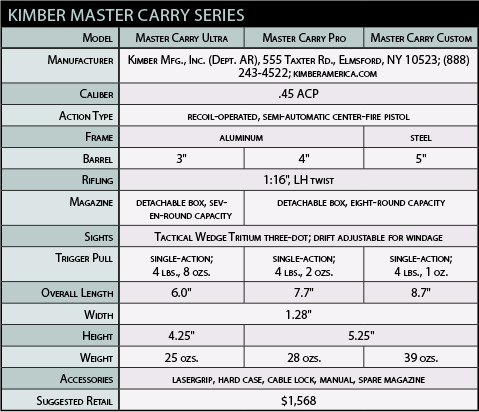
Regardless of their maker or origin, most M1911s are the original full-size pistols as first built at the Colt factory and the Springfield Armory before World War I. Through the years, this has been the most commonly manufactured-by wartime contractors and post-World War II entrepreneurs-version of the G.I. gun. Although determined shooters have done it, the big 39-oz., 5-inch barreled-service pistol is hard to hide. In an open holster, the gun has no peer as a serious fighting handgun. But the demand for a lighter, shorter version of the Government Model dates to the mid-1950s and has been answered by just about everybody in the M1911 business. Usually, they have 4 inch to 4 ¼-inch barrels, shortened slides and lightweight receivers. Such guns are far easier to carry than the full-size models, but not quite as easy as the third variant. That’s the Government Model snubby, a 3 inch to 3 ½ inch, short-butt, light-receiver .45 ACP hideout. Kimber’s Master Carry family has a gun in each of these sizes. They are called the Master Carry Custom with a 5-inch barrel and Master Carry Pro with a 4-inch barrel and shortened slide assembly. Finally, the shortest of the lot is the 3-inch Master Carry Ultra.
Even a casual glance at the three guns laid out on a desktop shows an obvious family resemblance. Nonetheless, each is uniquely designed to fill a specific role. Let’s first look at what is alike in the Master Carry family and progress to the individual members. Color is the most immediately noticeable feature. It’s a dull black for the slide and a non-reflective silver finish for other parts. Nothing flashy here, just a basic businesslike finish that wears well through the years. Meprolight sights with tritium highlights are found on all three pistols. Kimber calls these sights a Tactical Wedge design, since they have the currently popular downward sloping contour. All three guns use a guide rod to support the recoil spring. Controls on all three guns are alike, with the same elongated ring hammer, medium skeletonized trigger, beavertail safety and extended thumb safety. The lower rear corner of the butt gets a radical rounding-off treatment that really looks good. Kimber’s marketing people must have had tongue in cheek when they named this feature-the RoundHeel. It’s far better than some, which appear to have been band-sawed to final contour.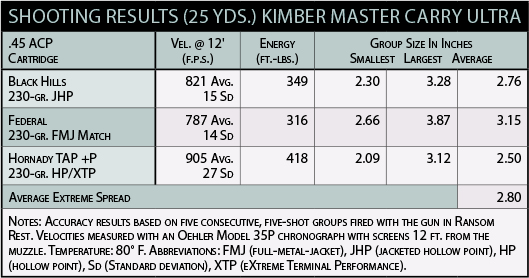
Master Carry stocks deserve a mention. They are Crimson Trace Lasergrips, made in a special version to fit the RoundHeel shape. It’s interesting to note how these popular grips have evolved during the last few years. There is a visible red laser at the top edge of the right panel. It sends a beam of light alongside the right side of the frame, and it appears to the shooter as a red dot on the target. The side panels are made of G10, a glass epoxy laminate, with an outer contact surface of unique checkering and serrations that really anchor the pistol in the shooter’s hand. Powered by two nickel-size No. 2032 batteries under the left side, they have a system power switch, also on the lower left. The two stock panels are connected by a band of rubbery material that runs atop the pistol’s frontstrap. Imbedded in the connecting bridge, the shooter finds a laser activation switch-right under the base of his middle finger. Firm pressure turns the laser on, and its a system that lots of new handgunners are finding beneficial.
With this quick survey of the common features of all members of the family, it’s time to look closely at each gun and, hopefully, see them in the context of their individual tactical roles.
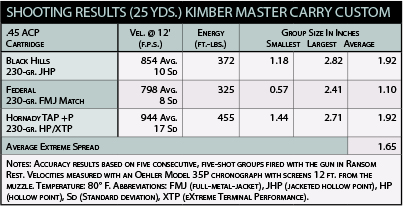
First, consider the Master Carry Custom. This is the current Kimber rendering of the full-size classic pistol that armed America for most of the 20th Century. At a full 39 ozs. (it’s all-steel, after all) and measuring 8.7 inches by 5.25 inches, the Custom will not likely be seen in many coat pockets. In proper holsters, the gun might be right at home and can be carried concealed. For the most part, this full-weight .45 ACP is made for open carry, action-shooting competitions and home defense. The weight helps in taming recoil. Unlike the other two guns in the series, the Custom has forward cocking serrations on its slide. It is a modern rendering of the G.I. pistol.
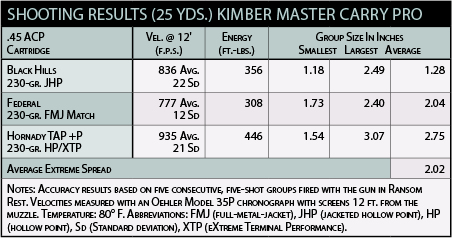 Some references suggest that a shorter version of the Government Model pistol was considered at Colt in the immediate pre-World War II era, but such a gun did not materialize until the mid-1950s. Today, any maker who comes up with a version of the original Government Model follows it quickly with a short version. The gun is a staple of the M1911 product line, and most versions have light receivers. So it is with Kimber’s Master Carry Pro, which has a barrel/slide unit a full inch shorter than the Custom’s, as well as an aluminum alloy frame. It shoots as well as the longer, heavier gun and handles almost as well. At 7.7 inches by 5.25 inches and weighing 28 ozs., it is short enough to easily carry, and the weight saving is dramatic. This style of .45 has been called the professional’s choice, because it does almost as much downrange as the big gun, but is far easier to conceal, carry and deploy.
There are plenty of good reasons for the Master Carry Ultra. This is the mini-gun in the family, and there is a continuing strong demand for it. Kimber takes an inch off the Pro’s barrel/slide top end and another from the receiver. The result is a short, light .45 pistol that weighs just 25 ozs. It is much easier to carry habitually than either of the other Master Carry models. That has more significance than most people realize. The more onerous the carrying becomes, the less likely most shooters will be to do it. As M1911-style .45s go, the Ultra is fairly easy to carry. Good holsters help a great deal, but the weight of the gun is still the most decisive factor in taking the gun along when you leave home. I must note that the rounding of the butt is less pronounced on the Ultra, because there is less mass on the short butt to be removed.
If this three-size-large, medium, small-rationale is to be accepted, the three pistols in the Kimber Master Carry family are great choices. When you dig deeper into the handling characteristics and overall performance of the three guns, it is apparent that they fill three different roles. A trip to the range with an assortment of service ammunition begins to tell the story.
 Looking first at the problem of recoil, I made some interesting observations. When switching from a standard velocity load to a +P (in the same bullet weight), recoil becomes exponentially easier to manage as the size and weight of the gun increases. The same thing occurs if you use an increasing variety of bullet weights. If you are simply attempting to choose a load for defensive shooting, you are facing a daunting task, particularly when ammunition is so costly these days. I personally believe that attempting to gain a performance advantage with more velocity in a short-barreled .45 pistol will not be productive. I would pick a 230-gr. load that I like and stick with it.
The guns did their part very well. The full-size Custom had the weight to soak up a lot of the bump of most 230-gr. loads. Fast pairs were fairly easy to execute. At the other end of the line, the little Ultra was harder to shoot with speed. It wanted to bounce off target and required a strong Weaver stance to control. Split times suffered accordingly. Not surprisingly, the compromise middle gun-the Master Carry Pro-was much easier to manage than the Ultra. Most of this function and familiarization shooting was done with a wide assortment of ammunition of different bullet weights and brands ranging from partial boxes to most of my .45 ACP leftovers from other projects.
 That was a completely different project from the accuracy testing, because I fired all three pistols in the Ransom Rest, where recoil does not enter into the equation. Using three different commercial loads from three domestic ammunition makers, I worked my way through the American Rifleman protocol of five consecutive, five-shot groups. How about a bottom line first? The average group size for all three pistols was 2.15 inches, but the Ultra averaged 2.80 inches, the Pro was 2.02 inches and the Custom was 1.65 inches. That is excellent performance. I had one malfunction, a failure to chamber, but traced it to an aftermarket magazine of dubious pedigree that somehow got mixed into the cycle. Using Kimber’s magazines produced flawless functioning. After the shoot, I fired a few more rounds with Wilson, Colt and McCormick magazines and had no malfunctions.
In the Master Carry family, Kimber offers a trio of properly performing defensive pistols that let the buyer choose a size and weight option to suit his need. If he has more than one need, Kimber will be delighted to sell him more than just one of the Master Carry series, like the Custom and the Ultra. Or maybe you could settle for the gun in the middle, the Pro. That is an all-around gun that is hard to beat.