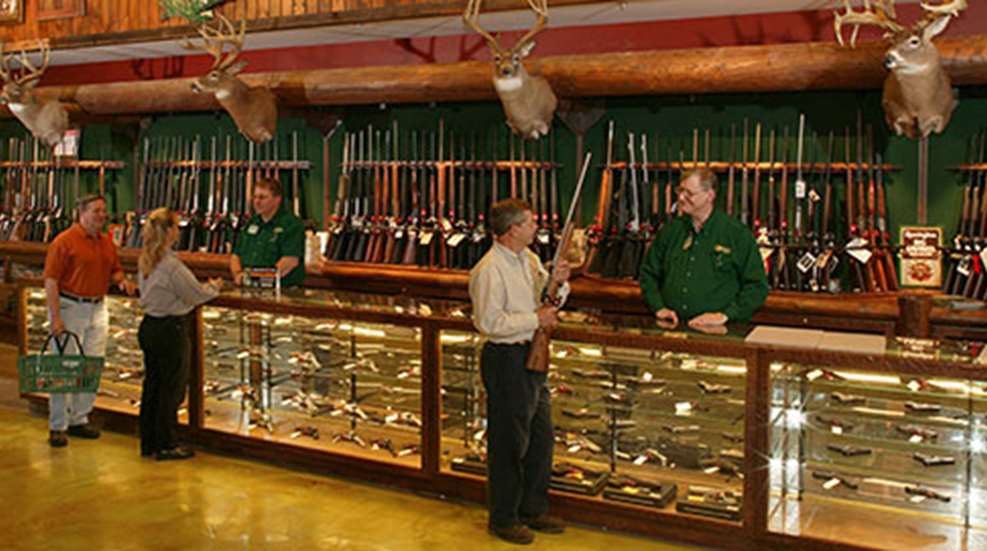
Photo Courtesy of Bass Pro Shops
Most gun salesmen spend their time in front of racks of guns. Not Chad Seaverns. He spends his days in a virtual mall. As the chief operating officer of the National Firearms Dealer Network (NFDN) he believes he has a good part of your gun-buying future in his hands.
Sure, Seaverns knows that a survey conducted by the National Shooting Sports Foundation (NSSF) found that only 13 percent of gun sales were started online in 2011. But he sees that as a fine beginning, saying the 87 percent represents raw potential. NFDN looks at the dynamic marketplace fueled by record gun sales and a growing number of gun owners (more than 100 million in the United States) with optimism and predicts tremendous growth online.
“A lot of people don’t know about all the deals out there and new buying options for firearms and related products,” says Seaverns. “Our company can help them find those deals through live-streaming technology.”
When you log onto nfdmall.com storefronts appear on your computer’s screen-digital street signs for Beretta, Mossberg, Smith & Wesson and many other gunmakers. You’ll be able to shop by company or firearm type. You can just go right in with a few clicks to check out whatever you’re after. As you do you’ll cleanly view competing products and see technical information that’ll make you an educated consumer.
Of course you can’t walk out of a virtual mall with a gun. Your order will be sent to a nearby gun dealer that has a Federal Firearms License (FFL). You can then go right into the gun shop of your choosing and complete your purchase-after going through a background check, of course.
The local gun store won’t mind, either, because it gets the sale. It simply pays NFDN a monthly fee for the service. NFDN provides the gun shop with a website template that it can modify and control. The store can even upload more products and name its own prices. Basically, NFDN is a central hub that sends your searches into the deep databases of the four largest distributors. When you choose a product-a gun, riflescope or whatever-you click “Buy Now” and then choose where you want to physically purchase your product. As you do that you are seamlessly transferred to a website maintained by a local gun shop or sporting goods retailer.
A great benefit of the system is that you can find almost anything real-time in the distributors’ warehouses. Your local gun shop might not have a magazine for your SIG Sauer P938, but NFDN’s real-time link to the distributors’ databases will likely turn up whatever you’re after. You can even compare prices by using NFDN’s site to check the websites of your local gun stores.
That’s just the beginning of why Seaverns thinks he has a bead on the future of gun sales at nfdmall.com. Maybe you’ve seen some of your local gun shops go bust. Maybe you’ve lamented that those independent little stores with the gun guru behind the counter are being beat-out by the big-box stores and destination retailers. Maybe you still go to a local gun shop when you can because the service is so good and because you know that the guys or gals behind the counter know their guns. Well, NFDN works exclusively with those types of stores.
“We encourage the stores we work with to have a kiosk in the store so they can help customers look up and order anything they don’t have in stock,” says Seaverns. “Most products will be delivered within a few days.”
NFDN has already signed up more than 560 local stores and is growing. As it expands, NFDN is helping to level the playing field for local sporting goods stores. This isn’t to say that one type of store is better than another, but rather that more competition-choices for you-is a good thing.
All this makes NFDN different from businesses such as gunbroker.com and other online gun-auction sites, but it doesn’t displace the important niche such sites have established. Gunbroker.com links buyers and sellers and uses local licensed firearm dealers as transfer agents (stores with FFLs typically charge between $20 and $50 to do a background check and, if approved, transfer a firearm). At auction sites you have the tools to locate hard-to-find used guns and to possibly get deals. Though it should be noted that even gunbroker.com is hard to categorize in this evolving marketplace, as it isn’t just a gun-auction site. It also offers hunting gear, collectibles and other goods.
At press time gunbroker.com had many more receiving FFLs listed than did NFDN, but the latter is a young and growing company so that’s to be expected.
There are, of course, other online players in the market. Gunsamerica.com, for example, calls itself the “Largest online gun classifieds since 1997.” It says it is dealing with so much change in the marketplace that it placed a disclaimer on the website that reads, “[P]lease don’t be alarmed or get too miffed at us if you see something you do not like or notice something is not working properly. All you need to do is contact customer service and let us know.” That’s a sign that a company is trying to keep up with the competition in an evolving marketplace-again, that’s good for you.
A downside to buying used firearms from private sellers, of course, is that some deals are too good to be true. Online businesses that link buyers and private sellers through an FFL mostly have good reputations and tools for consumers to use to avoid being taken, but you do have to be careful.
NFDN doesn’t have that problem, as consumers using nfdmall.com are actually buying new goods from local gun shops or sporting goods stores. That’s not to say one buying option is better than the other, but simply that there are more options than ever. Speaking of choices, the brick-and-mortar stores haven’t been idle. There is a lot more to this story on the changing marketplace of gun sales.
The Big-Store Expansion
At the end of 2013, Cabela’s had 50 stores and plans to open 13 more in 2014. Bass Pro Shops had 59 stores and plans to open about a half dozen more in 2014. At press time Bass Pro’s latest store opening was a 104,000-sq.-ft. store in Round Rock, Texas-the second fastest growing city in 2012, according to the U.S. Census Bureau. This is Bass Pros’ seventh store in Texas. The company estimated that 116 million people would visit its 77 stores (including Tracker Marine Centers) across America and Canada in 2013-about 40 million more than attend Major League Baseball games during a typical year.
To attain such growth Cabela’s and Bass Pro Shops have turned their retail stores into attractions that bring the outdoors inside with top-quality taxidermy, aquariums stocked with monster bass, indoor mountains and archery ranges. Currently, the largest Cabela’s retail facility is in Hamburg, Pa. It has more than 250,000 sq.-ft. of floor space. Bass Pro says its average customer stays two and a half hours and drives an average distance of 50-plus miles. Cabela’s has similar statistics.
In fact, Ralph Castner, Cabela’s chief financial officer, says, “A lot of people drive 100 miles or more to go to our stores. We’re expanding to make their drives shorter and to reach new customers. They come a long way because we offer deals on gear, large firearm selections and because our stores host a lot of events and attractions.”
Cabela’s is a publicly traded corporation trading under “CAB.” Cabela’s founders, Dick and Mary Cabela and Dick’s brother, James Cabela, began Cabela’s in 1961 and took the company public in 2004. About half of Cabela’s sales come from hunting-related merchandise with about a third coming from the sale of firearms, ammunition and accessories in 2012. Also, in 2012 about 30 percent of Cabela’s revenue came from catalogs that have long been goody lists for sportsmen.
Bass Pro Shops is a privately owned corporation. In 1971, Johnny Morris rented a U-Haul trailer and took off across the country filling it with the newest premium fishing tackle he could find. When he returned to Springfield, Mo., he set up shop in his father’s liquor store, which was located on the way to Table Rock Lake. The site of the original Bass Pro store in Springfield now brings in more than 4 million visitors annually and is the state’s top tourist attraction.
As both companies expand, they’re moving to regions where consumers want them-not necessarily to places most would think of as synonymous with outdoor recreation. For example, Bass Pro’s store in Rancho Cucamonga, Calif., is just over an hour’s ride from Santa Monica, a bastion of anti-gun rallies and restaurants that cater to vegans. This 180,000-sq.-ft. store sells firearms, predator calls, the latest camouflage and other products most people don’t think of when California comes to mind; nevertheless, the hunters and gun owners are there and can grab an NRA flier by the door and order “Hunter on Fire” (a chicken sandwich with spicy buffalo sauce) from Uncle Buck’s Fishbowl & Grill on site.
Cabela’s opened a store in East Hartford, Conn., in 2007 and plans to open a store in Berlin, Mass., in 2015. Meanwhile, Bass Pro is planning to open a 200,000-sq.-ft. Bass Pro Shops Outdoor World in Sayreville, New Jersey, just off the Garden State Parkway. That there are enough sportsmen and gun owners to support mega-stores with firearms and many other products in these “blue states” shouldn’t surprise many hunters and gun owners, but it can be a shock to urban anti-gun elites. Regardless, these stores offer events, gun-training courses and more.
Cabela’s and Bass Pro Shops, of course, are hardly the only players in the market for your gun dollars. Other big chain stores have taxidermy, often have gunsmiths on the premises and hold classes that teach gun safety, handling and more. Dick’s Sporting Goods, Inc., for example, is a Fortune 500 American corporation that trades on the market under the stock ticker “DKS.” It was founded in 1948 when then 18-year-old Dick Stack quit an Army surplus store in Binghamton, N.Y., after the store owner mocked his ideas for stocking fishing tackle. Dick started a tackle store with $300 from his grandmother. Dick’s now has more than 450 stores in 42 states.
Gander Mountain, headquartered in St. Paul, Minn., currently has 119 stores in 23 states. It began as a catalog-based retailer in Wilmot, Wis., but sold its mail-order business to Cabela’s in 1996. Formerly traded on NASDAQ, Gander Mountain was turned into a private company under the majority ownership of David Pratt and the Erickson family.
Then there’s Sportsman’s Warehouse, an outdoor sporting goods retailer that operates 47 stores in 18 states. Sportsman’s Warehouse calls itself “America’s Premier Outfitter.” To interact with its customers Sportsman’s Warehouse offers concealed-carry classes and more. (Go to sportsmanswarehouse.com/events to see what they’re up to in your neighborhood.)
All these competing chains and more are expanding and trying to grab a piece of the hot and growing gun market. According to the research firm Southwick Associates, Inc., ammunition sales were up 15 percent from 2011 to 2012, shooting accessories were up 30 percent and the share of rifle sales chambered in .223 Rem. was up 14 percent (in 2012 one in five rifles sold was chambered in .223 Rem.). Of course ammunition, especially .22 Long Rifle, .223 Rem. and 9 mm Luger, has been in such high demand during the past few years that there have been wide and prolonged shortages across the country. Gun sales have generally been going up every year since 2000, surged in 2008 (just before President Barack Obama was elected), and haven’t fallen off since.
“The biggest change I see this year is that people in their twenties and thirties have become a bigger part of the market,” says Rob Southwick of Southwick Associates, Inc. “Those in this demographic are now buying rifles-especially modern sporting rifles-and they’re shooting for fun.”
Scott Blackwell, president of Freedom Group, an American firearm manufacturer holding company that includes Remington, Bushmaster and DPMS, notes that they sell their firearms with standard pricing that doesn’t give the larger stores an advantage over smaller retailers. He says, “It’s an increasingly diverse marketplace and that’s good for those buying guns and for us. Last year Wal-Mart sent a flier to millions of households that advertised Remington guns. Meanwhile, larger retailers have deep inventories, but the small and medium-size gun stores have a knowledge base that’s hard for the big stores to compete with. This increasingly diverse marketplace is good for America’s gun owners and our American-made products.”
Local Firearm Superstores
New online options and destination stores get most of the national attention, but there’s something else taking place in the center of the market, without which this article would have a hole. Some regional stores have been growing even as they keep their local appeal.
Gat Guns in Dundee, Ill., located about an hour and half west of Chicago, for example, has expanded several times since first opening in 1979. After a recent expansion it now has 63 shooting positions. Greg Torino, owner of Gat Guns, says, “We’re excited and are big supporters of the NRA. We’re the 50th state to win our right to carry concealed. This is a boon to freedom and to our bottom line.”
Randy Potter, Gat Guns’ store manager, says, “Ten years ago we had two women working behind the counter. We now have nine. We have women-only classes taught by a lady who is an International Practical Shooting Confederation shooter. We’ve also opened up our aisles, added more lights, put in granite counter tops and more. We’re catering more and more to suburban moms and dads. We now rent 160 firearm types and have instructors available for anyone who needs them.
“Over the last few decades our consumers have changed and we’ve changed with them,” said Potter. “I just sold an AR-15 to a guy who has hunted all his life but now wants a rifle for home defense. We used to get mostly hunters. Now we also get a lot of women and young men who want to shoot recreationally and to defend themselves.”
Another must-visit regional store is Bill’s Gun Shop and Range, which has two locations in Minnesota (Robbinsdale and Circle Pines) and one in Hudson, Wis.-each location has 64 lanes in its range and rents guns. Owner John Monson says, “Guns are still selling, but sales have eased off a bit. For a while it was challenging just to keep guns and ammo in stock. We’re fully stocked now. We have ranges at all our stores, host a ladies night every Wednesday and cherish our customers here in Minnesota and Wisconsin. I could sell more guns and certainly more ammo online, but I don’t want to do that. I serve the customers who come to our stores.”
Other regional gun stores are also earning their customers. In Ashland, Va., there’s Green Top, a 55,000-sq.-ft. gun store that’s a local landmark. Then there’s ATP Guns in Summerville, S.C., a store that says it is “The Most Lady-Friendly Gun Shop this Side of the Mason-Dixon Line.” They have a “Ladies Night” every Tuesday and Thursday and explain that these training sessions are designed for “ladies that have never shot a gun” or who were “trained incorrectly… .”
Many store owners realize that there are now more than 5 million women participating in the shooting sports, an increase of 46.5 percent since 2001. In fact, those independent gun stores sold 43 percent of the handguns sold in 2011, according to a report by the NSSF.
This is the kind of thinking and expertise that is winning new customers in the growing marketplace for guns. There are a lot of other examples-Shooter’s World in Tampa, Fla. (see p. 63), the Arkansas Armory near Little Rock, Wades Guns in Bellevue, Wash., and many more. Behind all this growth and innovative thinking is a new future being built on a foundation of pro-Second Amendment legislation and programs backed and run by the NRA.
SIDEBAR: Welcome to Shooter's World
A recent NSSF survey found that the primary motive for recent handgun purchases is concealed carry (32 percent), followed by non-competitive shooting (28 percent) and then home defense (24 percent). Two-thirds of handgun owners said they are likely to purchase another handgun within the next year. Also, 30 percent of handgun purchasers bought their first and only handgun within the past year.
Bruce Hammond, director of marketing and communications for the National Sporting Goods Association (NSGA), says the regional stores have been earning their market share. He says, “While we see an increase in online purchases, the increases online are modest as compared to the specialty sport shop channel.”
According to the NSGA, between 2010 and 2012, the percentage of rifles purchased at specialty sports shops (gun shops, outdoor stores, etc.) increased from 31.8 percent to 37.3 percent, while online purchases increased from 5.1 percent to 7.8 percent. However, it’s difficult to separate those numbers, as sales that begin online are sometimes completed in gun and sporting goods stores. NFDN, for example, doesn’t get in the middle of gun transactions, but rather facilitates sales. In this modern economy one is helping the other and that’s certainly the future of guns sales.
Most Popular