7/17/2012
The FN Model 1900, though based on American John Browning’s 1897 patents (it was his first semi-automatic pistol design), was actually developed by Fabrique Nationale in Belgium and was the second handgun to be chambered in 7.65 mm (.32 ACP), the first being the similar Browning Model 1899.
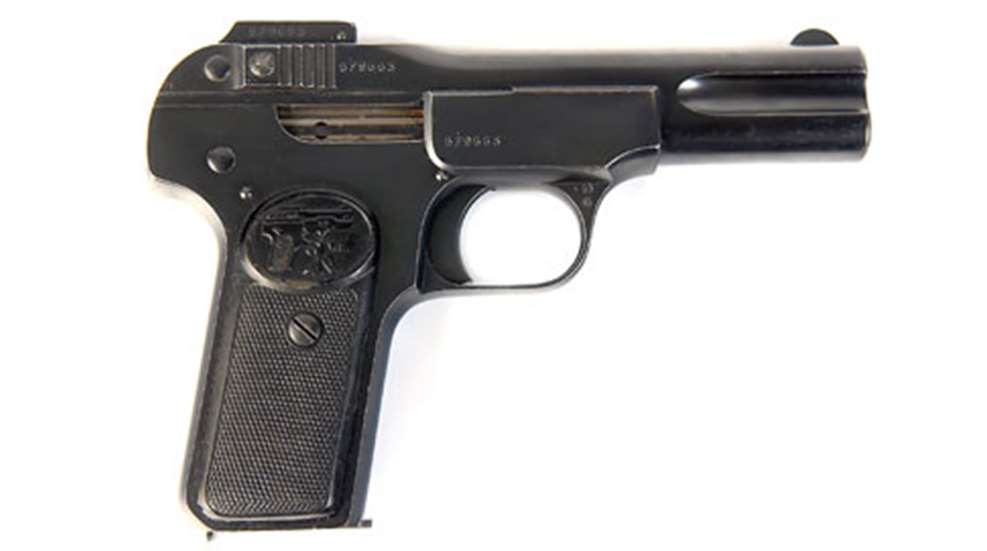
Although having a somewhat archaic appearance and lacking the streamlined silhouette of its follow-on, the Model 1910, the 1900 still remains quite a clever design. A blowback, the 1900’s recoil spring, which is enclosed in a channel above the barrel, also functions as the firing pin spring, giving the gun plenty of power to set off even the most stubborn primer. Unlike later pocket automatics, the 1900 had a separate breechblock that attached to the slide by means of a pair of large-headed screws. The safety was a small lever sited on the left side of the frame where it could be flicked down to fire (“FEU”) and up for safe (“SUR.”)
The magazine held seven rounds and was secured by a small heel-style catch. Grips were of checkered hard rubber and, depending upon when the gun was made, displayed the initials “FN” below a facsimile of the gun itself, or simply “FN.” Sights were a non-adjustable rear notch and rounded blade front, the rear incorporating an ingenious feature consisting of a rounded pin that rose up to block the notch when the trigger was pulled on an empty chamber. This device warned the shooter that the pistol was unloaded, as the gun’s slide did not remain open after the last shot.
The most common 1900s were blued, though nickel was not unusual. Reflecting the esteem in which the pistol was held, many were also highly embellished with engraving and gold inlay—a good example being an elaborate cased version of the pistol made for Belgium’s King Albert.
Almost as soon as it hit the market, the 1900 earned a reputation for ruggedness and reliability. It was immediately adopted by Belgium as its service sidearm and over the years saw employment by the militaries of many countries, including Greece, Austria-Hungary, Russia, France and Germany. Despite the introduction of the sleeker, more modern-looking Model 1910, the 1900 continued to be offered until 1914, by which time some 724,500 had been made.
It was also popular with civilians. Measuring only 63⁄8-inches long and weighing but 22 ounces, the gun was easily concealed and its rounded contours allowed it to be easily drawn from pocket, purse or holster. And while it never achieved great popularity in the United States, due in part to the preeminence of the 1903 Colt, it was well thought of elsewhere. Copies of the 1900 were even made in the Middle East and China, where the pistol was held in particularly high regard.
The gun depicted here is in superb condition, showing little use. Bluing is in the 98 percent range, and the piece is mechanically perfect. As such, it would probably bring a solid $650 on today’s market.
Gun: Model 1900 FN Browning
Manufacturer: Fabrique Nationale
Serial Number: 679663
Condition: NRA Excellent
Caliber: 7.65 mm (.32 ACP)
Manufactured: c. 1912
Value: $650