Upon returning from veteran furlough in the spring of 1864, the Seventh Pennsylvania Cavalry was issued Model 1860 Spencer carbines. A few days later, on the skirmish line, the men noticed a number of hogs rooting in the woods in front of their position. Before the officers could stop the firing, a number of pigs became supper for the men. A few troopers were arrested for killing the pigs, not because of the consumed swine, but because it was against orders to fire at any object other than a “gray-jacket.” On a more serious note, simply put, the .52-cal. M1860 Spencer carbine was the most advanced carbine in service during the American Civil War.
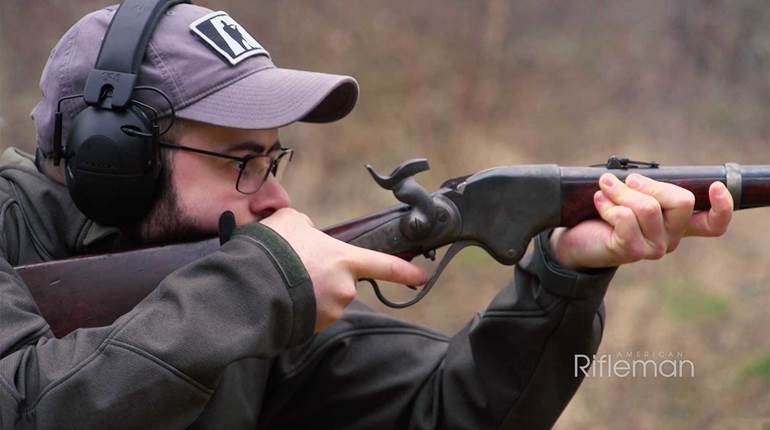
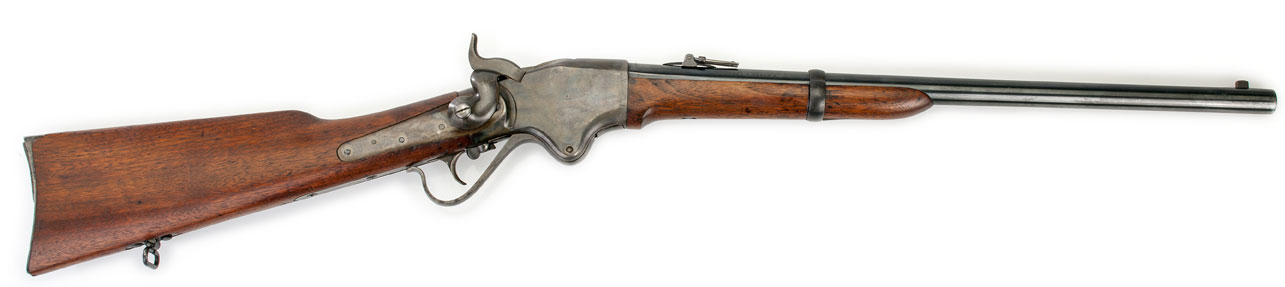
United States Patent No. 27,393, dated March 6, 1860, was granted to Christopher M. Spencer for his breechloading, repeating design. The tubular magazine, located in the buttstock, held seven rimfire cartridges. Lowering the operating lever, which also served as the trigger guard, ejected the fired case and automatically fed the next round into the chamber from the magazine. With the action closed, the hammer was then cocked, and the Spencer was ready to fire again.
The wartime Model 1860 Spencer carbine weighed 8 pounds, 4 ounces and had an overall length of 39 inches. The 22-inch-long blued barrel, secured to the stock by a single band, had a brass blade front sight, and the folding rear sight-secured by a curved spring base-was graduated out to 800 yards. A sling swivel was located on the buttstock, and there was a sling ring and bar on the carbine’s left-side grip area.
The serial number is found at the rear of the breech. On the Model 1860, the flat top surface of the receiver was stamped:
SPENCER REPEATING
RIFLE CO. BOSTON MASS
PAT’D MARCH 6, 1860
As the Spencer Repeating Rifle Co. was completing its contract with the U.S. Army for 7,500 30-inch-barreled Spencer rifles in June 1863, the company requested a contract for an additional 11,000 carbines at $25 each, which was awarded on July 13, 1863. Deliveries started in October, and by the end of the year the government received 7,000 carbines. In December, the contract was revised to state that the U.S. Ordnance Dept. would take delivery of 34,500 carbines in 1864 at the same price of $25. Another wartime contract of May 24, 1864, stated that the Army would take the entire production fabricated by the Spencer factory through Sept. 1, 1865. The accoutrements included in the contracts were a cleaning brush and thong, plus screwdrivers to take the gun down. By the time the wartime contracts were completed on Jan. 1, 1866, the Spencer factory had delivered 64,685 carbines.
Field Service 1863-1865
The first Spencer carbines did not reach the field until late 1863, at which time three cavalry regiments reported having nearly 1,000 Spencer carbines, but, by the winter of 1864, several Army of the Potomac cavalry regiments had been rearmed with M1860 Spencer carbines. In the failed Judson Kilpatrick-Ulric Dahlgren attempted raid on Richmond in February 1864-in which Dahlgren was killed-59 Spencer carbines were reported lost.
The firepower of the Spencer carbines was apparent in the action at Parker’s Store in the densely wooded area of the Wilderness on the morning on May 5, 1864. The 500 members of the Fifth New York Cavalry dismounted and formed a loose skirmish line, and there they were attacked by a division of Confederate infantry. For three hours the men of the Fifth held off the Southern attacks until they started to run out of ammunition for their Spencers, which forced the Federals to pull back. The Confederates opposing them believed that they had been fighting an entire brigade. The Fifth New York suffered about 80 casualties in the action.
By September 1864, 9,000 Spencer carbines were in field service for the Union, and they were highly regarded. The field reports from 10 officers of the Fourth U.S. Cavalry rated the Spencer carbine the best arm in cavalry service. Brevet Maj. Gen. James Wilson felt that the Spencers were the best firearms ever put into the hands of the soldier. He stated that the Spencer “excels all others in use in durability, rapidity of fire, and general effectiveness.”
In Wilson’s 1865 raid through the Deep South, his men were mainly armed with Spencers and equipped with Blakeslee cartridge boxes. Late in the war the Ordnance Dept. placed orders for 32,000 Blakeslee cavalry cartridge boxes, which were the invention of Col. Erastus Blakeslee of the First Connecticut Cavalry. They were designed to carry 10 tinned tubes containing seven Spencer cartridges each, giving cavalrymen an additional 70 cartridges at their fingertips. This gave soldiers tremendous potential firepower, and prior to the raid Wilson requested that his men be issued a quantity of the Blakeslees.
Late on the afternoon of April 2, 1865, 1,550 Union cavalrymen, armed mainly with Spencer carbines and rifles, waited for the order to attack the Confederate defensive positions at Selma, Ala. The attack was being made by Brig. Gen. Eli Long’s Division of Wilson’s Cavalry. Before the attackers even reached the Confederate defensive positions, they had to cover 600 yards of open fields. In front of the Confederate positions was a stockade of cedar posts 5 foot high, sharpened at the top. They then had to cover additional open space before coming to a 5-foot deep ditch and then climb a 15-foot embankment, all the while being fired on by the Confederates. They were commanded by one of the South’s best generals, Lt. Gen. Nathan Bedford Forrest. At 5 p.m., the order was given to advance. The enemy opened fire with artillery and musket fire, but the cavalrymen marched steadily forward in a single line firing their Spencers as rapidly as possible. The command was given to charge when within 150 yards of the Confederate works. With a cheer the cavalrymen started on a run for the Rebel lines. Up and over they went, capturing the positions within 25 minutes of the action’s start, and in which the attackers suffered about 300 casualties. After the capture of Selma, Wilson’s Cavalry continued on to Macon, Ga., where they were informed that the war was over.
The spring of 1865 found the Cavalry Corps of the Army of the Potomac located around Petersburg, Va., and it reported 5,300 Spencer carbines in field service. On the last day of March, Sheridan’s cavalry was attacked by Confederate infantry and cavalry at Dinwiddie Court House. On the march to the court house, the troopers found the roads nearly impassable. Conditions were so bad, a private from the Second Ohio Cavalry nearly drowned when his horse fell in a water-filled hole in the middle of the road. The trooper-loaded down with his Spencer carbine, 40 rounds of ammunition and full haversack-disappeared entirely in the mud and water, and only the quick help of his friends saved him. The archives remain silent on the fate of his horse. The Confederates were in the process of flanking the First New Jersey Cavalry during the battle, and Sgt. John Wilson from Company L and one other trooper slowed the rebel advance long enough to allow the withdrawal of the lead horses. Sgt. Wilson shot two of the rebel color bearers, and for his actions was awarded the Medal of Honor. Yet another trooper had a cartridge jammed in his carbine, rendering it useless, so he took a Spencer and ammunition from a wounded soldier going to the rear, and continued the fight.
That battle and the next day’s action at Five Forks-plus the breakthrough around Petersburg-forced Lee to evacuate Petersburg and Richmond. The war in Virginia was over a week later on April 9, 1865, with Lee’s surrender to Grant at Appomattox Court House.
Model 1865 Spencer Carbines
The fall of 1864 and the early months of 1865 saw three major changes to the Spencer carbines being delivered on existing Army contracts, resulting in a nomenclature change to the Model 1865. In November 1864, the Ordnance Dept. directed that the carbines be chambered for the new standard rimfire round, .56-50, replacing the .56-56. The new .56-50 ammunition could chamber in the older M1860 carbines, but the earlier .56-56 would not chamber in the new carbines. The .56-50-chambered guns were stamped on the receiver “Model 1865,” and the barrel length was shortened to 20 inches.
One final improvement was the March 1865 incorporation of the Stabler cut-off attachment, which was invented by Edward Stabler of Sandy Springs, Md. It allowed the carbine to be fired as a single-shot with the seven cartridges in the magazine being held in reserve. Stabler was paid a royalty of 25 cents for each carbine fabricated with his magazine cut-off device.
On June 27, 1864, the Burnside Rifle Co. entered into a contract with the Ordnance Dept. to manufacture 30,500 .52-cal. M1860 Spencer carbines with deliveries completed by Aug. 31, 1865. With the changes directed to be made to the carbines, deliveries did not start until April 15, 1865, and they continued until the end of October, with a 30,496 M1865 Spencer carbines being delivered. Six additional carbines were delivered as samples, prototypes and models. Of this number, 14,494 were equipped with the Stabler cut-off and 16,008 without.
The company paid Spencer Repeating Rifle Co. a royalty of 50 cents for each carbine delivered to the Ordnance Dept., and $1 was paid for the 4,000 Spencer carbines sold to military individuals and civilians.
The Spencer factory manufactured nearly 23,000 M1865 Spencer carbines, of which 12,502 were equipped with the Stabler cut-off. In the post-war period, Springfield Armory retrofitted about 12,000 M1860s to incorporate M1865 features.
The .56-50-cal. M1865 Spencer carbines manufactured by the Burnside Rifle Co. and the Spencer Repeating Rifle Co. weighed 8 pounds, 5 ounces with 20-inch barrels, and they had an overall length of 37 inches. The Burnside receivers were stamped:
MODEL 1865
SPENCER REPEATING RIFLE
PAT’D MARCH 6, 1860
MANUFACTURED AT PROV.R.I.
BY BURNSIDE RIFLE CO.
The Spencer factory carbines had the both the M1860 stamping and the M1865. A saddle bar and ring was located on the buttstock’s left, and sling swivels were located on the barrel band and underside of the buttstock.
In 1871, Springfield Armory converted 1,109 M1865 Spencer carbines manufactured by Burnside into rifles, replacing the carbine barrels with 32-inch-long standard M1868 Springfield rifle barrels and fore-ends secured by two barrel bands. The converted rifles retained the carbine’s saddle bars and rings on the left side of their buttstocks. It does not appear that those converted rifles were ever issued.
Post-War Field Service
The years after the Civil War saw the U.S. Cavalry assigned to various outposts on the frontier, and in 1866, four additional cavalry regiments were organized for frontier duty, with the last two being the U.S. Ninth and 10th Cavalries, better known as “Buffalo Soldiers.” They, along with the rest of the Army, tried to maintain order and protect against hostile Indian attacks. The M1865 Spencer carbine was the standard in post-war service and remained in service into the middle 1870s.
One of the largest Indian raids into Texas occurred in July 1870. Chief Kicking Bird led 100 Kiowa warriors from Fort Sill Reservation on a raid into Texas. On the Wichita River, the raiders came in contact with a detachment of 55 Sixth U.S. Cavalry troopers from Fort Richardson. Totally surrounded, the cavalrymen-armed with Spencer carbines-fought a delaying retreat. The men dismounted and led their horses, and in the four-hour engagement before the Indians called off the attack, the cavalrymen suffered two dead and 11 wounded. The Kiowa losses were 15 killed and several wounded. For their conspicuous acts of bravery, nine cavalrymen were awarded the Medal of Honor.
Two years later, Captain Jack and his Modocs moved into the lava beds of Northern California in late 1872 after a clash with the cavalry, and a portion of the Spencer carbine-armed First U.S. Cavalry and the Warm Springs Indian scouts were sent to force them out of the lava beds. The siege of Captain Jack’s position lasted several months and finally ended in the summer of 1873, at which time Captain Jack abandoned the stronghold. Then the troopers-with the assistance of the Warm Springs scouts-tracked the Modocs down and Captain Jack was captured and later hanged.
Spencers were replaced by the .45-70 Gov’t Model 1873 Springfield carbines, and it was with the newly issued single-shot Model 1873 “Trapdoor” that troopers of Lt. Col. George Custer’s U.S. Seventh Cavalry entered the Little Big Horn on June 25, 1876. What influence-if any-the seven-shot, repeating Spencers may have had on “Custer’s Last Stand” would be pure conjecture, but the Spencer’s firepower relied on by the U.S. Cavalry since 1863 was assuredly missed.
Most Popular