Samuel Colt patented his revolver during the presidency of Andrew Jackson. Through the next century the revolver evolved from a single-action, front-loading blackpowder arm to a cartridge-firing, double-action wheelgun. In my opinion, the revolver reached its pinnacle in the mid-1950s with Colt’s introduction of the Python. Since then, the only notable revolver advancements we’ve seen have been more potent cartridges and higher-capacity cylinders. What could possibly be done to the revolver to make it better, or even different?
Emilio Ghisoni, an Italian firearm designer who once patented, of all things, a recoil-operated, semi-automatic revolver, the Mateba, understood that by lowering the axis of a revolver’s barrel in the hand, recoil and muzzle flip could be greatly reduced. To do this, though, would require positioning the barrel so that the revolver fired from the cylinder’s bottom chamber instead of the top.
Working with Italian competitive shooter Antonio Caduzzo, the team produced a unique revolver that highlighted Ghisoni’s signature bottom-barrel design; however, Ghisoni didn’t live to see it become reality, since he passed away in 2008. But, Caduzzo found another partner, Rino Chiappa, owner of Chiappa Group and Chiappa Firearms. Chiappa Firearms is well-known for its replica arms of notable models from Sharps, Winchester and Colt.
The unconventional revolver, coined the Rhino, was introduced at the 2010 SHOT Show. It drew a crowd, mostly because of its unorthodox appearance, but also because of its distinctive design. The response was similar to that of the Glock pistol’s introduction because the Rhino was such a radical departure from the conventional wisdom that dictated what a handgun had to be.
Redefining The Revolver
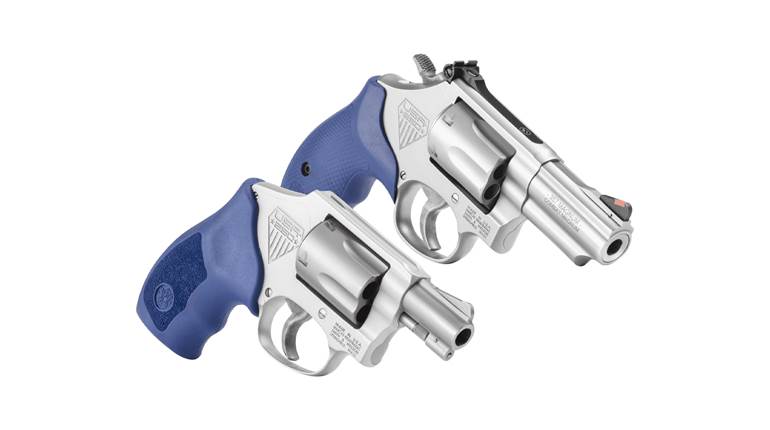
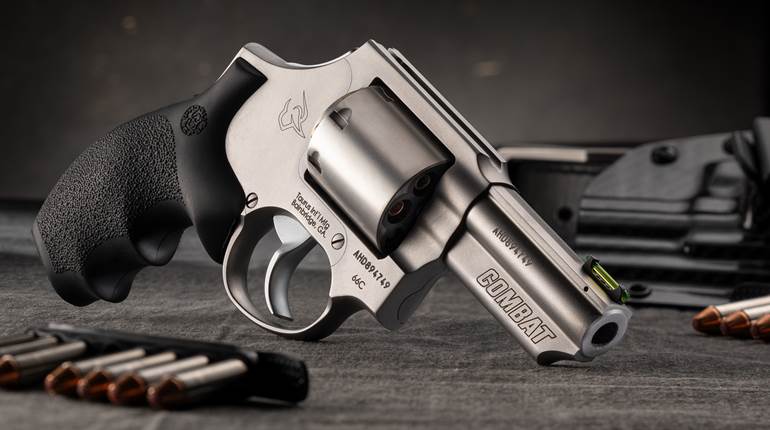
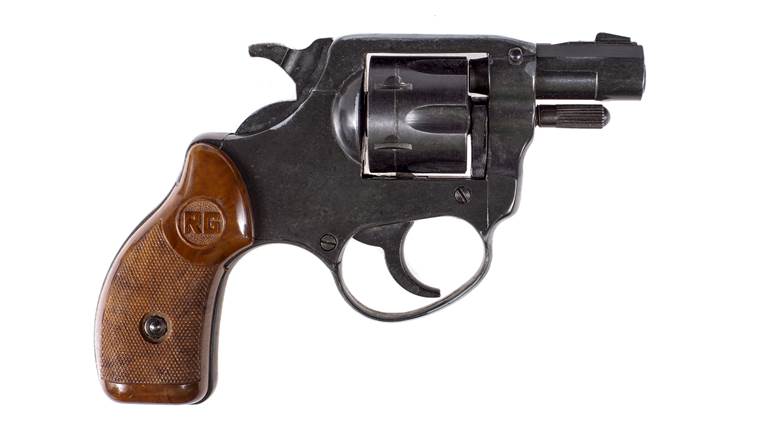
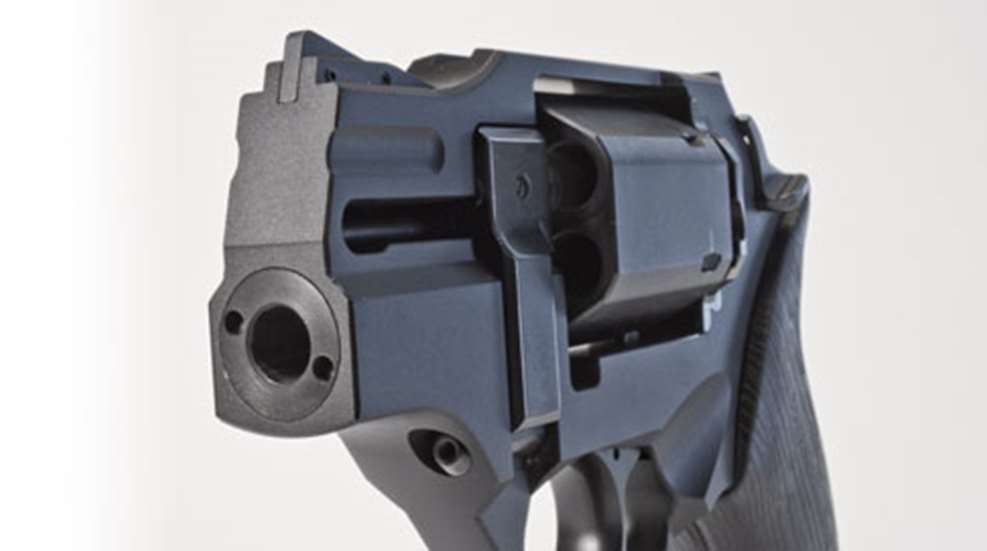
The Rhino functions as differently as it looks. The geometry of the design seems off because the trigger is positioned about mid-cylinder and the hammer is directly above—as opposed to forward of—the grip. Revolvers also typically have a curvaceous look to them, and if you compare a Rhino side-by-side with a modern revolver, such as the Smith & Wesson Model 36 Chief’s Special, then it looks, well, prehistoric. With regard to its size, the six-shot Rhino is essentially the same length—about 0.2 inches thicker and 1-inch taller—and 5.5 ounces heavier than the five-shot Model 36.
As for operation, forget the established parameters of the conventional revolver. The only similarity the Rhino shares with the modern double-action revolver is that when the trigger is pulled or the hammer is cocked, its cylinder rotates to line up a chamber with the barrel before the gun is fired. The internal lockwork produces the same result, but in a completely different manner.
The most radical departure from the common revolver is the position of the barrel, which made it impossible for a conventional, exposed hammer to work. This is because the cartridge to be fired resides just above the trigger, not near the top strap and in front of a hammer, as found in traditional revolvers. On the Rhino, what appears to be an exposed hammer is nothing more than a cocking lever. Pulling it to the rear rotates the cylinder, and when it is released, the lever falls forward. It may startle those accustomed to a conventional revolver. The lever, however, just actuates the true hammer buried inside the complex lockwork. The single-action firing mechanism within the Rhino operates like a standard striker-fired semi-automatic handgun; by retracting the cocking lever the striker is pre-loaded—comparable to cycling the slide on a Springfield Armory XD.
When the cocking lever is fully retracted a small red plunger, signifying the handgun is in the single-action mode and ready to fire, is visible near the top, rear of the frame. For double-action operation, the Rhino requires only that the trigger be pulled. One difference, however, between the Rhino and conventional revolvers with hammers it that the progression of the trigger pull cannot be observed.
Ironically, the Rhino is uncocked like conventional revolvers: while maintaining a grip on the cocking lever, pull it rearward while depressing the trigger. Then, ease the cocking lever and the trigger forward together. This reverts the revolver to double-action operation.
To the left of the cocking lever, which is notched to serve as a rear sight, is the cylinder-release latch. Depressing the latch frees the cylinder, similar to how the safety of an M1911 is disengaged. It is easily pushed clear of the frame using a single finger. With the cylinder free the ejector rod is visible at the front of the crane for case or cartridge removal—nothing new here.
The Rhino’s ejector rod, crane, cylinder and barrel are steel; however, the frame, which fully encases the barrel, is aluminum alloy. A one-piece, rubber-like boot-style stock fits over the grip frame, and it is held in place by a single screw at the base. The material is soft, pliable and comfortable, but seems a bit under-engineered compared to the rest of this abnormal revolver.
Two other Rhino characteristics worthy of note are the shape of the trigger and the positioning of the cylinder in relation to the hands. The trigger is wide—almost a half inch, which is comfortable and reduces the perceived effort required to pull it. Because the grip axis is closer to the cylinder, you need to make a mental note to keep the thumb of your non-shooting hand behind the gap between the cylinder and the barrel.
The action of the Rhino was not flawless, but smoother than many modern double-action revolvers. According to my trigger-pull gauge, double-action operation required a 10-pound, 8-ounce pull, and it was about half that when the revolver was fired in the single-action mode. My wife typically has issues with a 10-pound trigger pull, but the Rhino’s wide trigger seemed to help reduce the effort required to work the action.
At The Range
The first round I fired through the Rhino was Hornady’s 110-grain Critical Defense .38 Spl. load. For comparison, in my 19.5-ounce Model 36 S&W Chief’s Special, this load is snappy but controllable. The Rhino’s muzzle rise was imperceptible, and recoil was as comfortable as a handshake. I then used the +P version of the load, which my wife will not shoot out of the Chief’s Special. Neither of us could discern a difference. Remington’s .38 Spl. +P, 125-grain Golden Saber ammunition proved less intense in the Rhino than did the 110-grain, Critical Defense load from the Chief’s Special.
During accuracy testing, I was surprised by how much the lower barrel axis dampened recoil and controlled muzzle flip. Still, I thought full-house, .357 Mag. loads would rock the Rhino. I was wrong. I could feel the bite in the palm of my hand from the Federal 180-grain jacketed hollow-point loads, but muzzle rise was negligible.
Accuracy testing complete, I moved on to shooting the Rhino in a manner more consistent with what the handgun was designed for: self-defense. Starting at the low ready position and using the .38 Spl., 110-grain Critical Defense +P loads, I found that I could keep three shots inside an 8-inch circle at 10 yards in less than two seconds. My best time on this drill with the Chief’s Special was a half-second faster, but with one miss. The real surprise, though, came with the 180-grain, .357 Mag. loads. I put six shots inside an 8-inch circle in 3.1 seconds—a full second faster than I was capable of performing with a Ruger SP 101 in .327 Fed. Mag., or even with a 4-inch S&W Model 10 in .38 Spl. using the 110-grain +P loads.
There’s no doubt that the lower barrel axis of the Rhino reduces muzzle rise and contributes to a more controllable revolver. The recoil is still there but is driven straight back into the palm of the hand. You’ll feel a bite with full-power .357 Mag. loads, but muzzle rise is so minimal you’ll first think you’ve had a misfire or even a squib load. The speed at which you can aim follow-up shots with this revolver is nothing short of astounding.
Final Thoughts
If your firearm purchases are driven by aesthetics, you likely won’t give the Rhino a second look. It is not sexy or graceful. On the other hand, if you’re a revolver aficionado and like the idea of a very controllable, powerful handgun for self-defense or even competition, the Rhino deserves some consideration.
I dare not speculate on its durability. My wife and I fired 200 rounds through the test gun, however, and we experienced only three malfunctions. These were with the Remington 125-grain Golden Saber .38 Spl. +P loads. On three separate occasions, when attempting to eject the cases from the cylinder, the ejector star jumped the rim of a case and left them only partially extracted.
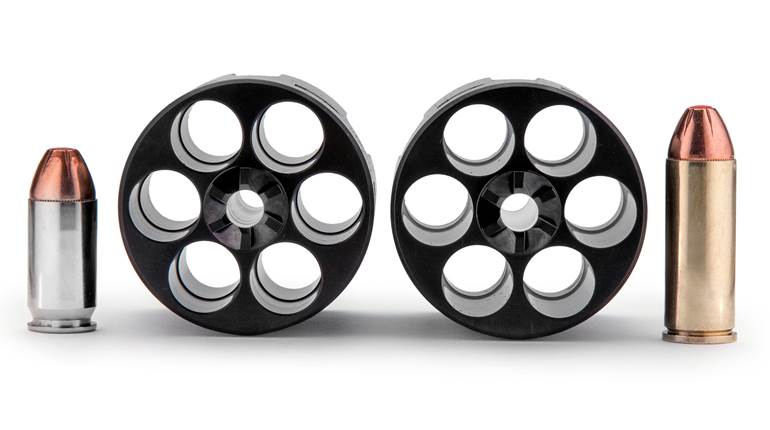
Chiappa is offering 2-, 4-, 5- and 6-inch versions of the Rhino. Obviously, the 2-inch version is intended for the defensive-handgun market. It is indeed a bit heavy by today’s compact revolver standards, but is far more comfortable and controllable than revolvers twice as large. The longer-barrel versions might find a home with competition-revolver shooters because their recoil-reducing benefits are comparable to those of a compensated revolver. Also, S&W L-frame speedloaders work with the Rhino.
Maybe, the most important thing to keep in mind about the Rhino is that it is the first incarnation of the new millennium revolver. For more than 100 years we have not seen a significant advancement in revolver design. Now, with the Rhino, what we have is a small, lightweight revolver in a powerful chambering that is very controllable. That is indeed something. And, while Sam Colt may not approve, remember, about 30 years ago a lot of folks believed polymer-frame pistols were too weird to be successful, too.
Manufacturer: Armi Sport di Chiappa Silvia
Importer: Chiappa Firearms; (937) 835-5000; www.chiappafirearms.com
Action: double-action, center-fire revolver
Caliber: .357 Mag. (.38 Spl.)
Cylinder Capacity: six
Frame: black-anodized aluminum alloy
Cylinder: steel
Barrel: 2"(tested), 4", 5" and 6", six grooves, 1:19" RH twist
Stock: black synthetic, one-piece
Sights: non-adjustable ramp front and notch rear
Trigger Pull: double-action, 10 lbs., 8 ozs.; single-action, 5 lbs.
Length: 6½"
Width: 17⁄16"
Height: 415⁄16"
Weight: 25 ozs.
Accessories: leather pancake holster, cleaning rod, owner’s manual and hard case.
Suggested Retail Price: $749