Adaptability-it is likely the foremost reason the AR has become America’s universal modern rifle platform and is unquestionably a serendipitous byproduct of the gun’s modular design and space-age construction. It also meshes perfectly with American shooters’ penchant to own something a little different. When it comes to building an AR from the ground up, modularity means it can be easily tailored from the start, or modified after the fact, to suit the specific, often evolving, requirements and tastes of all manner of users.
In fact, a do-it-yourself build is perhaps the only way to end up with exactly the AR you want. At least that was the conclusion I came to and the reason for this project. My aim here is not to retrace every aspect of the AR-building process in step-by-step fashion-that has already been covered elsewhere-rather it is to suggest how to approach the process and to convey a few of the tips I learned along the way that might make it less stressful the first time around.
I admit that the AR rifle platform had never been my favorite, but even as a lifelong fan of the Garand-based gas guns, particularly the M1A, I could no longer resist the accuracy, parts availability and adaptability inherent in the AR’s modular design, or its long military pedigree. So, I decided that, starting with an ordinary AR flattop upper and standard lower receiver, I would build an all-around rifle suitable for target work, hunting and self-defense-within the limits of the .223 Rem. cartridge. A carbine might have been the more popular choice, but therein lies the beauty of such a project-you build the gun that suits your needs and preferences despite what the masses are doing. Regardless of your reasons for going the built-it-yourself route, however, the first step should be to decide what role or roles you intend the finished rifle to perform. For example, a dedicated close-quarters self-defense carbine will call for an entirely different set of components and design parameters than a long-range varminter. Either choice is entirely valid and easily achievable, though, given the myriad choices in available components.
One company has simplified the process of building your own AR like no other by stocking what is likely the largest selection of AR components-1,500 individual parts from 175 vendors at last count-ever warehoused under one roof. That company, Brownell’s of Montezuma, Iowa, has a nearly 75-year track record of supplying the gunsmithing trade and consumers with the best available firearm components, tools and advice. And, despite its enviable reputation for old-fashioned customer service, it is not in the habit of getting behind the times. So a few years ago it constructed a dedicated website, ar15builder.com, for the express purpose of allowing its customers to virtually configure their own ARs using its vast inventory of receivers, barrels, stocks, fore-ends and other components. I tried it and found it enjoyable and helpful for learning about the various components, their compatibility and their prices. I also viewed the company’s DVD, “How To Build an AR-15” and read the book The AR-15 Complete Assembly Guide by Walt Kuleck with Clint McKee from Scott Duff Publications. All of that pre-build activity better prepared me to discuss the build with suppliers and to perform the final assembly.
After forming a few gut feelings about the direction I wanted to go with the rifle and jotting a short list of questions, I picked up the phone and called Brownells, asking to speak with one of its more than 14 staff gunsmiths-all of whom, by the way, have built at least one AR. When Mike, a self-described “M1911 man” who had nevertheless built somewhere between six and 10 ARs, came on the line, I proceeded to pepper him with my thoughts, concerns and questions, and he was able to walk me through them in short order.
In completing the build illustrated here, my first, I found one of the most challenging aspects of the process was thinking far enough ahead when selecting specific components so that subsequent choices would be compatible and complementary. Each choice brought with it the somewhat agonizing opportunity to stick with the plan or to deviate for some reason that I may not have considered earlier. As a result, I ordered the parts in three or four separate shipments over a period of several weeks and simply set them all aside in a box to begin assembly at a later date. What you’ll find on p. 72 are descriptive vignettes of each of the resulting subassemblies and/or specific components that I believe lent the rifle its unique identity.
When the time came to assemble the rifle, I found that it went together quite easily because of the familiarity I had gained with its operation and construction by watching the video and reading the book. In addition, all of the parts were delivered as-advertised-properly packaged and complete. I simply took my time and worked only as far as the parts, tools, time and my patience allowed. But when the time finally came to assemble the completed upper and lower assemblies, I realized that any certainty about whether it would hit the mark I had established in my mind would come only after I fired the first shots.
After checking headspace with “go” and “no-go” gauges, I gathered some ammunition and took it to the range where I cautiously fired the first round. I was pleasantly surprised to see that the gun cycled and chambered the second as it should. After shooting a third time I went downrange and was pleased to find a cluster of holes in the target about the size of a dime. There were a couple of failures to fully chamber during the break-in process that followed, but the gun has since run without a hitch and continues to turn in excellent accuracy, particularly with the heavier bullets for which the barrel was designed.
If asked to describe the AR that resulted from this project, I would characterize it as a “special purpose rifle”-compact and quick-handling enough for short-range self-defense use yet endowed with enough true rifle characteristics for moderately long-range shooting. One unanticipated result, an all-up weight of 12 pounds, 12 ounces, is about the only disappointing aspect of the build. But after the shock of the scale’s revelation wore off, I decided that for a rifle with such a stout barrel profile, quick-release optics, metal back-up sights, a metal fore-end and a bipod the weight was justified-of course that won’t stop me from attempting to prune it a bit by looking into upgrades such as a lightweight integrated optic mount.
In the end, the gun’s overall configuration, features and capabilities are exactly what I sought at the outset months earlier. Although the total build cost-including the scope, rings and bases-was in excess of $3,000, it is in line with fully-equipped top-of-the-line rifles. Plus, the gun shoots well and provides the feel and performance I always wanted from an AR but couldn’t seem to buy outright. Also, the experience of building it from scratch gave me a much greater understanding of the AR’s design and construction and far greater respect for America’s most popular rifle.
LRB Arms Receivers
If there’s one set of components that will have a cascading effect on an AR build, for better or for worse, it’s the upper and lower receivers. Buying from a reputable parts vendor such as Brownells all but ensures that both will be made from properly hardened aluminum alloys by the correct processes and machined to exacting dimensions in key areas. In addition, holes will be free of burrs and finishes will be even and closely matching. Consider that a flat-top upper will allow for greater versatility of the finished product with regard to optics mounting. I had coincidentally ordered receivers directly from the manufacturer, LRB Arms, before the run on AR rifles and parts began. I chose LRB partly because of my high regard for the company’s signature product-hammer-forged semi-automatic M14-type receivers-and partly because I knew that its vendor, JV Precision Machine Co., produces the company’s AR receivers from 7075-T6 aluminum forgings to close tolerances and high standards of quality. Both upper ($110) and lower ($110) receivers exhibited fine fit and consistent finish and showed no evidence of burrs or other manufacturing glitches.
Daniel Defense Barrel & Rail
Not only is the barrel the heart of a gun’s accuracy, its length and weight can heavily influence the entire build. With that in mind, it was the first component I selected from Brownells after buying the receivers. I decided early on to go for a barrel capable of handling heavier bullets, those in the 75- to 77-grain range, having a true 5.56x45 mm NATO chamber accompanied by a 1:7-inch twist rate. One of my Brownells advisors highly recommend Daniel Defense, so I chose the company’s 18" Strength 2 Weight (S2W) model ($279), which I believed would provide a good balance between optimized velocities and reasonable handling and portability. The choice also dictated another fundamental design consideration in building an AR: The barrel’s gas port location and 0.750-inch measurement at the boss for the gas block required the use of a mid-length, rather than carbine- or rifle-length gas system and thus simplified other decisions when it came time to select the fore-end, gas block/front sight assembly and gas tube. The barrel’s stout profile, hammer-forged chromemoly-vanadium steel construction and salt bath nitride treatment inside and out were further assurances that it would likely deliver good accuracy and be durable over the long haul. Its M4-style feed ramps mated perfectly with corresponding cuts in the LRB upper. Because I knew I wanted to mount certain accessories on the fore-end, but was not a fan of the round, extended models now in vogue, I chose Daniel Defense’s Lite Rail 9.0 ($365). It is machined and welded as one piece and free-floats the barrel by attaching to the upper receiver with a special barrel nut, an included spanner and a collar that secures the rear of the unit to a matching flange with six Allen-head machine screws. Its upper rail surface mated nearly seamlessly with the upper receiver’s rail, and it stopped just short of the gas block.
DPMS Internals
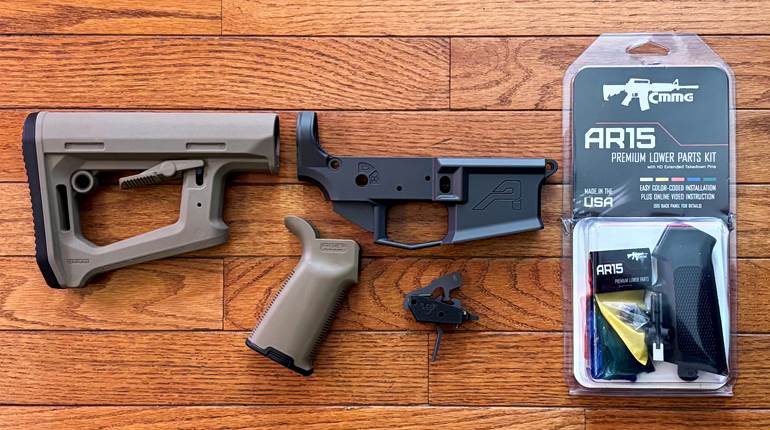
Both upper and lower receivers, if ordered as stripped components, require the addition of numerous small parts, including tiny roll pins, detents and springs, usually sold as “parts kits” or “completion kits.” These were and continue to be some of items hardest-hit by the insatiable nationwide demand for AR rifles, parts and accessories. Once Brownells informed me by e-mail that they were once again available, I chose to keep things simple and ordered their polybagged kits as supplied to them by DPMS, which has a long history of providing mil-spec AR components to the firearm industry. My thinking was that securing things in that manner would help move the project along, allowing for selective upgrading, such as with an adjustable trigger, when my needs and additional funds became available. For the Upper Receiver Parts Kit, Mid-Length ($59) that included the ejection port cover and forward assist assemblies, the gas tube and other small parts. For the Lower Parts Kit ($60) it included the trigger and safety selector components. Other required assortments include the Buttstock Mounting Kit ($52) with buffer tube and buffer components. I also ordered a DPMS Bolt Carrier ($58) and Bolt ($45) because I knew they would be military-grade and because they were among the few available.
Magpul Furniture
Having begun as a manufacturer of flexible polymer magazine pulls designed to allow more rapid and sure magazine changes in combat, Magpul Industries has evolved into one of the largest producers of polymer AR magazines, stocks, fore-ends, sights, slings and more. Its Magpul Original Equipment, or MOE, components, as their name implies, are supplied on a host of factory rifles and have come to all but dominate the aftermarket for individuals seeking to build their own ARs. For this project, I chose the fixed MOE Rifle Stock ($70), which has smooth contours that afford a comfortable cheekweld along with multiple attachment points for push-button sling swivel cups and a ribbed rubber buttpad that hinges to allow storage of a cleaning rod and other supplies. I also chose the MOE + Grip ($24), with rubber overmolding, and the company’s signature AFG2 Angled Fore-Grip ($35), which, mounted fully to the rear of the fore-end’s lower Picatinny rail, presents a comfortable purchase point for the support hand for efficient use of the gun in close-range, dynamic scenarios yet still allows mounting of the bipod ahead of it. The choice of such components is important because of how they allow it to interface with the shooter. Magpul seems to have dialed-in ergonomic design, which means the shooter can remain comfortable and relaxed during extended or stressful sessions, resulting in more hits on the targets.
Sights, Optics & Mounts
I wanted a quality set of iron sights and decided to go with a barrel-mounted front unit for a little more sight radius and because it left the upper Picatinny rail clear for possible use with a scout-mounted scope. As with a rack-grade military AR, the base of the No. 41-BL Silhouette Folding Front Sight ($160) from A.R.M.S. I chose has that familiar triangular shape when raised and serves as the gas block and sling mounting point although I chose to address the latter by mounting a push-button-style sling point on the left Picatinny rail so as to prevent influencing the barrel through sling tension. I mounted an ARMS No. 40L-SP ($120) at the rear, and was pleased to see that its base contour neatly matched that of the upper receiver. Both units are made of steel and fold quickly, allowing an unobstructed view through the riflescope or other optics.
As to optics, there are myriad choices available for ARs, from small, non-magnifying reflex sights to large, high-magnification scopes, and a host of mounts and rings as well. Regardless of which type of optic is chosen, reasonable quality can mean that it and its attendant mounts and accessories might exceed the cost of the rifle itself. So before making a decision, consider such basics as: suitability to the type of shooting anticipated; compatibility with iron sights-e. g. the ability to ”co-witness”-rail mounting area requirements; and, of course, optical quality and price. I chose the VX-R Patrol 1.5-4 X 20 mm scope with FireDot Special Purpose Reticle ($580) from Leupold set in the company’s Mark 4 Tactical steel rings ($164) and mounted atop an Accucam Quick Detach Scout Length Mounting Base ($159) from GG&G mostly because I had them on hand. Given the capabilities of the rifle, greater magnification would certainly be in order. But the combination has proven to allow for quick yet precise aiming at close targets and yet turns in respectably small groups on paper at moderate distances as shown in the accompanying table.
Bits & Pieces
Sometimes the details on a project can make all the difference, and a handful of small components helped make this particular AR more suited to my personal preferences. One was the Ambidextrous Safety Selector ($60) from Battle Arms Development. Ordered as a kit with a variety of lever styles, it allows the user to select a favorite length and thickness to install on each side of the gun. Another drop-in worth its weight in gold is the Ambi-Catch ($90) by Norgon, LLC, which allows the magazine to be released by pressing in on the left side as well as preserving the primary release on the right.
Two other items that made a big difference in handling and configurability, respectively, are the Badger Ordnance (badgerordnance.com) Tactical Charging Handle ($100) and the company’s TRAMP bipod mount ($60). The former makes grasping and retracting the charging handle faster and less demanding of fine motor skills and the latter allows a QD-stud-mounted bipod, such as the ubiquitous and durable SL ($133) from Harris shown here, easy to lock onto and remove from the lower Picatinny rail with one hand-the key to both being skeletonized grasping “ears.” Finally, the CA556AR203 ($130) combination flash suppressor/sound suppressor interface from SureFire has a reasonably traditional appearance at the end but includes a long “skirt” that allows for easy fitting of a long bayonet or sound suppressor.