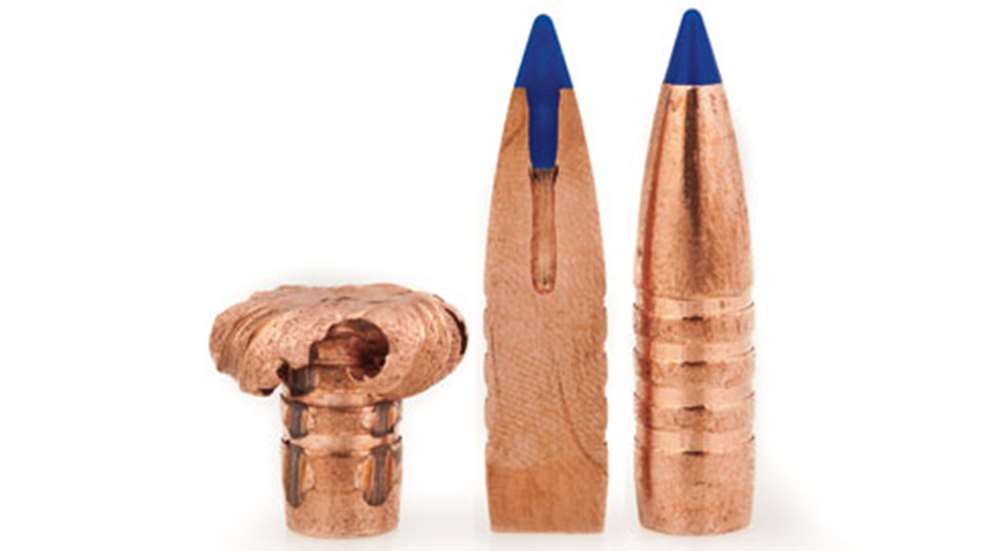
Unveiled in 2007, the Tipped Triple-Shock X-Bullet (TTSX) offered an upgrade in the performance of an already-excellent product, the Triple-Shock X-Bullet (TSX), but without the increased cost of the Maximum-Range X-Bullet (MRX) , which had an expensive Silvex core. Although few hunters complain of the on-game performance of the TSX, the TTSX is a better option when long shots are likely. What makes it better? Let’s compare the projectiles.
Often muzzle velocity and energy are the primary determining factors in cartridge and load selection, while all-too-important considerations, such as the bullet’s BC, remaining velocity (required for expansion) and wind speed and direction at 300, 400 and even 500 yards, are ignored; however, all are relevant.
When compared to TSXs, TTSXs offer a marked increase in ballistic coefficient (BC). Take, for example, the .30-cal., 168-grain TSX, which has a BC of 0.404, while a 0.308-inch, 168-grain TTSX has a BC of 0.470. How much difference does this make? Actually, quite a bit. When comparing them at a muzzle velocity of 3,000 fps, at 500 yards the TSX is traveling 1,940 fps and produces 1,404 ft.-lbs. of energy, as opposed to the TTSX’s 2,073-fps velocity and 1,603 ft.-lbs. of energy. Moving on, with a 200-yard zero, the TSX drops 6.9 inches at 300 yards, 20.2 inches at 400 yards and 41.1 inches at 500 yards, and a 10-m.p.h. crosswind drifts the projectile 7.0 inches off course at 300 yards, 13.1 inches at 400 yards and 21.4 inches at 500 yards. With the same sight-in distance, the TTSX drops 6.6 inches at 300 yards, 19.1 inches at 400 yards, and 38.5 inches at 500 yards. Bullet drift at 300 yards is 5.9 inches, 10.9 inches at 400 yards and 17.8 inches at 500 yards. The differences, particularly as distance increases, are notable, and could, with a slight distance or wind speed miscalculation, determine the lethality of the shot.
Prior testing, which involved my shooting 130-grain TSXs and TTSXs into Bullet Test Tubes, revealed that at 1,958 fps the TTSX not only retained 129.2 grains of its original weight and penetrated 14 3/4 inches of media, but also fully expanded; however, the same could not be said of the TSX. The TSX, which retained all its original weight, only partially expanded at 1,960 fps, and dug into the media 13.5 inches.
Although the window at which the 168-grain TSXs and TTSXs reliably upset might differ slightly from their 130-grain cohorts, just as food for thought, take the 1,940-fps velocity of the 168-grain TSX at 500 yards used previously, and consider that, for example, the .308 Win. VOR-TX load propels its 168-grain TTSX to 2,680 fps (factory published) at the muzzle, not 3,000 fps used in the example. Now the picture as to why the TTSX is superior to the TSX for longer shot distances becomes all that much clearer; hence the reason that TTSXs have been among my go-to bullets for antelope hunting.
But, the TTSX doesn’t dispose of the best features of its non-tipped predecessor. Like the TSX, the TTSX has grooves—the number of which varies with projectile length—that circumscribe the bearing surface. As the grooves provide an area for copper displaced by the rifling to settle, the bullet exhibits an increase in accuracy and reduction in pressure and fouling. And weight retention is typically near 100 percent (usually only the tip is missing).
As one can easily see, Barnes Bullets chose wisely when selecting the TTSX as its primary projectile for VOR-TX ammunition.
Most Popular