There are few more remarkable national stories than that of Japan during the latter part of the 19th century. Between 1853, when Commodore Perry first steamed into Uraga Harbor in his “four black dragons spitting fire,” and the Russo-Japanese War of 1905 in which Japanese forces humiliated those of the czar, the country moved from a feudal nation to a modern, industrialized society.
Things martial received top priority. When Perry arrived, the shogun’s forces were armed with matchlocks, but in a scant half-century had progressed to state-of-the-art repeaters—though with a decidedly Asian twist.
Their interest was piqued by Perry’s gift of Maynard and Hall rifles, “Army pistols” (probably single-shot, percussion Model 1842s, and several models of Colt revolvers on his second voyage in 1854, the Japanese military subsequently investigated and adopted a potpourri of Western arms. They included Pattern 1853 Enfields, Spencer and Henry repeaters, Martini-Henrys, Dreyse Needle Guns and Remington Rolling Blocks, to name a few.
In the handgun department, the Japanese were particularly taken by the wares of Smith & Wesson, ultimately officially adopting several different models of the superb S&W Russian revolver.
Not wanting to be reliant upon foreigners for their armament, the Japanese embarked upon a program whereby they would design and build their own arms. In 1880 they introduced their first infantry rifle, the Type 13 “Murata.” It was followed in short order by the improved Type 16 and Type 18, and in 1889 by the Type 22 smallbore repeater. While of indigenous manufacture and design, all of these arms manifested some European influences.
Handguns, relegated slightly to the back burner, were not forgotten and, in 1893, the emperor’s armorers unveiled an indigenous revolver—the Type 26, so-named because it premiered in the 26th year of the Meiji emperor’s reign.
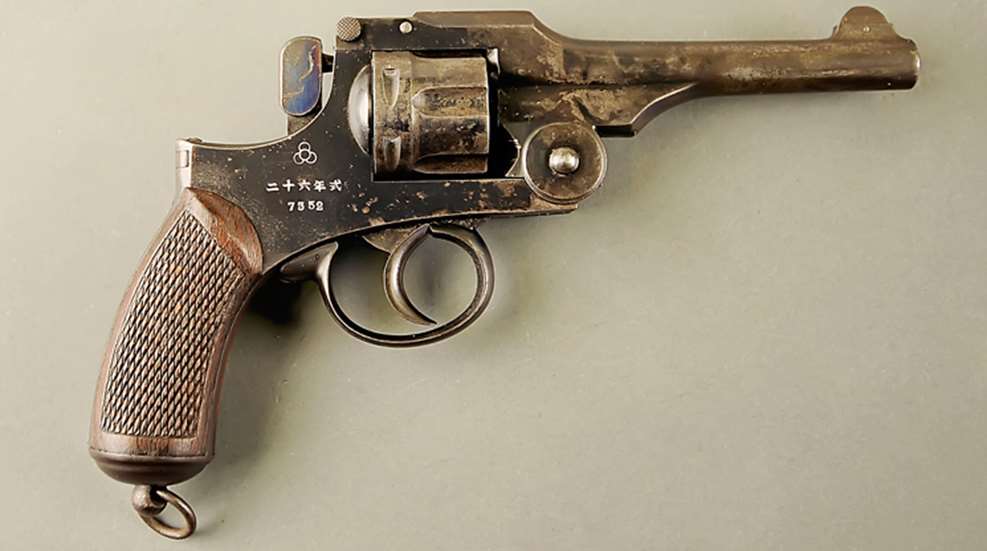
Manufactured at the Tokyo Artillery Arsenal (Koishikawa, Tokyo) beginning in 1894, it was, to put it politely—quite interesting looking. Double-action-only and chambered for a unique 9 mm rimmed blackpowder cartridge, the six-shooter borrowed major features from various American and European handguns. Like the Smith & Wessons, it was a top-break with simultaneous ejection. The mechanism was reminiscent of those of the Austrian Rast & Gasser and British Webley Mark I revolvers, and it had a swing-open gate on the frame, similar to those of the French Model 1873 and 1892 revolvers, that allowed easy servicing and lubrication. The combination of features lent the gun a very distinctive appearance.
Being double-action-only, the Type 26’s block-like hammer had no spur. The stocks were diminutive but well-configured with checkered beech or, later, Philippine mahogany panels. Much smaller than the Smith & Wesson Russian, the Type 26 measured only 9.09" overall and had a 4¾" barrel, and the quality of manufacture was excellent. The finish was bright blue and sights consisted of a simple groove in the topstrap and a rounded-blade front pinned into a grooved base at the muzzle.
Though serviceable, the gun had one serious drawback—the cylinder locked only when the trigger was pulled. Otherwise it free-wheeled, which meant that if the shooter fired only some of the gun’s rounds and then replaced it in the clamshell holster, it would be possible to inadvertently turn the cylinder so the hammer would fall on a spent case—not a great feature in the heat of battle.
Though ultimately replaced by the superior Nambu semi-automatic pistol, the Type 26 remained in Japanese service in primary and secondary roles through the Second World War. Production ceased in 1935, and a number of Type 26s were also arsenal-refurbished. Those guns may be recognized by their duller blue finish and grooved stocks.
The Type 26 shown here is in excellent condition both physically and mechanically. Though there are no serial number records, knowing that more than 59,000 were made, and given this revolver’s 7000-range serial number, we can guess it was turned out about 1900.
Though interesting, Type 26s are not particularly desirable among collectors. As such, a revolver in this condition would be worth $800.
Most Popular