Not that long ago, sporting goods store shelves contained an adequate selection of 16-ga. shells. The last few years, however, barely a box of any 16-ga. shells can be found anywhere. But that’s of little concern to those with a shotshell-reloading press, such as the MEC 600 Jr., close at hand.
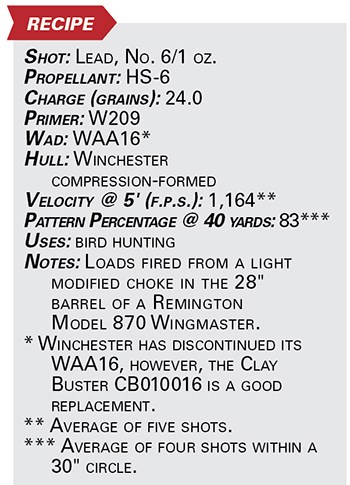 The 16 gauge is normally loaded with 7/8 oz. to 1¼ ozs. of shot. For decades, an ounce of No. 6 shot has worked well in several 16-ga. guns for our family hunting birds—from blue grouse to pheasants and sage grouse. Shotgunners after smaller birds, like Hungarian partridge and ruffed grouse, may want to switch to No. 7½ or No. 8 loads for clay-target shooting.
You’ve heard that the 16 gauge produces excellent patterns. Well, here’s proof—the light modified choke in a Remington Model 870 Wingmaster placed an average of 83 percent of an ounce of No. 6 shot in a 30" circle at 40 yards, with an average of 39 percent of the pellets landing within the 15"-diameter center of the patterns.
That pattern is too tight for shorter shots, however, like ruffed grouse in a creek-bottom thicket. Spreading shot for wide patterns at close range can be accomplished by inserting a Ballistic Products X-Stream spreader insert into shotcups with the shot. I take a less-expensive approach and cut index cards into rectangles, make a cut halfway up the center of each piece so two pieces slip together to make a “+” and fit them into a shotcup with the shot. A card 0.60" wide and 0.88" long fits into the shotcup of a Winchester WAA16 wad. The card spreader insert increased the usable pattern diameter by 4" and spread 30 percent more pellets out of the 15"-diameter center of the patterns at 20 yards.
—John Haviland, Field Editor
Most Popular