The Speed Draw

How fast can you draw and fire two shots? Can you do it before an attacker can get to you? You might be surprised.

According to FBI standards, 21 feet is the distance that an agent can engage an attacker with a knife. This is this the distance that a trained agent can defend his or her life. Now, what do you think are your chances? Try this drill to determine how fast you can draw and fire when an attacker is charging toward you.

The Speed Draw
This drill requires two people—a runner and a shooter—two objects that can be easily found on the ground and a silhouette target.
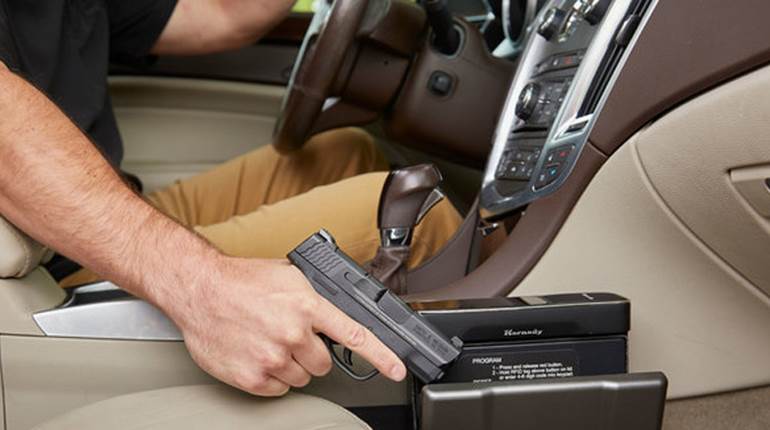
• The shooter stands facing the target about 7 yards (21 feet) away with the gun in the holster concealed by a cover garment.
• The runner stands facing in the opposite direction of the target to the side of the shooter and just far enough in front that the shooter can see him or her in the peripheral vision.

• The runner should be holding two objects that can be easily found on the ground, one in each hand.
• When both parties are ready, the runner takes off running in the opposite direction of the target.
• As soon as the shooter sees the runner take off, he or she draws and fires two rounds center mass of the target.
• At each shot, the runner drops one of the items.
• Once finished, make safe, holster and measure the distance.
• Then, swap roles and repeat.

I’ve conducted this drill many times as both the shooter and the runner as an example in my classes. Even against a skilled shooter, most runners can reach around 24 feet before the first shot and almost 30 feet by the second. Provides a good reason to practice your draw, doesn’t it?

Share |

Comments

ADD YOUR COMMENT

Enter your comments below, they will appear within 24 hours


Your Name


Your Email


Your Comment

3 Responses to The Speed Draw

Richard wrote:
August 11, 2011

This is called the Treller theory, or drill - so named after a Salt Lake City detective. He was the first to prove that an attacker could cover 21 feet in less time that an above average shooter could draw and effectively engage the threat. His theory held up in court and would be the model justifying the use of deadly force in such a scenario even today. Of course movement is ALWAYS the great equalizer in this instance--- as in most instances. I feel that if I were faced with this scenario tomorrow, I feel fairly confident (if I saw it coming) that someone would learn in the hardest way possible that it is best NOT to bring a knife to a gun fight - of course, I further cheat with the use of instinctive shooting techniques to further pick up the curve at close range. As always, just my 2cents worth - be safe.

Don Harris wrote:
July 12, 2011

Ever wonder why in a "felon" stop our troopers have their guns drawn when approaching the stopped vehicle?They want to have at least a chance of defending themselves in the even of an attack. A gun "in leather" is just a weight on your hip when you are ambushed.

Pete wrote:
July 09, 2011

No one is fast enough, despite what we learned from "Gunsmoke" and "Have Gun Will Travel." The only real defense is to PAY ATTENTION to your surroundings at all times. If it looks dangerous, IT IS. Move away from the threat to give yourself time and distance to react...and you will often find that simply by adding distance, changing direction, etc., the potential attacker will realize you are on to her or him and move on to a weaker target.