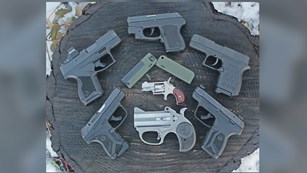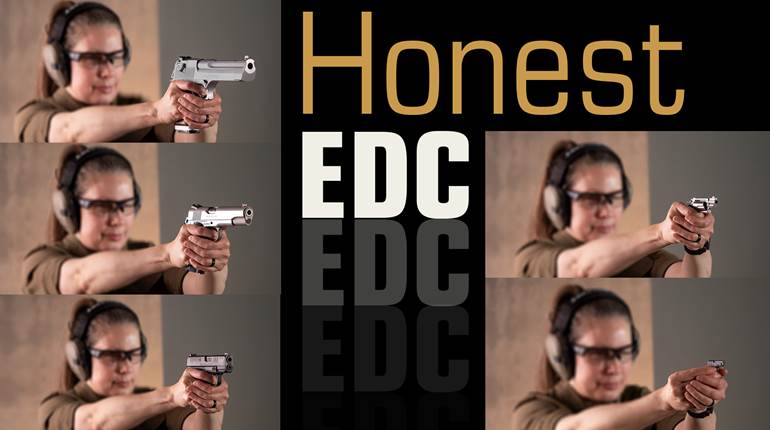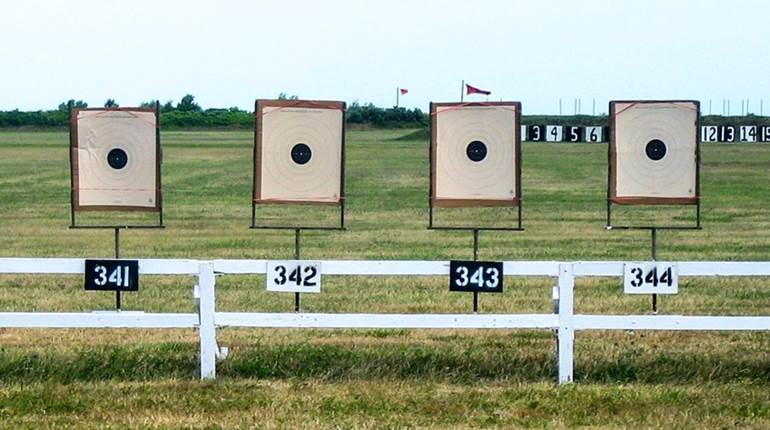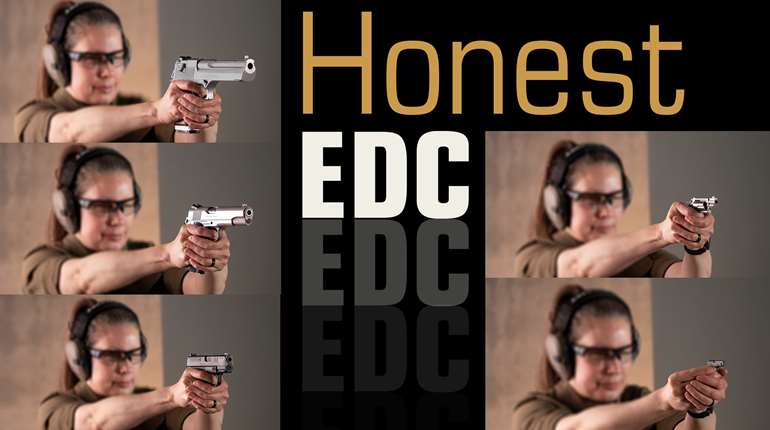
I stumbled onto a new website not long ago. The author was doing a pretty good job of evaluating the usefulness of a number of handguns that appealed to him. With an open-mind approach, he was shooting the subject pistols and revolvers in a number of different exercises, including accuracy at 25 yards and controlled pairs at 7 yards. Since I have been doing pretty much the same thing for more than 25 years, I appreciate the effort that goes into doing this, but I sometimes wonder about the precision of the information I have developed and reported over the years.
When you are attempting to tell an informed readership about the accuracy of a particular handgun, you have to remember the several screens you are working through. For one thing, the gun is nothing without ammunition. In any caliber, there is a wide range of accuracy performance in the several different loads from any given maker. There are probably three or four dozen different loads available from each manufacturer in popular calibers such as .45 ACP and .357 Mag. You can't possibly shoot all of them to determine the most accurate for the gun, but when you do get good results with a particular load, it's time to try it in other guns and lay in a test supply if it proves to be a consistent performer.
It's also important to look at how you are shooting the gun since the skill of the shooter is very important, as is the technique he or she is using. The handgunner's ability to align the sights, assume a proper sight picture and smoothly release the trigger is a function of training and experience. Shooting one-handed standing is much harder than sitting at a bench with the pistol on sandbags. If you are trying to evaluate the gun, the ammo or the gun and the ammo, then you have to remove as many human variables out of the equation as possible. Sandbags on solid benches (preferably concrete), combined with several kinds of commercially available rests have made gun articles much more credible than they once were, and more gun writers seem to be going about their work in this fashion.
Now before I set out to be a gun writer, I bought two pieces of equipment that are still in use and still accompany me to the range. One of these is an Oehler chronograph, used to measure and analyze the velocities of ammunition. There's often a little more information than just average velocities that come from Ken Oehler's magic box. If you learn to use it well, it will tell you things about the quality of the ammunition. However, the other device—the Ransom Rest—is even more useful. Chuck Ransom's original device has been manufactured in pretty much the same way since the 1960s. This mechanical device holds a handgun during firing and recoil in such a way that it returns to exactly the same spot with respect to alignment with the target. This permits the shooter to literally fire hundreds of rounds of ammunition at exactly the same spot. This way, you can evaluate many kinds of ammo in the same gun, or by changing the gun, you can evaluate the accuracy potential of different guns using the same ammo.
I have been accused of all manner of wrongdoing for using this device. Some of the critics feel that I am cheating, while others claim that the gun can only be measured by firing in the human hand. I believe that removing the human element simply makes the information derived much more reliable. If the Ransom Rest has any limitation in my opinion, it lies in the fact that the maker can't provide grip inserts for everything on the planet.