America’s first metallic cartridge was a .22 rimfire, and it was introduced more than 150 years ago. While that little .22 Short was first fired in Smith & Wesson’s tip-up revolver, it went on to broader use in many rifles. Because of its modest price, low noise and minimal recoil, those early.22 rimfire revolvers were very popular handguns. Some Civil War officers even carried them in pockets as defensive firearms. They must have been hugely optimistic, because a .22 doesn’t have a large enough bullet or velocity to be an ideal fighting load. This does not change the fact that the .22 rimfire handgun has long been a big part of a handgunner’s battery.
Along the way, there have been many other .22 cartridges, and most of them have been chambered for pistols or revolvers. One that hasn’t made its way into handguns is the .22 Winchester Auto, which is the initial and only round used in Winchester’s Model 1903 rifle. As a kid, I made a slick trade for one and painfully recall the anguish of having a neat little rifle for which there was no ammo. A very similar—but not interchangeable—cartridge is the .22 Remington Auto. Aside from a few oddities like the .22 Extra Long, most.22 rimfires are still in production. Both the .22 BB Cap and .22 CB Cap are efforts to reduce the range and power of the .22 for indoor practice and pest control. On the other side of things, there was an effort to get more power from the .22 with the .22 Winchester Rim Fire (.22 WRF). Initially made for the Winchester 1890 rifle, it was also used in some Colt revolvers. This was a step up the power scale from the .22 Long Rifle, and the WRF lasted until 1959 when the .22 Winchester Magnum Rimfire burst on the scene. Earlier .22 WRF ammunition will work in a .22 WMR arm, but not vice versa. The .22 WMR is the king of rimfire cartridges in the power sense. The latest news in the .22 WMR story is the development of short barrel loads for snubby revolvers.
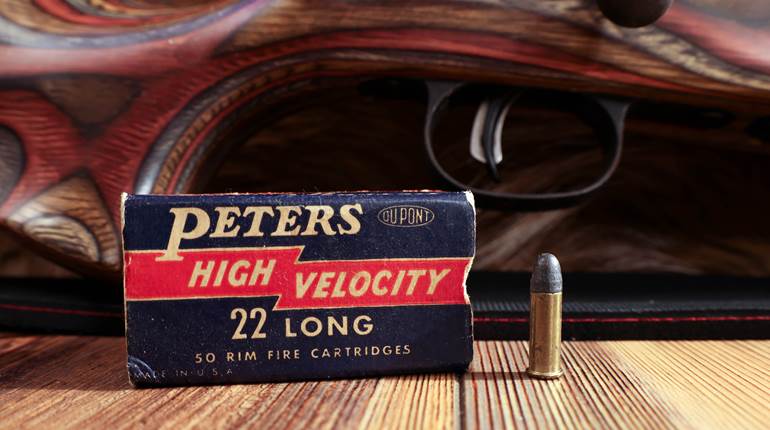
We got the .22 Short in 1857, the .22 Long in (about) 1871 and the .22 Long Rifle in 1887. These three cartridges, along with the .22 WMR, constitute the greatest majority of American rimfire shooting. To be even more specific, most is done with the .22 LR and the .22 WMR. There is a bewildering array of ammo on the market for these two rounds, and while the WMR is more powerful, America’s most popular cartridge remains that nifty little .22 Long Rifle.
Most Popular