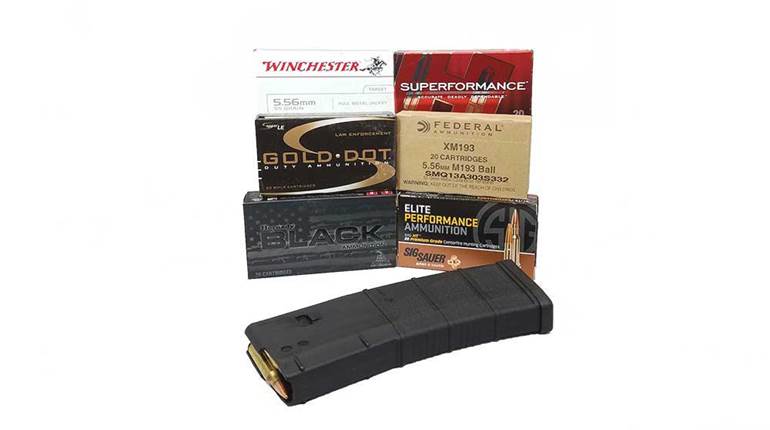
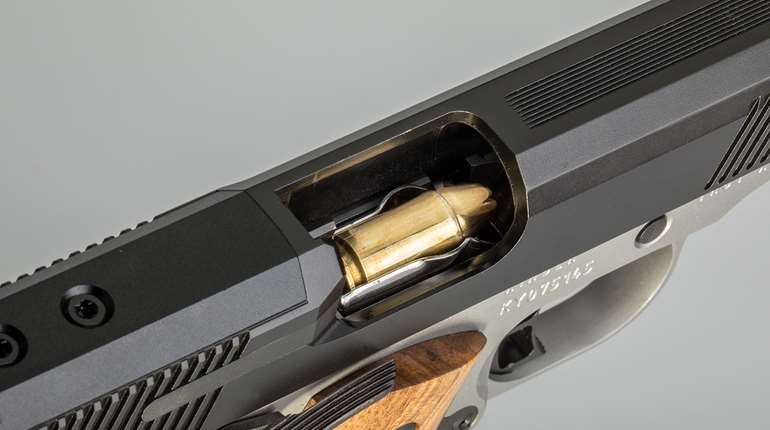
The U.S. military is soon to field a new projectile in its standard issue 5.56 mm NATO cartridge. There are two purposes to the new projectile: increased performance and less toxicity in the environment (i.e., lead-free).
The new round is designated as the M855A1 and it shares identical weight and velocity to the current M855, 62-grain bulletat around 3,100 fps. The difference is the bullet’s construction, which while similar, is changed from the steel-shank, lead-core, copper-jacketed SS109 projectile of the M855 round.
The new A1 projectile is also tipped with a steel penetrator, but unlike the SS109, the steel tip is bronze coated to prevent corrosion (instead of being painted green) and features a more aerodynamic shape that called a “steel arrow head.”
Instead of a lead core behind the steel tip, the A1 projectile features a solid copper core. The copper jacket that encases both the cooper core and the “steel arrow” is of an unusual design with a “reverse drawn” process.
As we know from the Insider’s favorite hunting bullet, the Barnes X, a solid copper bullet of the same weight as a lead core bullet is going to be longer since lead is denser than copper. That’s true with the A1 bullet as well, although the Picatinny Arsenal which developed the M855A1 has not yet divulged specific details like the bullet’s length, ballistic coefficient or sectional density. Picatinny does, however, note that the M855A1 has a higher chamber pressure than M855, but does not provide a number.
In a prepared statement, the Dept. of Defense described the evolution of the new round:
“In post-combat surveys and field reports from Iraq and Afghanistan, most soldiers have indicated that the (M855) works fine, delivering the desired effects against threat targets. But some soldiers have reported that the round did not perform consistently, causing concern in the ammunition community.
“In parallel, mounting environmental concerns drove the Army to consider replacing environmentally unfriendly materials such as lead. The Army's ammunition community, led by PEO Ammo, saw an opportunity to address the two concerns associated with the M855 round—lead and consistency.
“The Army's solution is the new M855A1 Enhanced Performance Round (EPR). This round offers better performance than the M855 against all targets likely to be engaged with small arms. This is quite a feat, considering the long-standing solid performance of the M855.”
The Insider is trying to procure a box of M855A1, but this will be tricky. When Colt engineers were invited to the Aberdeen Proving Grounds to test fire the new round in the Colt M4, they were told in no uncertain terms that the removal of a single cartridge, or even a spent casing, would result in criminal prosecution—no exceptions.
I was in the Colt factory earlier this week and Colt, even as a military contractor for the M4 rifle, still does not have any M855A1 for test firing.
If I come up with any… mum’s the word.