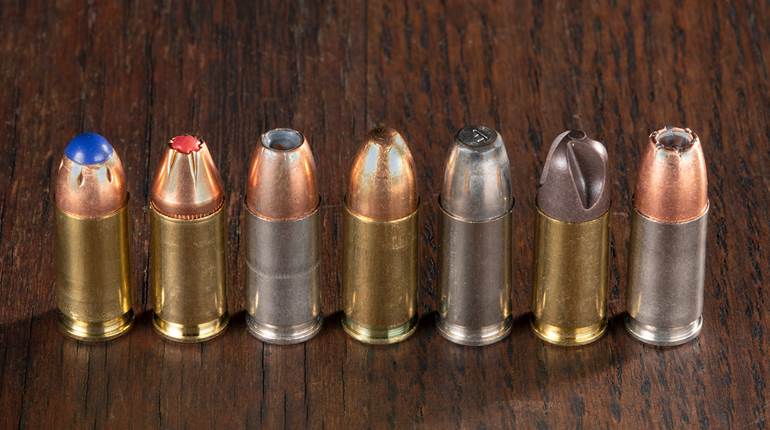
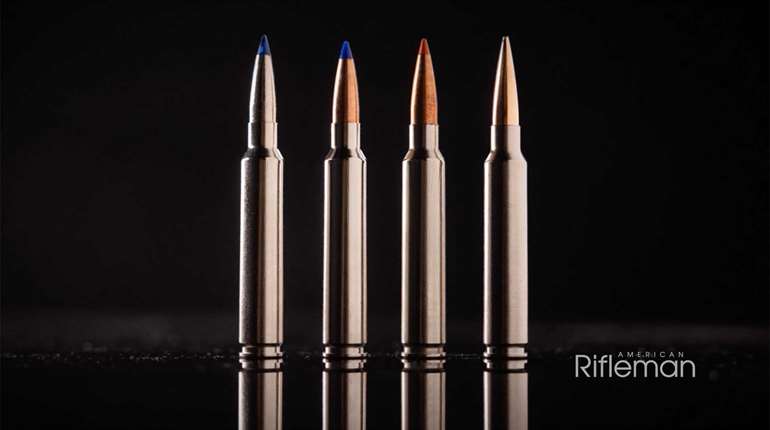
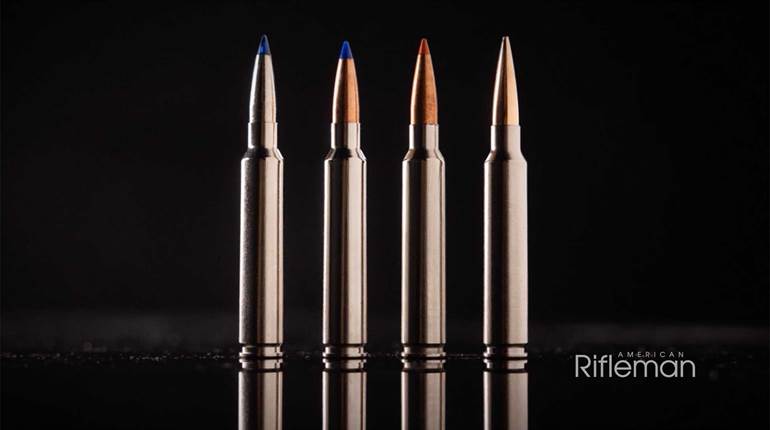
The hollow-point bullet is a staple of combat handgunning, but it is a widely misunderstood device. I’d like to get into this subject in order to put the JHP in a better light. To begin with, the current trend in defensive bullets and ammunition might be best described as expanding, rather than just hollow point. That’s because the only type of bullet that expands on impact was, for years, the JHP or Lead HP. For many reasons, the bullet engineers are now building a few expanding ones that use other mechanisms to cause the bullet to increase its diameter in the target medium. Why?
The basic reason is to regulate the manner in which the bullet’s developed energy transmits to the target. A moving bullet’s striking energy is a function of its weight and velocity. A good example is the standard .45 ACP load, a 230-grain FMJ slug at 850 feet per second, which produces 369.9 ft.-lbs. of kinetic energy at the muzzle. If you use the same powder charge and a well-designed expanding bullet that also weighs 230 grains, you will get exactly the same energy. But the expanding bullet will deliver its energy in a much different way. The much harder ball round is far less likely to deform or expand in the tissue of an attacker, and often completely penetrates the target. This means that the energy you paid for in weight, recoil and muzzle blast is wasted beyond the target. It might even be a hazard to downrange objects or people. If you add more velocity-say another 100 fps-you get 460.1 ft.-lbs. of energy and an even greater tendency to penetrate and possibly over-penetrate.
It is a completely different story with expanding bullets. Their performance varies with maker and design, but the design philosophy seeks to create a bullet that is fragile at the striking end. A bullet of this type begins to deform on impact and expands to a greater diameter as it progresses through the target medium. Since the bullet is spinning as it continues forward, the expansion process is often well controlled. Details of both bullet core and jacket, their bonding, internal cavity configuration and other factors increase or decrease the amount of expansion. The bullet engineers can create reliable expanders at pistol velocities-bullets that expand to as much as 50 percent more than their original diameter. The rate of expansion produces an interesting effect.
A given bullet is usually developed to work best at a typical velocity. If you increase velocity (as in many +P loadings), the bullet will not penetrate more, but rather less. That’s because the increased velocity also increases the rate of expansion. In other words, the faster load reaches greater diameter more quickly and there is a quicker braking effect. Winchester Ranger SXT, a 230-grain JHP at 850 fps penetrates about 14 inches of ordnance gelatin, while its +P counterpart at 950 fps does about 10 inches. There are some exceptions to this rule, but in general, this is what happens. Tactically, an expanding bullet is probably a better choice because the developed energy stays in the target and there is less chance of collateral damage via over-penetration.
Most Popular