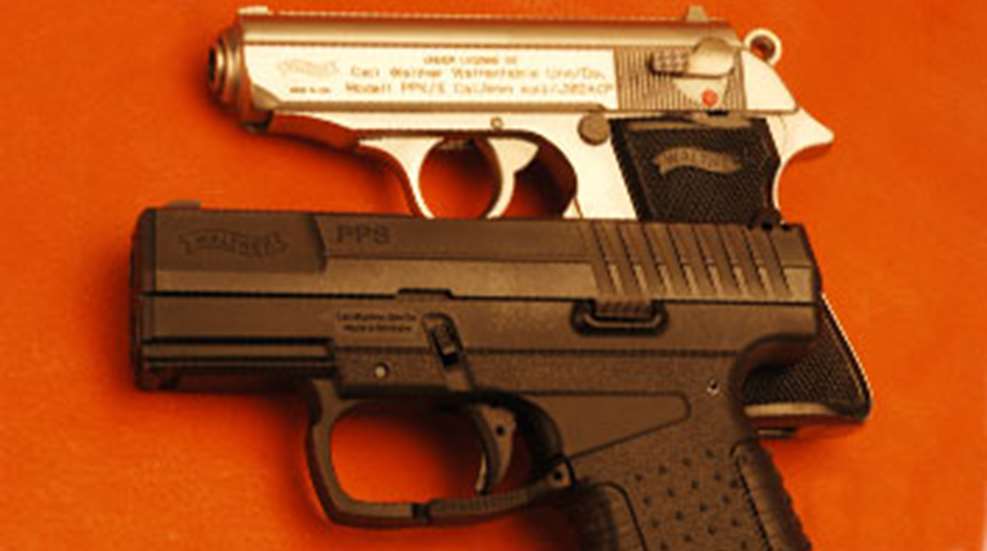
Reader “MJ” sent an e-mail in which he voices his confusion over the proper use of the terms “blowback” and “recoil operated.” He went on to say that he had completely failed to understand why the barrel on his new Ruger LCP was flopping around. Enough similar questions have come my way that I think it's probably time to revisit this business of how semi-automatic pistols work.
This class of firearm came into common use right around the turn of the last century. Many designers had noticed that two things happened when you fired a round from a handgun. One, the bullet left the cartridge, spiraled down the barrel, exited the muzzle and headed toward the target. Two, the gun moved violently back in the shooter's hand. The act of firing developed a rearward motion and some designers saw that if it could be harnessed, it could be used for productive work. In short order, we had the first automatic handguns, which I believe picked up that designation because they automatically reloaded their own chambers. This new style of handgun most commonly had a lower receiver with a removable magazine of cartridges in the butt and the trigger/hammer mechanism. The top half of the pistol (slide) moved (or “recoiled”) on rails and was pressed forward by a strong coil spring.
Depending on the nature of the cartridges to be used, a pistol with a fixed barrel, heavy slide and strong recoil spring will work quite well. The concept calls for keeping the slide closed until the bullet leaves the muzzle and gas pressure drops abruptly. If you don't, burning powder and hot gasses will come out the ejection port and injure the shooter. Since the recoiling upper of the gun is at rest when the shot is fired, it wants to stay at rest. A heavy slide and a strong recoil spring will work to keep the slide in position for the millisecond that it takes the bullet to get all the way down the barrel and out. Then residual energy causes the slide to move back against the pressure of the recoil spring and the rest of the extraction, ejection, feeding, chambering, etc. cycle occurs. As long as the pressure is fairly modest, this system works quite well and is easy to manufacture. In precise terminology, this is called a blowback system. Most commonly, its use is confined to small-to-medium sized autos in cartridges such as the .25 ACP, .32.ACP and .380 Auto. Understand that it would also work with much more powerful rounds, but building the gun to fire higher pressure rounds would demand a slide so heavy you wouldn't or couldn't carry it or a recoil spring so strong that you couldn't rack the slide. Or possibly both. As a practical matter, such a gun is unworkable.
For more powerful rounds, the designers found ways to lock the barrel and slide solidly together until the heavier, faster-moving bullets left the muzzle. These guns also have a fitted barrel, moving slide and strong recoil spring, but they are designed in such a way as to mechanically lock the barrel to the slide. For a very short distance of initial slide travel, the barrel is fixed to the slide. When pressure drops, the natural recoil process operates an internal cam mechanism, which causes the barrel to unlock from the slide, stop and then allow the moving slide to complete its rearwards travel. In this fashion, we can truly state that the system is recoil-operated. This is the way that most service automatic pistols work, and over the century-plus they've been in existence many designers have found different way to accomplish the locking/unlocking process. I have just been playing with a Beretta that uses a rotary barrel locking system and recall that the service Beretta, Model 92 or M9, uses a pivoting locking block first developed by Walther. There are a couple of other types, but the vast majority of pistols rely on the basic system developed by John Browning. Here, the barrel-to-slide lockup has the barrel tilting up to lock integral lugs into recesses in the slide or the entire breech end of the barrel locking into the ejection port. On recoil, they stay together until an underbarrel cam moves the barrel down out engagement with the slide. This system was first used on Colt and Browning pistols and now finds its way onto many other makes. It is simple, has become easy to manufacture and has particular use in today's shooting world.
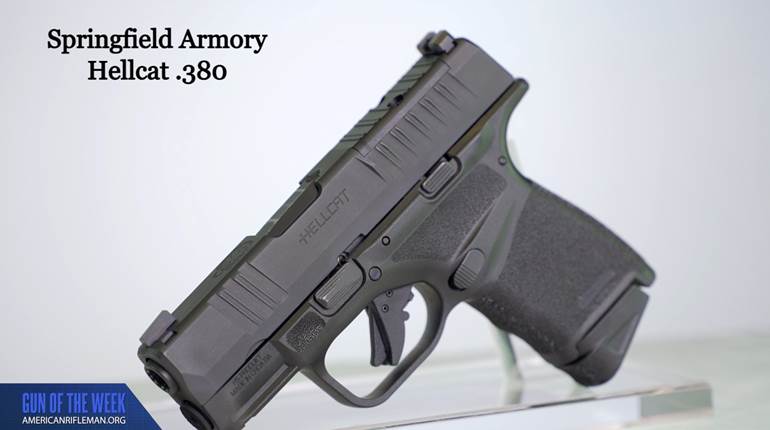
Yesterday's .380 autos were almost exclusively blowback guns, but a blowback pistol for current ammo must have a certain amount of size and weight. If you take the same basic locking system used in a .45 automatic and scale it down to fit a much smaller gun, you can actually use this type of mechanism to build a light, portable pistol chambered for .32 and .380 cartridges. You can do the same thing with a 9 mm pistol and there are many out there. If 9 mm recoil is intolerable, the mini-.380 —with a modern, recoil-operated system—is an alternative. Ruger, Kahr, Sig Sauer, Smith & Wesson and Kel-Tec among others are some of the available choices.