I talked about the 5.5 mm Velo Dog cartridge a while back and referred to its use as the parent cartridge for Col. Charles Askins' wildcat .22. This prompted readers to write and ask for more information about this long ago effort by the legendary adventurer/author/soldier/shooter. It's been awhile since anyone has written this one up, so let's take a look at one of the more clever—but controversial—wildcats of all time. It dates to before World War II and only one gun was ever made for this round.
Just before WWII got rolling, Charley Askins was the reigning National Pistol Champion in a highly competitive game. This was the old Camp Perry bullseye game, which featured a slow, timed and rapid fire aggregate of 90 rounds with three handguns—a .45, a .22 and an “any center-fire.” It's still the same basic course, but certain rules have changed to permit optical sights, etc. In those days, this was a sport closely watched by many large segments of the public. Large military teams showed up, as did a number of police agencies. Immense prestige accrued to the annual winners, which drove the competition ever more powerfully. One perennial winner was the U.S. Border Patrol, an organization of which Askins was a member. A working Patrol officer, Askins was well known for getting into shooting situations with smugglers and other criminal types. One night, he took a Velo Dog revolver from a contrabandista in the course of arresting him.
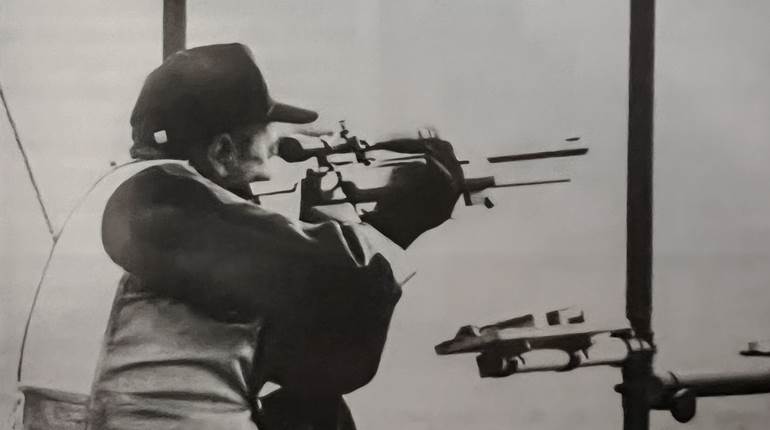
The gun was lightweight junk and went in the trash. The ammo, however,was interesting and Askins kept it. That ammo was a long skinny .22 center-fire round, close in dimensions to the old .22 WRF. Center-fire is the key word in this equation, because the Velo Dog cartridge easily made the definition of “any center-fire.” Askins was competing primarily with autos, using an early Match grade 1911 for the .45s stages and a Colt Woodsman for the .22 events. He had no choice but to use a .38 revolver for the center-fire, as did almost all other competitors. Charley wanted to use an auto for center-fire, but there were none available. So he made his own, using a wildcat .22 round based on the Velo Dog cartridge. First he had to get the dimension of the Velo Dog down to approximately the same as that of the .22 Long Rifle. This was very complicated and included shortening the case, reducing the diameter of the rim and reaming the case mouth to accept .22 bullets. Tedious, but it was not as hard as converting a King Woodsman to fire the stuff. Buchanan, an ace pistolsmith, changed the gun to center-fire, modified the breech face and extractor for the thicker rim, and then opened the chamber and modified the magazine feed lips for proper feeding. It was cut-and-try gunsmithing, but they made it work.
Dubbed the .221 Askins, the new round was an almost recoilless winner and the good Colonel started taking all the marbles in every match he entered. As Camp Perry approached, the word was out that Askins couldn't be beaten—his new gun and ammo raised his center-fire scores by an average of 9.7 points per string. For reasons that I can't completely understand, his innovative—but within-the-rules—gun was regarded as cheating by the disgruntled competition. It should be obvious that anyone was free to do exactly the same thing and therefore enjoy the same advantage. Eventually, Askins' boss caught so much flak that he started leaning on him to abandon the concept. At Perry, Askins waited until the last minute before withdrawing from competition. The rules of the game were quickly changed to preclude any caliber smaller than .32. In those days, the competitive atmosphere was such that something as unusual as this could be allowed to happen. Askins developed a breakthrough gun, but it was falsely perceived to be taking an unfair advantage.