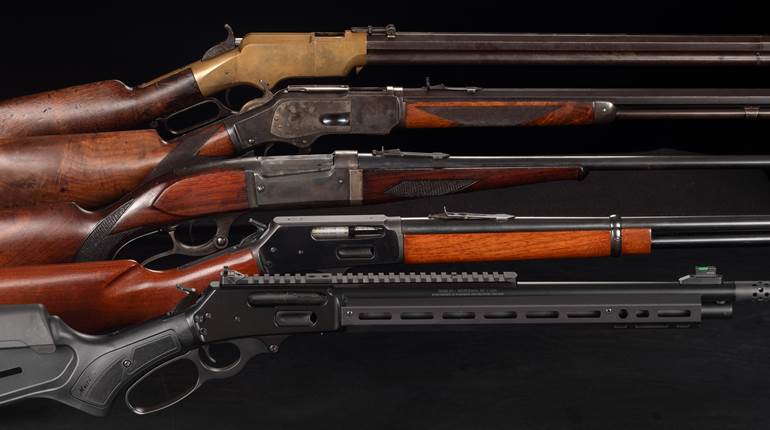
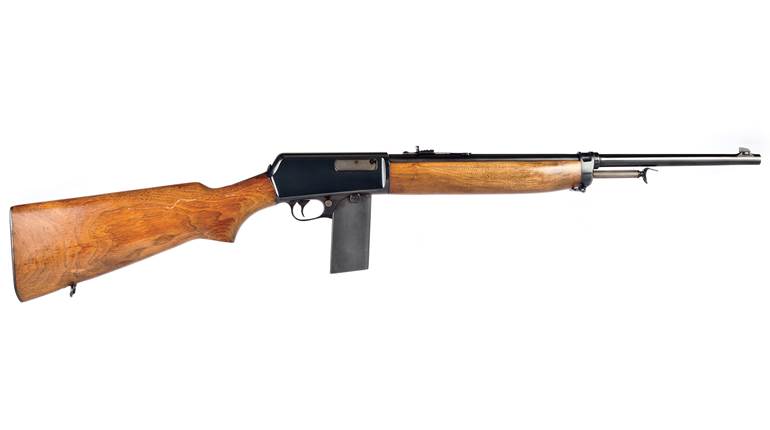
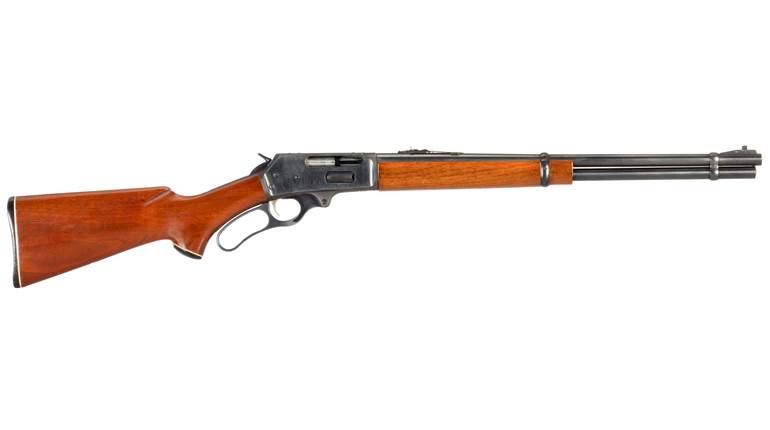
Just as there are extraordinary individuals who have, in the words of Hamlet, “shuffled off this mortal coil” to become enshrined in immortality, certain guns have transcended their physical trappings of wood and steel to become legendary in the annals of firearm history. Such a gun is the Winchester Model 1894, John Moses Browning’s ingenious culmination of the lever-action rifle combined with a tubular magazine.
While the Winchester ’73 may have been ‘the gun that won the West,” the Model 94 was the gun that galloped past the closing days of the frontier and maintained Winchester’s lever-action lead throughout the 20th century and into the 21st. That historic ride lasted for 112 years, thus making the Model 94 one of the longest continuously produced rifles in the world. But it was abruptly reined-up short on Jan. 16, 2006, with the announcement that the Winchester factory in New Haven, Conn., would be closing within three months. With more than 7 million guns produced, the Winchester 94 was to be no more.
Winchester lever-actions are some of the most collectable and fastest-appreciating firearms. Consequently, 24 hours after the news media broke the story of the factory’s closing, there wasn’t a Model 94 left in Winchester’s warehouse; dealers had snatched them all up almost as rapidly as consumers were buying them.
For many of us, knowing that the Winchester 94 was no longer in production was like losing an old friend. My first hunting rifle was a used .30-30 Win. flat-band 94 purchased as a teenager in 1960 at Pinney & Robinson’s Sporting Goods in Phoenix. Later that year, I took my first deer with it, and it accompanied me on many a desert and mountain jaunt. Even when not hunting, it felt good just having it along. The carbine came with a saddle scabbard stamped “Marfa, Texas.” Although I have acquired numerous Winchester 94s since, I still have that carbine and scabbard.
Not surprisingly, the factory’s closing increased demand for the Model 94, but it was too good a gun to go away forever. However, there needed to be a reason to bring it back. Now, in celebration of the 200th anniversary of Oliver Winchester’s birth in 1810, Winchester Repeating Arms has resurrected the Model 94 for a limited run of 500 Model 1894 Custom Grade and 500 Model 1894 High Grade rifles, each with embellishments reminiscent of options once offered by the factory.
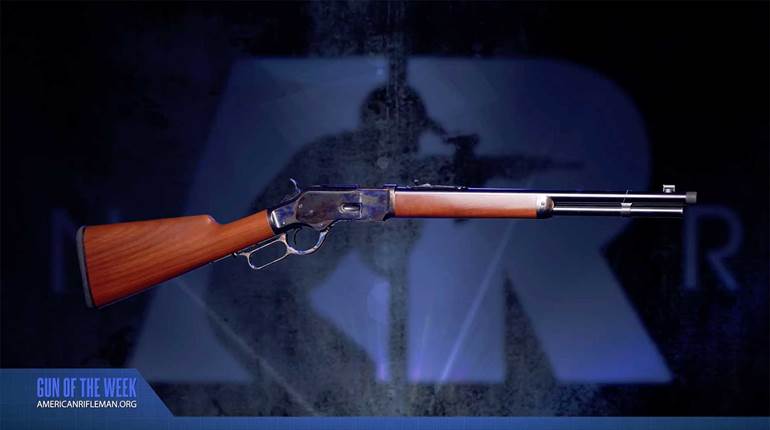
Expertly made in Japan by Miroku—the same company that crafted the re-issues of the Winchester Models 1885, 1886, 1892, 1895, plus the Model 71 —both Custom Grade and High Grade rifles feature 24-inch half-round, half-octagon barrels topped with Marble’s buckhorn rear and gold bead front sights, plus checkered high-gloss walnut stocks with crescent buttplates, and angle eject actions. Appropriately, the rifles are chambered in .30-30 Win., the cartridge synonymous with the Model 94.
The Custom Grade, priced at $1,959, has Grade IV/V walnut and is richly blued with scroll engraving and gold accents. The right side of the receiver depicts a gold portrait of Oliver Winchester alongside a gold banner proclaiming “1810-2010 —Two Hundred Years—Oliver F. Winchester.” The receiver’s left side features a gold 1890s “WRA” logo with scrollwork. The top of the bolt sports Oliver Winchester’s signature in gold and the barrel is gold-inscribed “One of Five Hundred.”
At suggested retail price of $1,469, the High Grade features high-gloss fancy Grade II/III walnut and the same engraving patterns on the receiver as the Custom Grade, but is differentiated by a “French gray” silver nitrate finish without gold accents. However, like the Custom Grade, the blued bolt features Winchester’s gold signature. Five hundred Custom Grade and High Grade rifles will be offered as two-gun sets with matching serial numbers, but dealers may sell them individually. Up to 5,000 additional High Grades with unique serial numbers will be available as well.
Nearly five years have transpired since the closing of the Winchester factory, and this limited edition pays tribute to the New England shirt maker whose name has come to personify the first successful lever-action repeater. But the saga of the Model 94 has been a much longer journey, one that began when Oliver Winchester paid John Browning $15,000 —the same amount he had received for his Model 1886 and 1892 patents—for rights to manufacture what was destined to become the first repeating rifle adapted to smokeless-powder cartridges. Specifically, it was the .25-35 Win. and the .30 WCF or, as the latter came to be known, the .30-30 Win., which would become indelibly linked to the Winchester 94.
Ironically, metallurgy problems initially kept these two smokeless loadings from being introduced with the rifle for which they were intended. Thus, in 1894 the newest Winchester made its debut with two older blackpowder cartridges, the .32-40 Win. and .38-55 Win. It wasn’t until a year later that the Model 94 came out in its much-touted .25-35 Win. and .30 WCF chamberings. But nickel steel barrels weren’t the rifle’s only new features.
Unlike the twin sliding rods of the Model 86 and 92, the Model 94 had a single bar, which contained the firing pin and slid up and locked between the hammer and the closed bolt, thus providing a greater margin of safety. In addition, the new rifle had a hinged receiver floor that pivoted downward when the lever opened the action. It wasn’t quite as smooth as its two predecessors, but it was a lot stronger.
Rifles with 26-inch round or octagon barrels were offered, along with a 20-inch-barreled saddle ring carbine. In addition, special-order Model 94s were produced with half-round, half-octagon barrels, take-down versions, special engraving and checkering patterns, and in a variety of barrel lengths, including rare “Baby Carbines” (since dubbed “Trappers” by collectors) that sported 14-, 15-, and 16-inch barrels.
The Winchester 94 met with immediate success, especially in its .30-30 Win. loading, which propelled the original 160-grain soft-point bullet out of the muzzle at 1970 fps. This extended the lever-action’s effectiveness, as the same sight picture could be used out to 125 yards and still result in a hit on a deer-sized target. Small wonder that some have credited the Model 94 with putting more venison on the table than any other rifle in history. It became a favored firearm not only for hunters, but also as a working tool on ranches and farms. Also, because its large trigger guard accommodated gloved hands, it was the rifle of choice during the 1897 Alaskan Gold Rush, causing the Winchester 94 to be christened “The Klondike Model.”
In addition, law enforcement agencies, such as the Los Angeles and Glendale, Calif., police departments, various railroad police and the Texas Rangers added the Winchester 94 to their gun racks. And during World Wars I and II special Ordnance-marked Model 94 carbines were issued to U.S. troops stationed along the Mexican and Canadian borders, as well as to home guard units. Through the years the Model 94 was used by such diverse individuals as frontiersman Nat Love, presidential sportsman and NRA Life member Theodore Roosevelt, and Texas lawman Tom Threepersons, all of whom favored the Model 94 in .30-30 Win.
So closely has the Model 94 remained identified with this cartridge that I remember, growing up in Arizona, any Winchester 94 was generically referred to as either a “thuty-thuty,” or a “treinta-treinta,” no matter what its actual caliber might have been. Today there is still an obscure brand of tequila called “30-30” that, up until recently, depicted a Model 94 carbine on its label.
The rifle-length Model 94 was discontinued in 1924 and through the years various changes were made to the carbine. But the most dramatic occurred in 1964, when, in what is now recognized as an ill-advised move, manufacturing procedures were modified to reduce costs. Thankfully, by 1967 the company realized it had done something terribly wrong and steps were gradually taken to restore the Model 94 to its former glory. Nonetheless, that chapter in the Model 94s history has provided collectors with the designations of “pre-’64” and “post-’64” Winchesters. But in many ways the revitalized Model 94 today is a better gun than before.
For example, one year after U.S. Repeating Arms Co. licensed the Winchester name (which is owned by Olin Corp.) in 1981, “Side Eject” was added, which finally made mounting a scope on the Model 94 practical. Then, in 1990, USRAC asked for my input regarding tweaking the Model 94 to overcome sagging sales in a sluggish economy and its “post-’64” stigma. As a result, the wobbly, rattling action was tightened and quieted by bringing back the old-style link pin and adding a wave washer. More visibly, rather than being stamped, the loading gate was once again milled out of solid steel, just as on the “pre-’64” guns.
Legal concerns eliminated the half-cock notch, but it was replaced with a trigger-block safety and a trigger return spring that reduced rattling. Unfortunately, a dished-out, push-button safety was eventually added, blemishing the Model 94s handsome, flat-sided receiver. But on Jan. 1, 2003, I could imagine that the cheers among Model 94 aficionados weren’t to celebrate the New Year, but because Winchester announced that day the ugly button had been replaced by a much less obtrusive tang-mounted safety.
In 1964 the Model 94 launched another new era with the Wyoming Diamond Jubilee, the first Winchester Commemorative, which opened up a whole new collecting field by honoring everything from the Golden Spike Centennial to the NRA. But perhaps none are as symbolic as the two new Oliver Winchester Model 94 Limited Editions, which are a tribute to the gun as much as to the man who gave it his name.
Because of this, I felt compelled to see how this reincarnated Winchester handled on the range. Although its 5-pound trigger pull was not conducive to the utmost accuracy, from a solid rest and using Winchester 170-grain Power-Points, I was able to print a 1.5-inch, 75-yard five-shot group. Of course, ideally I should have been using the limited-edition Oliver F. Winchester commemorative 150-grain Power-Point ammunition, but it wasn’t ready in time for this article. Still, like the rifles themselves, I know the wait will be worth it.
Manufacturer: Miroku Firearms Mfg. Co., Japan
Importer: Winchester Repeating Arms Co.; (800) 333-3288; www.winchesterguns.com
Caliber: .30-30 Win.
Action Type: lever-action, center-fire repeating rifle
Magazine: tubular under-barrel, eight-round capacity
Receiver: blued steel with scroll etch-engraved design with gold accents, (Custom Grade); Silver nitrate with scroll etch-engraved design (High Grade)
Barrel: 24", half-round, half-octagon
Stock: high-gloss checkered walnut with classic 1890s Winchester pattern, fancy grade IV/V walnut (Custom Grade); fancy grade II/III walnut (High Grade)
Overall Length: 42"
Weight: 8 lbs.
Suggested Retail Price: $1,959 (Custom Grade); $1,469 (High Grade)
Note: 500 two-rifle sets consisting of a Custom Grade and High Grade with matching serial numbers will be produced. In addition, up to 5,000 individual High Grade rifles may be offered for sale.
Most Popular