3/20/2013
At the outset of World War I, the Russian Army was the most formidable land force in the world—on paper. With almost 3 million men in uniform, it was a potential juggernaut that terrified the German general staff. The only problem was that supplies and equipment were woefully short. More than a third of the army didn’t even have firearms. A solution came from a most unlikely source when Winchester’s all-American Model 1895 lever-action rifle entered the service of the Czar.
The standard-issue Russian infantry rifle at the time was the Model 1891 Mosin-Nagant. It was a very good bolt-action repeater, but the Russians simply couldn’t make enough of them. At the Battle of Tannenberg, for instance, half of the Russian infantry went into battle unarmed and had to pick up the rifles of their fallen comrades.
That woeful shortage of arms caused the Russians to turn to the neutral United States for help. As well as contracting with Westinghouse and Remington to make Mosin-Nagants, they went to Winchester and ordered 300,000 musket versions of the Winchester Model 1895 lever-action, chambered in the 7.62x54 mm R Russian service cartridge. Ultimately, more Russian 1895s would be manufactured than any other variant.
Though it may seem unlikely, the Model 1895 was an excellent choice. Winchester was already tooled up for it, and the action was strong enough to handle the stout Russian cartridge. The rifle was John Browning’s first lever-action designed for smokeless propellant. All that was needed to convert it from a sporting configuration to a military one was to extend the barrel length and fit it with a bayonet lug and charging bar so the gun could be loaded by way of stripper clips. Actually, the 1895 musket was not really a new arm. In 1898, the American secretary of war had ordered 10,000 of them for use during the Spanish-American War, but the conflict was so short they never made it to the front. Later on, some saw service in the Philippines. Those guns did not have charging bars as the American battle rifle of the period, the Krag-Jorgensen, was not clip-loaded.
Until that time, all lever-action rifles fed from a tubular magazine, but the spitzer bullets of the new high-powered smokeless cartridges made that hazardous because of the danger of rounds being set off when placed nose-to-primer in the tube. The Model 1895 eliminated the problem with a five-round box magazine that was loaded through the top of the receiver.
The Model 1895 didn’t have a safety catch, relying instead on a hammer half-cock position to do the job. The lever though, had a hinged lower portion that locked into position and prevented the action from being opened unless the shooter’s hand was actually pushing down on the loop.
More than 293,000 Model 95s were built for the Russians in 1915 and 1916, though obstructive antics by Russian inspectors caused a number of 1895s to arbitrarily be condemned, even though they were entirely serviceable.
With the onset of the Bolshevik Revolution and the withdrawal of Russia from the war, the 1895’s fate becomes somewhat cloudy. Some have turned up with markings that indicated they were sent to Republican forces during the Spanish Civil War, and others ended up in Finland and Germany, among other places. Many thousands were later re-imported to the United States in the early 1960s where they were sold for as little as $35.
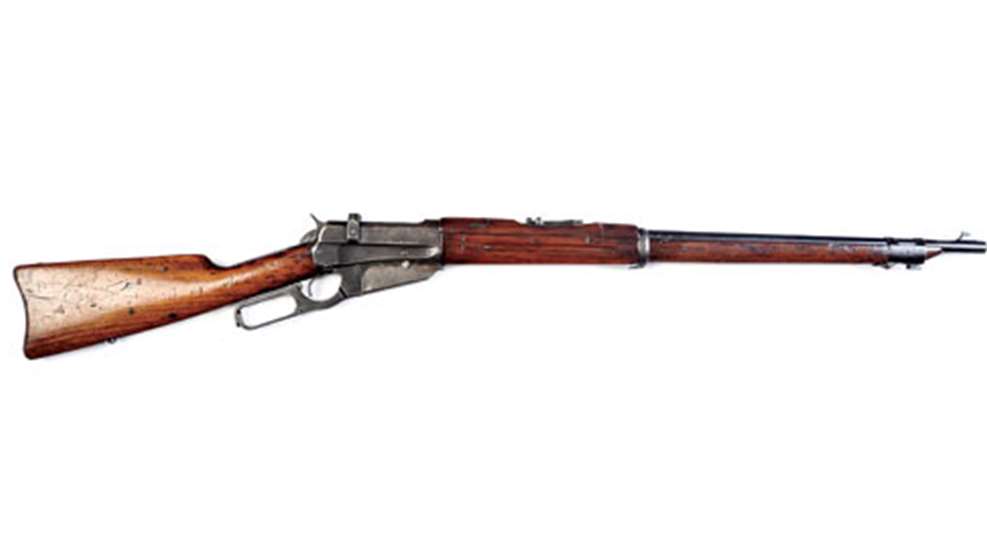
The Russian 1895 shown here is in NRA Antique Fine condition, retaining about 40 percent of the original bluing. Also, its stampings—the Winchester address, patent dates, serial number and caliber designation along with the Russian standard proof and various other stock marks—are clear and sharp. There are some initials scratched lightly on the left side of the stock, which do not affect the gun’s overall appearance or value. In such condition the rifle is worth in the $1,500 to $2,000 range.
Gun: Model 1895 Russian Musket
Manufacturer: Winchester Repeating Arms Co.
Serial Number: 168122
Condition: NRA Antique Fine
Caliber: 7.62x54 mm R
Value: $1,500 to $2,000