1/23/2013
During the Revolutionary War, the Americans fielded a cacophony of British, French, German, Dutch and home-grown products, which created an inventory of different styles and calibers of varying degrees of serviceability. A few years later the United States decided to create its own indigenous military arms. The first U.S. pistol was the Model 1799 North & Cheney—an ungainly-looking flintlock that was modeled on the equally unprepossessing French Model 1777. Manufactured between 1799 and 1802, only about 2,000 of the unique, brass-framed smoothbores were made.
In 1805, the U.S. introduced the Model 1805, a very Yankee-looking pistol whose elegant lines mimicked, to a degree, those of the U.S. Model 1803 rifles. Highly collectible, many experts hold that the 1805 was one of the most beautiful flintlock handguns ever built. It has since been immortalized in the insignia of the U.S. Army’s Military Police Corps and as the totem of the American Society of Arms Collectors.
In 1813 Connecticut maker Simeon North was contracted by the U.S. government to supply a beefy .69-cal. pistol. Unlike its predecessors, it featured a hefty double-strapped iron front band (all the gun’s furniture was iron), a component that was retrofitted on a number of Model 1811s. As well, the black walnut stock incorporated a reinforcing band up the spine of the stock from the grip cap to the barrel tang. The flashpan was brass and the ramrod was hickory with a threaded, slotted iron ferrule to accommodate patches, a wiper and a ball screw.
North had made 1,626 of the guns when in 1816 the military decided on some changes. The caliber was to be reduced to .54, and a brass front sight blade was added to the top of the barrel band. Unlike the 1813, a portion of the stock extended forward of the band. The lock was casehardened, and the barrel and mountings were browned. In the spirit of “waste-not, want-not,” about 1,000 1813s (also called the 1816 Navy Pistol) were purchased by the sea service, which stipulated that nautical belt hooks be added to the pistols.
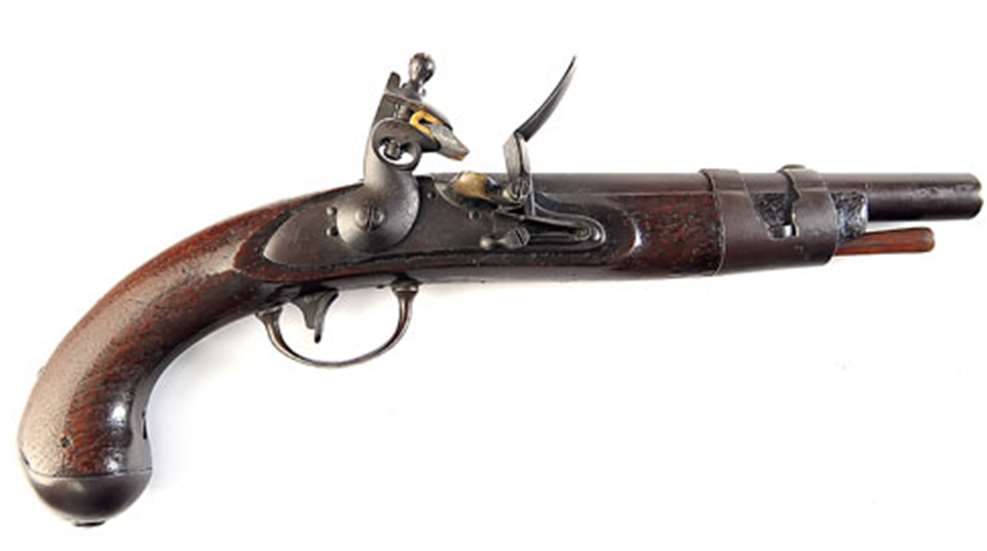
Some 19,374 Model 1816s were produced from 1817 until 1820. The guns measured a substantial 15 1/4 inches long with a barrel length of 9 1/16 inches and weight of 3 pounds, 3 ounces. They had two distinctive lock markings, the first involving the maker’s name, “S.NORTH,” in an arc surmounting an American eagle, flanked by the letters “U.” and “S.”, which in turn perched above the address, “MIDLN CON.” Later guns had a similar motif, though the image was slightly smaller and the address read, “MIDLTN CONN.” Barrels exhibited a “P/US” proof on the left side of the breech, and sometimes the initials “RJ” for inspector Robert Johnson. Stocks, too were stamped with the inspector’s initials, the particular example here bears “LS”, denoting sub-inspector Luther Sage. Model 1816s saw widespread use in such conflicts as the Seminole Wars, Mexican War and—converted to percussion—in the early days of the Civil War.
The Model 1816 pictured is in excellent mechanical condition and the exterior shows little use other than the normal nicks and dents one would expect to see in a firearm that has been in and out of armories and collections for nigh on to 200 years. The finish is dark, a combination of original browning and patina. Lock markings are of the later style. Today, 1816s are still accessible at reasonable prices. A gun like the one pictured would sell for between $2,750 and $3,250. Converted to percussion, the price would drop by a good 50 percent.
Gun: U.S. Model 1816 Flintlock Pistol
Manufacturer: Simeon North
Serial Number: None
Condition: NRA Antique Fine
Caliber: .54
Manufactured: c.1819
Value: $2,750-$3,250
Most Popular