Handguns > News

How to Travel Legally with Your Gun

If you carry a concealed firearm on a regular basis, you should know how to stay legal with it while traveling. Follow these simple tips to make your trip go smoothly.

This article first appeared in Self-Defense News at Second Call Defense.

Whether for fun or business, traveling presents many challenges if you're transporting or carrying one or more firearms. The last thing you want is to have your trip interrupted by an unexpected detour to a local jail.

This is a quick guide with five simple tips and some reference material to help make your trip go smoothly. Remember, laws change regularly and while it doesn't seem fair, it's ultimately your responsibility to know and abide by current law.

Meet Federal firearm transportation guidelines
For the most part, Federal law is pretty straightforward. No federal permit is required. And the Firearms Owners' Protection Act (FOPA) shields you from local restrictions if you're transporting firearms for lawful purposes.

Under FOPA, notwithstanding any state or local law, a person is entitled to transport a firearm from any place where he or she may lawfully possess and carry such firearm to any other place where he or she may lawfully possess and carry it, if the firearm is unloaded and locked out of reach. In vehicles without a trunk, the unloaded firearm must be in a locked container other than the glove compartment or console. Ammunition that is either locked out of reach in the trunk or in a locked container other than the glove compartment or console is also covered.

Exceptions apply to those who are convicted felons; persons under indictment for felonies; adjudicated "mental defectives" or those who have been involuntarily committed to mental institutions; illegal drug users; illegal aliens and most nonimmigrant aliens; dishonorably discharged veterans; those who have renounced their U.S. citizenship; fugitives from justice; persons convicted of misdemeanor crimes of domestic violence; and persons subject to domestic violence restraining orders.

Guide to the Interstate Transportation of Firearms—summary of interstate transportation laws
Federal Firearms Regulations Reference Guide
—downloadable PDF
BATFE's Answers To Frequently Asked Questions
—downloadable PDF
Airline Transportation of Firearms
—essential information if you're traveling by air

Abide by state and local gun laws
This is where things get a little tricky. Laws vary place-to-place, and if you do anything other than pass through a state, you must obey all local laws. This is especially true when you are carrying a loaded firearm in your vehicle or on your person

There's no shortcut here. You need to map out your trip state-by-state to be sure you stay legal during your trip.

State Gun Laws at a Glance—see the interactive chart at the bottom of the page for information on state laws and CCW reciprocity
State-by-State Handgun Laws
—website with detailed information of interest to travelers
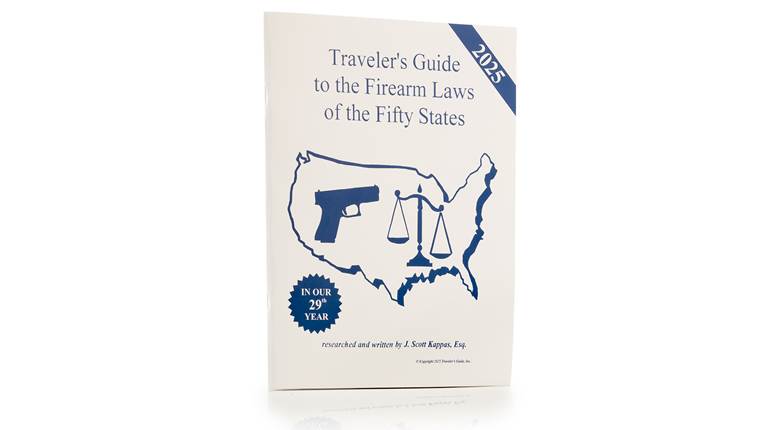
The Traveler's Guide to the Firearm Laws of the Fifty States
—handy printed guide for purchase that you can stow in your vehicle
Which States Honor Your CCW License?
—two-part list showing which states honor your CCW license and what other state licenses your state honors
BATFE's State Laws and Published Ordinances - Firearms, 2010-2011
—nitty gritty details of state laws, not for the feint of heart

Ask about restrictions at specific locations
This is pretty simple if you plan every stop in advance. It's just a matter of making a few phone calls and asking about any firearm restrictions. Unless you plan to disarm, you'll need to choose your lodging, camp sites, parks, etc. based on the answers you get.

Get a concealed carry license
If you don't have one, get one whether you plan to carry on your person or just have a firearm in your vehicle. In most places, this simplifies the laws that apply to you and make transportation and possession easier to do legally. If you're staying in a state where your home state license is not honored, get a non-resident license for that state or find a non-resident license that covers that state.

Guide to Non-Resident Licenses

Drive carefully and obey the speed limit
While you should make a good-faith effort to do everything right, being a careful driver can help you avoid situations where you discover what you've done wrong. Nearly every time someone gets in trouble for violating a state or local law, it's related to a traffic stop. An officer pulls you over, discovers you have a gun, then finds a technical violation.


Share |

Comments

ADD YOUR COMMENT

Enter your comments below, they will appear within 24 hours


Your Name


Your Email


Your Comment

9 Responses to How to Travel Legally with Your Gun

Jim Macklin wrote:
October 22, 2013

' “Bill of Rights” are - also known as the first 10 Amendments. [[][[]]Remember - the Amendments are Rights guaranteed to American citizens, who are the ultimate authority, and acknowledged under oath by all public servants] 2nd Amendment: “A well regulated Militia, being necessary to the security of a free State, the right of the people to keep and bear Arms, shall not be infringed.” 1. “A well regulated Militia,” = the subject. 2. Comma leads to a modifier/qualifier for previous subject “or” adds another subject. 3. “being necessary to the security of a free State,” = the modifier or qualifier. 4. Comma leads to a modifier/qualifier for previous subject “or” adds another subject. 5. “the right of the people to keep and bear Arms,” = subject. 6. Comma leads to a modifier/qualifier for previous subject “or” adds another subject. 7. “shall not be infringed.” = the modifier or qualifier. 8. Period = end of statement. Years ago I did some research into the original meaning by the Founding Fathers. I used a modern dictionary along with a dictionary printed in 1778. The definitions have not changed. The American people have the right for a Militia (army) to protect them - Federal or State. The American people have the right to keep and bear arms “possess and carry” firearms. Any firearm law that contradicts the Constitution automatically loses and is illegal - which is most if not all.' When the Bill of Rights was adopted and copied in 1959 when Alaska and Hawaii joined te Union, the Second Amendment had only ONE COMMA. Also few understand the word 'keep.' British law in 1775 required storage of larger quantities of ARMS to be kept in armories where it coud be controlled and confiscated easily. April 19, 1775 the British Army marched out of occupied Boston to confiscate the powder, lead, flints and swords as well as muskets and cannon at Concord & Lexington. The Minutemen knew that was a surrender of fight notice. When the Bill of Rights was written a few years later, the right to keep and bear arms was guaranteed to prevent the new government from tripping that wire. That is why gun control is so critical, they want total control and we don't want to give up our freedom.

Jim Macklin wrote:
October 22, 2013

Yes, NYC, NY state, NJ, MD, DE and MA often are reported as ignoring FOPA, often this happens when an airline cancels a flight and your checked bags are given to your possession until te next flight out. TSA calls the local police and you just became a felon. Federal law is nowhere near strong enough protection, there are traps on Corps of Engineers land and water, the Gun Free School Zone provides an exception ONLY if your CCHL is issued by the state where the school is located, state reciprocity does not apply. Little traps, where you don't expect them, Oklahome does not allow carrying a concealed handgun over 45 caliber, New Mexico doesn't allow a backup gun. www.handgunlaw.us , the NRA-ILA website, all states now appear to have a dedicated website that has the state laws needed. This maybe the State AG, state police or dept of public safety. Do your homework. BTW an unpaid traffic ticket makes you a fugitive from justice when they write a bench warrant because you didn't pay the $50 seatbelt fine.

John wrote:
October 18, 2013

There is something called a “Preamble” that is written as the “first” rule of order regarding the Constitution. A Preamble is always first, in front and is the “introduction” to what you are about to read. The Constitution Preamble is as follows: “We the People of the United States, in Order to form a more perfect Union, establish Justice, insure domestic Tranquility, provide for the common defence, promote the general Welfare, and secure the Blessings of Liberty to ourselves and our Posterity do ordain and establish this Constitution for the United States of America.” Most important is that the “ultimate” authority is the people and that it is the people with this authority that “ordain and establish” the Constitution. It is not the President, Congressional House, the Senate or any other elected politician. Furthermore, there is “only” one possible way for anyone to work in “any” political office. It is not their education or experience in any field. They “must” swear an oath to obey the U.S. Constitution. If they do not take the oath then they do not get into office. So, the first step in any political career is the sworn oath and testimony that the American citizen is the final and ultimate authority. The word “amendment” is defined as an alteration or correction to the previous text - in this case the Constitution. This is what defines what the “Bill of Rights” are - also known as the first 10 Amendments. [[]Remember - the Amendments are Rights guaranteed to American citizens, who are the ultimate authority, and acknowledged under oath by all public servants] 2nd Amendment: “A well regulated Militia, being necessary to the security of a free State, the right of the people to keep and bear Arms, shall not be infringed.” 1. “A well regulated Militia,” = the subject. 2. Comma leads to a modifier/qualifier for previous subject “or” adds another subject. 3. “being necessary to the security of a free State,” = the modifier or qualifier. 4. Comma leads to a modifier/qualifier for previous subject “or” adds another subject. 5. “the right of the people to keep and bear Arms,” = subject. 6. Comma leads to a modifier/qualifier for previous subject “or” adds another subject. 7. “shall not be infringed.” = the modifier or qualifier. 8. Period = end of statement. Years ago I did some research into the original meaning by the Founding Fathers. I used a modern dictionary along with a dictionary printed in 1778. The definitions have not changed. The American people have the right for a Militia (army) to protect them - Federal or State. The American people have the right to keep and bear arms “possess and carry” firearms. Any firearm law that contradicts the Constitution automatically loses and is illegal - which is most if not all.

Ron wrote:
October 09, 2013

to Terry Evers. LEGAL HEAT is not free but is only .99

Rich wrote:
October 09, 2013

The 2nd Amendment guarantees the 'right to keep and bear arms'.... Subsequent legislations have eroded that right on the national and local levels in order to make money for the coffers of municipalities, townships and boroughs. The 'wool has been pulled over our eyes' by politicians for too long!

Terry Evers wrote:
October 09, 2013

MY instructer a police officer advised to use FREE app LEGAL HEAT as it is updated daily

rpm64 wrote:
October 09, 2013

I have heard that the NJ police will not honor the FOPA and will prosecute if you don't have a NJ permit. Does anyone have more info on this?

Kim wrote:
October 08, 2013

There is also a very good app for your phone that is called Concealed Carry 50 State Guide I believe it costs less that $2.00 with free updates all of the time.

Fred Derf wrote:
October 08, 2013

Such a complex maze of rules, laws, regulations, fees, and licenses is CRIMINAL!