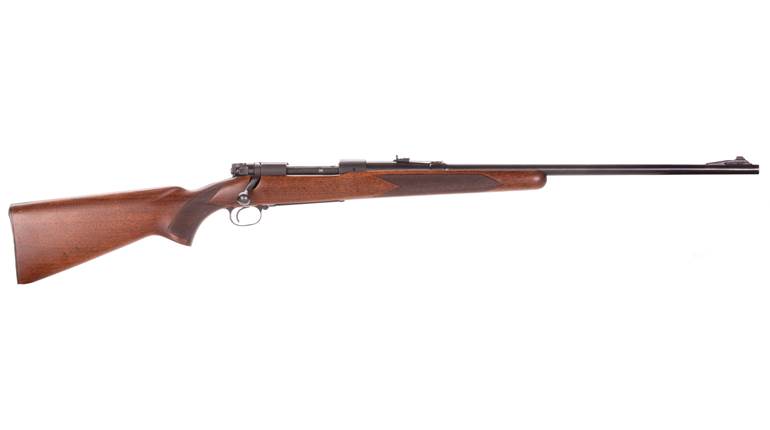
To grasp the importance of the Model 70, one must look back to the Model 54 and understand its role in rifle development. Up until World War I, American hunters were devoted to lever-action rifles. Though bolt-action rifles were around and used by many, the sexiness of rapid firepower overwhelmed the bolt-gun—as it does today—though the turn-bolt was favored by target shooters of the day. However, returning doughboys from The Great War found that the 1903 Springfield was tough, reliable and accurate. The .30-06 cartridge shot flat to extended ranges and hit with authority. So a market developed for bolt-action rifles chambered in fast-stepping cartridges. The cheap alternative was to get a surplus 1903 Springfield or a 1917 Enfield, tear off the superfluous military accoutrements and replace the stock with something more pleasing to the eye and easier to shoot.
This kept a lot of gunsmiths—from barnyard mechanics to true artisans—busy for sometime, but it also cut into the sales of the big manufacturers. Savage brought out the Hi-Power on a short Mauser action in 1920. Remington already had the tooling to make the 1917 Enfield, so it simply sporterized the warhorse and christened it the Model 30. Winchester looked into sporterizing the Enfield and even made a few prototypes, but it felt the need to produce a better product in order to retain its dominance in the rifle marketplace.
Another reason Winchester did not leap head first into the bolt-action mania was that it had two prior forays into that market—the Model 1883 Hotchkiss and the Model 1895 Lee Navy—and neither was much of a success. Benjamin B. Hotchkiss designed the 1883 model for the U.S. military, and James Paris Lee was a Scottish immigrant gun designer. Both men operated outside the Winchester engineering staff. That staff, led by Thomas Crosley Johnson, and included engineers Frank F. Burton, Leroy Crockett, Capt. Albert Laudensack and Arthur A. Rowley, were given the task of developing a bolt-action sporting rifle. The rifle was to be built around the .30-06 cartridge—the leading sporting and target cartridge of the day. Simultaneously, the engineering team necked down the military cartridge to .277-inch diameter with the idea of it being a superior long-range hunting and target cartridge. The .270 Winchester has become one of the most popular hunting cartridges ever produced.
The Model 54 traces its root to the 1898 Mauser. Its coned breech, bolt design, extractor, bolt sleeve and safety are all pure ’98 Mauser in concept, though refined for American tastes. Its stock can trace its origins to the Jaeger stocks of Europe that is sleeker, straighter and lighter than the clunky military stocks.
By 1931, Winchester had fallen into receivership—The Depression having taken its toll on the gun company. In December of that year ,Western Cartridge Company (WCC)—a competitor to the ammunition side of Winchester’s business for 40 years—acquired the assets and liabilities of the company. John M. Olin, who was vice president of WCC at the time, immediately realized the value of Tom Johnson’s engineering team and started them on a task to improve and refine the Model 54.
Three major criteria were targeted for improvement: acquire winning target accuracy, offer a rifle with the latest features to enhance its ability as a competition rifle and refine the quality and refute the criticisms of the Model 54. To those ends, Johnson’s team—Tom Johnson died in 1934—added a gas port to the right side of the receiver ring to lessen the chances of gases and metal primer parts hitting the shooter’s eye in the event of a blown primer or ruptured case. They also replaced the stamped, one-piece bottom metal with a new machined two-piece assembly that included a hinged magazine floorplate held in place by a spring-loaded plunger. Replacement of the military-type safety with one mounted on the bolt sleeve, operating on a horizontal plane was better suited to a low-mounted riflescope. The bolt sleeve was also redesigned to provide a sleeker profile that was more conducive toward a low-mounted scope, the bolt stop was moved from the trigger sear to the receiver and finally, the trigger was redesigned into a more simple and rugged, yet fully adjustable component.
The first 19 Model 70s were hand-built tool-room jobs in 1935. The following year production rifles were made to establish an inventory—some 2,238 copies—and in 1937 the Model 70 was released to the public. Standard production chamberings up through 1963 included .22 Hornet, .220 Swift, .243 Win., .250 Savage, .257 Roberts, .264 Win. Mag., .270 Win., 7 mm Mauser, .300 Savage, .308 Win., .30-06 Sprg., .300 H&H Mag., .300 Win. Mag., .338 Win. Mag., .35 Rem., .358 Win., .375 H&H Mag. and the .458 Win. Mag. A few Model 70s were made for export markets in 7.65 Mauser and 9 mm.
Variations on the Model 70 platform were numerous. The standard grade was the most popular, of course, but there were Super Grades, Alaskan, African, Carbine, National Match, Target Model, Bull Gun, Featherweight, Westerner and Varmint.
Initial sales were steady, if not spectacular, given that it was introduced during The Depression, and then World War II got in the way. By 1946, production was up to 7,000 units per year, and by 1951 some 44,000 copies were made. Production and sales remained strong until 1962. By 1963, only about 16,000 Model 70s were made and sold.
As a premium rifle, the Model 70 was expensive to manufacture. Arch rival Remington had already “improved” the design of controlled-round-fed Mausers in 1948 when it brought out the less-expensive Model 721, and again in 1963 with the soon-to-be-equally-iconic Model 700. Winchester’s bean counters howled, and the brass yielded. The Model 70 was going to be “improved.”
When the Model 70 of 1964 was released the shooting public screamed. The Model 70 had been destroyed in their eyes. Yet some of the changes actually brought about engineering improvements to “The Rifleman’s Rifle.” The square breech that replaced the cone breech was stronger, yet it fed just as reliably as the older version. Removing the feed rails from the receiver and putting them on the magazine box not only cut manufacturing costs, it also allowed the rifle crank who wanted to switch calibers to do so with less expense. But then there was the bolt: The time-honored, non-rotating, Mauser-style claw extractor was replaced with a smaller hook-like extractor in the right lug, and the blade ejector was replaced by a spring-loaded plunger that, as Jack O’Connor once put it, “throws empty cases clear over second base.” Too, the guide lug on the left locking lug disappeared, though by 1968 the now-present anti-binding device was incorporated. Rifle aficionados referred to the new Model 70 with disdain as a “bump-and-run” rifle—the bolt bumps a cartridge from the magazine and runs it into the chamber.
Finally, so-called improvements with the stock were presented. The barrel was free-floated, with Winchester touting it as a modern improvement used by esteemed target shooters. The reality was that it was an oversized groove that collected dirt and debris like a magnet, and it was coyote ugly to boot. To top off this travesty in wood, the checkering was pressed into the wood and covered with a high-gloss lacquer that not only refuted the principle of checkering to provide a better gripping surface, but it also highlighted the repulsiveness of the stock.
A couple of years later, Winchester was smarting from the bad press and hostile customer reaction. The stock underwent some improvements, returning to cut checkering and a more satin-like finish. But the new guys at Winchester could not help themselves, and in an effort to make the rifle more attractive without spending much money, added a Bakelite fore-end tip and grip cap set off with an oh-so-stylish white spacer made of plastic. My first center-fire rifle was one of these Model 70s, and within a year I had restocked it in a piece of hard, black Missouri walnut from the old Reinhart Fajen company. It may not be the artisan-like work of Al Biesen, but it looked—and remains so today—a heck of a lot better than the original piece of firewood. My restocking job included a full-length glass bedding job that significantly improved the rifle’s accuracy.
Twenty years ago United States Repeating Arms Co. (USRAC), a company that was licensed to use the Winchester name from Olin at the time—finally got the message. Riflemen wanted the original Model 70 with its controlled-round-feed system. They wanted satin-finished walnut with cut checkering. USRAC gave them all that and more, calling it the Model 70 Classic. One feature retained from the bump-and-run guns was the anti-binding device machined into the left lug. The onset of Computer Numeric Control machining centers is what allowed the Model 70 Classic to be reintroduced at a competitive price. USRAC retained the bump-and-run Model 70s for the budget-minded shooter, but the Classic and its variants were what shooters and hunters wanted.
Other variants on the Classic soon followed. The Featherweight shaved a few ounces off the Classic with its whippy barrel and a trimmed-down stock. USRAC reintroduced the Super Grade with its highly polished metalwork, an upgraded floorplate assembly and nicer wood. I have one chambered in .338 Win. Mag., and it’s as beautiful as it is effective on elk. Eventually USRAC had to jump on the stainless steel and synthetic stock bandwagons.
In 2001, USRAC introduced the .300 WSM, and it generated a great deal of interest. Toward the end of 2001, the company came up with the .270 and 7 mm WSM cartridges, set to be introduced at the 2002 SHOT Show.
Five years later USRAC closed the doors on the New Haven, Conn., facility, after producing Winchester rifles and shotguns for more than 140 years. The word was there would be no more Winchester guns. Aficionados like me went into mourning and began to rent our clothing. The day of the announcement I called my friend Scott Grange at Browning/USRAC and tried to buy a dozen rifles right then and there. Too late, I was told, “They’re all gone,” he said. I did manage to find a stainless-barreled and laminate-stocked .270 Win. Turns out it is a tack driver, and now I often choose it for whitetails on my place.
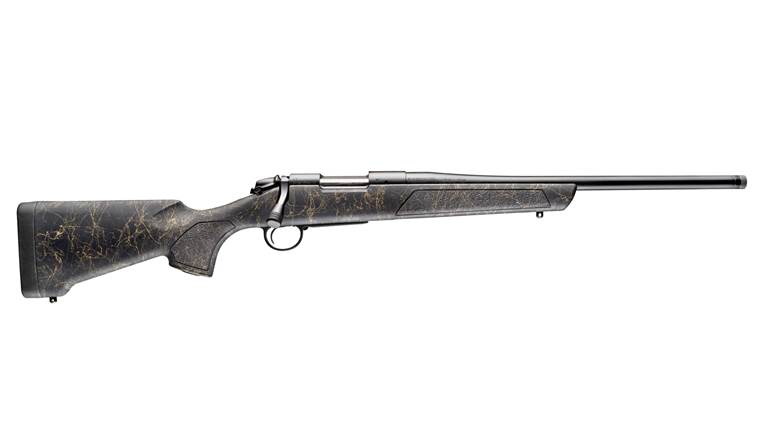
But you can’t keep a good man—or in this case, rifle—down. Two years after the New Haven plant went into mothballs, FN Herstal announced that it would start building a third generation of Model 70s at its Colombia, S.C., facility. The current crop of Model 70s are pretty faithful to most of the design concepts. Of course, they simply had to mess with something, so they jettisoned the remarkably simple and rugged adjustable trigger that has served so well for more than 70 years. It has been replaced with the M.O.A. Trigger with claims of zero take-up, zero creep and zero overtravel. It’s not really a bad trigger, but it’s not as easy to work with as the original Model 70 fire-control mechanism.
Today, we are blessed with a plethora of fine hunting bolt-action rifles—Savage, Remington, Kimber, NULA, as well as countless custom and semi-custom builders produce collectively the finest rifles in the world. Virtually all of them trace their roots back to the ’98 Mauser. I have examples of most of them, but clearly the most represented of them is the Winchester Model 70 with seven examples from .270 Win. to .375 H&H. One of the most famous snipers, Carlos Hathcock used a Model 70 with a barrel so worn it would barely keep its shot in 3 inches at 100 yards.
The term “The Rifleman’s Rifle” was introduced in 1952 by a Winchester marketing representative., but the name stuck. The Winchester Model 70 is the Rifleman’s Rifle.