9/18/2012
Thanks to Hollywood, gun mufflers, sound suppressors or “silencers”—one and the same—are viewed in a negative context by many non-shooters. But the truth is that noise suppressors are used daily—as they have been for more than a century—to enhance safety, ease instruction and improve accuracy for shooters of all demographics.
How Do They Work?
The first thing you need to understand is that when a cartridge is fired, there is no gunpowder “explosion” in the way that some may think. Smokeless gunpowder does not explode, it just burns very fast. The primer ignites when struck by the firing pin, and the powder is ignited by the primer. As it burns, it forms a very high-pressure gas, forcing the bullet down and out the barrel followed by all the residual hot gas. The loud “boom” you hear is the expulsion of gasses happening all at once, with little or no restriction.
To put the function of a sound suppressor it in its simplest terms, the suppressor works by slowing, redirecting and cooling the hot gasses created when the cartridge is fired. We can get into all kinds of scientific terminology, but that is the general function. If we relate it to something we are all familiar with, it will be easier to understand. Think of a balloon. If you release the gas very fast by use of a pin, it will make a “boom.” If you untie the knot and let go, the high-pressure gas inside will bleed out a little slower through the sputtering neck, making much less noise. If you hold the end when untied and slowly let the air out by using pressure of your fingers to control the flow, it will make very little noise, if any. A modern suppressor would fit roughly between the last two examples.
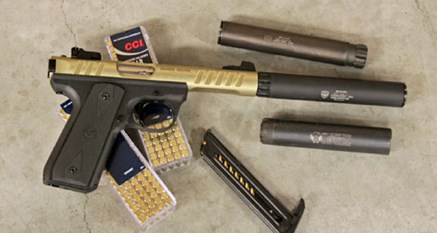 If you were to look at an X-ray of a silencer, depending on when it was made and who made it, you would likely see a few common features. There would be an expansion chamber close to the muzzle, a series of baffles that redirect the escaping gasses and end caps holding everything together. That is where the similarities end. Early sound suppressors used “wipes” that were constructed of a soft material that projectiles would pass through, closing up quickly behind them. Another effective type of suppressor was (and still is in some cases) an artificial environmental suppressor, or “wet can.” This suppressor typically uses no wipes, but performs best when a cooling liquid is introduced to the suppressor before firing. As the gasses cool they lose “energy” and are quieter than hot gasses.
Many modern suppressors use a baffle stack after the expansion chamber and before the end cap where the projectile exits. Current baffle shapes, types, materials and construction methods are sometimes closely guarded company secrets but two common styles encountered are “K” baffles and “M” baffles, named after the letter they most resemble if they were cross cut and viewed from the side.
To get an idea of how well a quality suppressor works, you can compare it to an automobile muffler. If you hear a dragster or stock car running on open headers with no muffler of any kind it will be very loud. It may damage your long-term hearing. That is the case with many unsuppressed firearms. If you listen to an automobile with a proper exhaust system, it will not be “silent” but will certainly not hurt your ears. That is a reasonable general comparison.
Another factor in firearm noise is that many projectiles travel at speeds above the speed of sound. The speed of sound is about 1,115 fps (at 32 degrees F at sea level). Elevation and temperature will affect that number. Anything breaking the speed of sound will produce an audible “crack,” and it is unrelated to the expulsion of gasses when related to shooting. Because of this sonic crack, it is unlikely a gunshot could go undetected, even with the best suppressor on the market. Subsonic ammunition can be used to alleviate some of the residual noise, but it is tough to meet the expectations created by the movie industry.
Positive Suppressor Use
Sound suppressors have some very beneficial uses, starting with training new and nervous shooters. The noise of firing a gun by those new to the sport is often associated with pain and recoil. The noise actually has little to do with either but perception can be powerful, especially when trying something for the first time. For that reason I have found great success in using suppressed firearms in training new shooters. Their enhanced comfort level allows them to concentrate on the fundamentals instead of developing bad habits, like a flinch they will fight to get rid of later.
Another benefit is avoiding scaring or bothering adjoining property owners. To many of us, the sound of gunfire from recreational shooting is as American as apple pie. Others, who may not have grown up in a rural paradise, find it bothersome and nerve-racking—maybe even to the point of unnecessarily involving law enforcement. Using sound suppressors allows you to go about your training, plinking, competing, hunting, etc., without broadcasting your activities over a wide area for miles around.
Using a suppressor is just being polite. If you are going to build a race track on your land because you are an off-road enthusiast and want to practice much more often than most people, you will seldom bother those in the surrounding area due to the muffler on your vehicles. If you have a shooting range on your property and desire to shoot whenever you can, a sound suppressor can allow you to shoot as much as you like and keep good relations with the neighbors. In some of the few European countries where firearm ownership is allowed it is considered rude to not have a “muffler” on a firearm, and they are sold unrestricted and over the counter. When Americans tell them suppressors are treated like “spy gear” in the United States and most people don’t use them they often ask if we drive our automobiles with no mufflers either, bothering everyone we encounter.
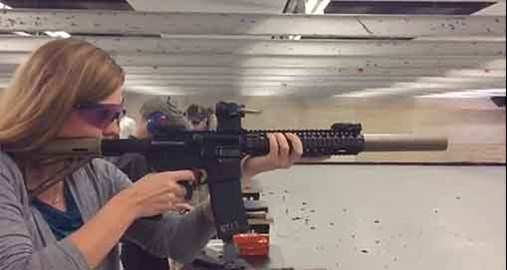 There is also the benefit of enhanced accuracy. Through the last few decades of being involved in testing and evaluation I have found that a quality suppressor attached to your firearm can have positive benefits in decreasing group sizes. As with any muzzle device it changes barrel harmonics and, more often than not, makes group sizes smaller.
As someone who has been responsible for overseeing many large, live-fire events I can say with certainty that a hot firing line full of suppressed firearms is a safer environment. When you can communicate without yelling through someone’s hearing protection and over the loud sound signature it is much easier to call a “Cease Fire” if an unsafe condition or concern may come into play. When you are all able to communicate using a normal voice and have no ear plugs on, communication potential is far easier.
There are also health reasons to use a suppressor. How many old shooters do you know who use the words “WHAT?” or “HUH?” several times during a conversation? This isn’t a coincidence; it is a result of long-term hearing loss. In most industries, safety monitoring organizations mandate the use of hearing protection in noisy environments such as construction sites, mills, assembly lines and automotive garages. Sound suppressors not only bring sound below the threshold of pain, they bring it below the threshold of damage. Even though most people wear hearing protection at the range, most do not while hunting and will suffer hearing damage at some point in their lives.
How Do I Purchase One?
Along with intentional, and politically motivated, distortions about the use of sound suppressors, there is an enormous amount of bad information in circulation regarding their legalities. Under Federal law they are perfectly legal. They are purchased by a lawful owner or dealer in National Firearms Act firearms and, if you live in a state that allows their possession and use, it is a simple and straightforward process that will test your patience more than it will affect your wallet. (Since we are only discussing Federal law, please research the laws in your state for specifics.)
A good comparison to use in the process of buying and owning any NFA firearm, sound suppressor included, is the purchase of an automobile. When you buy a new car or truck you fill out a title application that is submitted, and a new title is generated reflecting you as the lawful owner. There is a one-time title fee and it is never due again (unless you sell the item and the new owner pays to have the title changed to his or her name.)
There is no “Federal Silencer License” or “Annual Silencer Permit” but only this single-time transfer of title to you. The title fee (transfer fee) is $200. The price of the suppressor itself can vary from $150 to $2,000 depending on the caliber, materials and manufacturer. There are sound suppressors for every budget.
The application for purchase of a sound suppressor is referred to in the firearm industry as a “Form 4.” This form has information about the current owner and the device you are purchasing, among other things. It must be signed by your local Chief Law Enforcement Officer (CLEO) stating that you are breaking no state or local law by taking possession of the device you are buying, and it is accompanied by a few fingerprint cards and a check to the Bureau of Alcohol, Tobacco, Firearms & Explosives (BATFE) in the amount of $200.
The FBI will check your fingerprints to make sure you are eligible to own the device, the BATFE will research the device making sure it is legal and you are buying something acceptable for you to own. Upon completion the new title will be issued in your name, and the suppressor belongs to you. There are no unannounced 4 a.m. visits by federal agents demanding to see it, and no further paperwork to complete. It is just a title and nothing else.
Also, thanks to standardized threading and/or different adapters, one suppressor may be moved from one firearm to another within the owner’s possession. Depending on the model and the manufacturer’s recommendations, suppressors may also be used on a gun chambered in a different, smaller caliber.
So there you have it, far from their infamous Hollywood image. Once you sort through the misinformation out there, sound suppressors can be a real asset to responsible shooting and are actually reasonably economical to own given their advantages.
Most Popular