8/23/2012
Though every Englishman should hear what this particular rifle has to say about the Olympics, England and individual rights, I didn’t set out to embarrass this particular English journalist. It’s just that he had it coming.
Let’s just call him Stephen Grey, as that’s his real name. He’s not a bad sort. Grey was educated at England’s famed St. Alban’s School and studied philosophy at Oxford. He has outsized ears and somehow seems too tall for his boyish face. These features give him a look of young innocence you soon find is matched by sincerity. Then you run into his intellect and really like him. He wrote his last book, Into the Viper’s Nest, after being imbedded with soldiers in Afghanistan. He saw firsthand what the Taliban did to women. He knows all about the barbaric things al-Qaeda has done to a few of his colleagues. He knows jihadists consider civilians to be fair game. He knows about much uglier things than these. Nevertheless, he doesn’t think people should have the right to have firearms for self-defense.
Grey was seated across a table from me at a small dinner party some months ago in Washington, D.C., saying things like, “Americans need to give up their guns. They must become responsible citizens of the world.” Meanwhile, the other writers around the table—people who know my background—were glancing at me, bracing for the counterattack.
I stayed quiet as he described his utopian vision of a disarmed world like John Lennon singing “Imagine no possessions … I wonder if you can … .” I wanted him to be fully committed before I engaged.
Minutes later, as he paused to view the effect of his anti-gun offensive on a table full of Americans, I opted for an attack he likely hadn’t encountered before. I didn’t think he’d be swayed by crime statistics. And if I cited the dramatic English history of individual rights—and the loss thereof—he’d probably quote Friedrich Nietzsche’s Beyond Good and Evil to contend there is no absolute right and wrong and therefore no real individual rights. That philosophical discussion, as interesting as it might be, would be a smokescreen for his retreat. What I needed was a way at the truth he hadn’t encountered before, so I drew him in with the true story of a particular Springfield Model 1903.
“Stephen,” I began, “I understand that a world without guns in private hands, and therefore a world where a 110-pound woman can no longer shoot down a 200-pound rapist, is appealing to you. But let me tell you about a very special rifle. Its story just might make you rethink your views.”
He eyed me over his whiskey and soda.
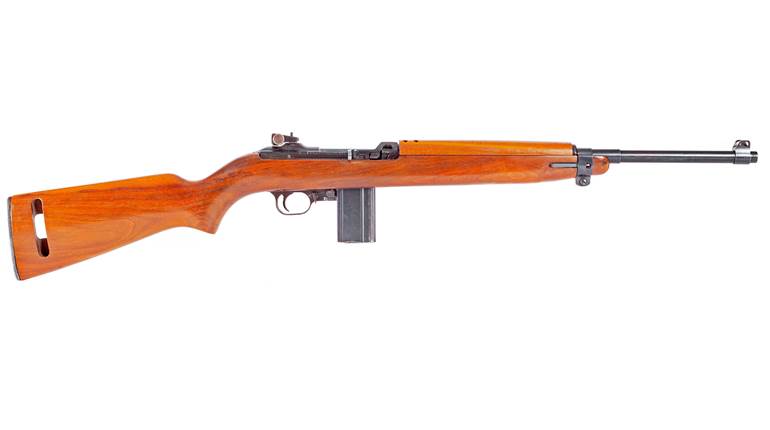
This particular rifle, I explained, is chambered in .30-’06 Sprg. It was built in 1905 or 1906 in Springfield, Mass. It’s a bolt-action Springfield Model of 1903 with the serial number 264631. Major John W. Hession (1877-1961), an American long-range competition shooter, purchased the rifle. He likely bought it in 1906. He topped it with a J. Stevens Co. riflescope and took it to the range. He found the rifle was so accurate that he took it to England to compete in the Olympics in 1908 at the Bisley Range. Then, in 1909, he used the rifle to set a world record at 800 yards at Camp Perry. At the time, The Piqua Leader-Dispatch (a newspaper that went out of business in 1919) ran the headline “World’s Record is Broken By Hession” on its front page. The feat made him a star. So much so that the June 1911 issue of Forest and Stream reported that when Hession competed at the DuPont Gun Club they were “especially pleased to have Mr. Hession with them. He is regarded by critics as the foremost long-range rifle shot in the world. His most remarkable performance, and the one which brought him the most fame, was at Camp Perry during 1909. At this time he made 67 consecutive bullseyes at 800 yards, a record never before equaled nor since broken.”
Hession was a top long-range competitor well into the 1940s. He won the Wimbledon Cup in 1932. And that wasn’t his first victory there. The Chicago Daily News Almanac and Year-Book for 1921 lists Hession as the winner of the Wimbledon Cup in 1919 as well. In fact, a Remington ad in Arms & The Man in 1914 boasted that Hession used Remington ammunition to win the Marine Corps Cup Match in 1913.
His impact on competitive shooting earned him a parting tribute in the April 1962 issue of American Rifleman. His obituary ran just after one for Col. Townsend Whelen. It reported that “one of his major achievements was to set four world records in one day. This he did on July 3, 1925 while competing in the Eastern Small Bore Championships at Sea Grit, New Jersey. In accomplishing this he fired 102 shots all of which, including sighting shots, were bullseyes.”
Clearly Hession was a renowned rifleman. He also had an understandable attachment to this particular 1903 Springfield. Such a profound attachment, in fact, that he later did something even more remarkable with the rifle.
World War II Gun Drive
After World War I, England passed gun-control laws that mostly disarmed its citizenry. The belief that there should be “a rifle in every cottage,” as proposed by England’s Prime Minister, Robert Gascoyne-Cecil, in 1900 was finished. According to the 1689 Bill of Rights “subjects which are Protestants may have arms for their defence suitable to their conditions and as allowed by law.” This changed with England’s Firearms Act of 1920. Its restrictions on the private ownership of firearms was partly sold to a war-weary public by politicians fanning fears that a surge in crime might occur because of the large number of firearms available following the war. Another justification for severely restricting firearm ownership was to fulfill a commitment to the 1919 Paris Arms Convention.
Whatever the rationale, the Firearms Act of 1920 passed and required an English citizen who wanted to own a firearm to first obtain a firearm certificate. The certificate, which was good for three years, specifically listed the firearm a person was approved to own and listed the amount of ammunition he or she could buy or possess. The police even had the power to exclude anyone who had “intemperate habits” or an “unsound mind.” Applicants for certificates also had to convince the police they had a good reason for needing a certificate. The 1920 law did not affect those who owned shotguns, but it gave government officials complete control over who could own handguns and rifles.
In 1933 the English Parliament next passed the Firearms and Imitation Firearms Bill. It increased the punishment for the use of a gun in the commission of a crime. Possession of a real or imitation firearm was also made an offense unless the person could show he had the firearm for “a lawful object.” A few years later England passed the 1937 Firearms Act. It extended restrictions to shotguns and granted chief constables the power to add conditions to individual firearm certificates. Clearly the power was in the hands of the state, not the individual.
Predictably such restrictions reduced the number of firearms in law-abiding citizens’ hands. Then came the Battle of Dunkirk in 1940. As the German war machine advanced, the British Expeditionary Force evacuated back across the English Channel. The retreat was costly. In their haste British troops abandoned most of their equipment. The massive loss of military arms, combined with the fact that the English people had been mostly disarmed, left the British people almost helpless before the advance of the Third Reich.
Luckily, they had gun-owning friends across the Atlantic. In 1940 a group of Americans, headed by C. Suydam Cutting, moved quickly to help rearm England’s citizens. They established the “American Committee for Defense of British Homes” and ran an ad in the November 1940 issue of American Rifleman that read in part: “British Civilians, undergoing nightly air raids, are in desperate need of Firearms – Binoculars – Steel Helmets – Stop-Watches – Ammunition.” The ad then said, “If you possess any of these articles you can aid in the battle of Britain by sending these materials to American Committee for Defense of British Homes.”
Hession, who was then working for Winchester Arms, decided to make a statement. He sent his prized Springfield Model 1903 to the American Committee for Defense of British Homes. Before he did, he had two plates attached to its stock. The one on the rifle’s butt read: “This rifle was used by Major John W. Hession” and was used “in winning Olympics Bisley England 1908 – Grand Aggregate Camp Perry 1908 – Worlds 800 YD. Record Camp Perry 1909 … .” A plate placed on the rifle’s fore-end read: “FOR OBVIOUS REASONS THE RETURN OF THIS RIFLE AFTER GERMANY IS DEFEATED WOULD BE DEEPLY APPRECIATED.”
Hession’s rifle was shipped to England. Before the end of the war the NRA alone sent more than 7,000 private firearms to England. The U.S. government, of course, sent many more. Congress passed the Lend-Lease Act in March 1941. Almost immediately, quantities of “U.S. Rifle, Cal. .30, M1” and others were headed across the Atlantic.
Winston Churchill was appreciative. He wrote in Their Finest Hour: “When the ships from America approached our shores with their priceless arms, special trains were waiting in all ports to receive their cargoes. The Home Guard in every county, in every village, sat up through the night to receive them ... . By the end of July we were an armed nation ... . Anyhow, if we had to go down fighting … a lot of our men and some women had weapons in their hands … .”
England, of course, was victorious after American troops entered the war and made the difference. And wonderfully, after the war, Hession’s rifle found its way back from England to Hession. It can now be seen in the NRA’s National Firearms Museum in Fairfax, Va.
Flash Forward to the 2012 Olympics
By this time, Grey had finished his whiskey and soda and was staring at the melting ice at the bottom of his glass. Even though he was dry, I wasn’t going to let him off without bayoneting the last of his anti-gun point of view. So I said, “Perhaps it is too obvious at this point to use the old axiom ‘those who don’t know their history are bound to repeat it,’ nevertheless today, sadly, Britain is again a disarmed nation.”
So disarmed, I pointed out, that law-abiding residents were helpless when Tottenham’s gangster youth decided to loot stores, mug residents and vandalize automobiles in August 2011 after police had shot and killed a person following a car chase.
Tottenham’s High Road was ground zero for the riots, which have an interesting tie-in to the history outlined here. The “Tottenham Outrage” of 1909—yes, the same “Tottenham” where the 2011 riots took place—was a famous gunfight that exhibited a very different English character.
Two men in Tottenham, armed with semi-automatic handguns, attempted to rob a payroll truck, but when the guards fought back the robbers fled on foot. The chase lasted two hours and covered about six miles as officers and armed civilians pursued the robbers. In the end one of the thieves committed suicide and the other later died in surgery. One officer and one civilian were also killed. The bravery of the officers and civilians prompted the creation of the Kings Police Medal and the funeral processions for the slain officer and the civilian passed through streets lined with mournful Londoners.
Yes, a lot has changed since the English people gave up their right to bear arms.
These days, to obtain a firearm certificate in England the police must be convinced that a person has “good reason” to own a firearm, and that he can be trusted with it “without danger to the public safety or to the peace.” English firearms licenses are only issued if a person has legitimate sporting, collecting or work-related reasons for ownership. And no, since 1946, self-defense has not been considered a valid reason to own a firearm—nor has national defense. So those armed civilians who helped the police in the Tottenham Outrage would, at best, only be bystanders today and at worst be victims.
Indeed, England’s Firearms Act of 1997 banned the private ownership of handguns almost completely. The ban is so restrictive that even England’s Olympic pistol team had to go abroad to practice. That became such a national embarrassment that the English government passed a special dispensation to allow the shooting events to be held in England during the 2012 games.
It’s also worth noting that at the opening ceremonies for the 1908 Olympics held in England—the one Hession had competed in—the USA team noticed there was no American flag among the national flags flying in the stadium. As a result, team USA’s captain and flag-bearer, Martin Sheridan, refused to dip the Stars and Stripes as he passed King Edward VII’s box during the parade of athletes. “This flag dips to no earthly king,” Sheridan later explained.
After relating all of this history to Grey, I ended with the moral of the story: “Now don’t you fret, Grey. If your people ever need to protect their freedom again from threats, domestic or foreign, thanks to the NRA, Americans will be there to help rearm your populace all over again.”
He didn’t even attempt a retreating volley.