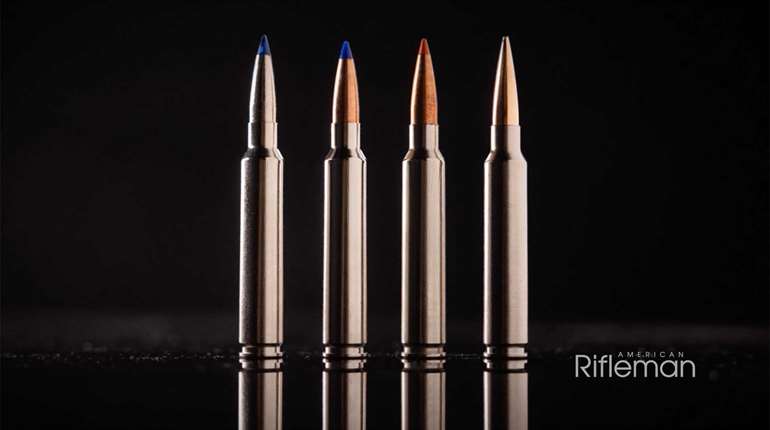
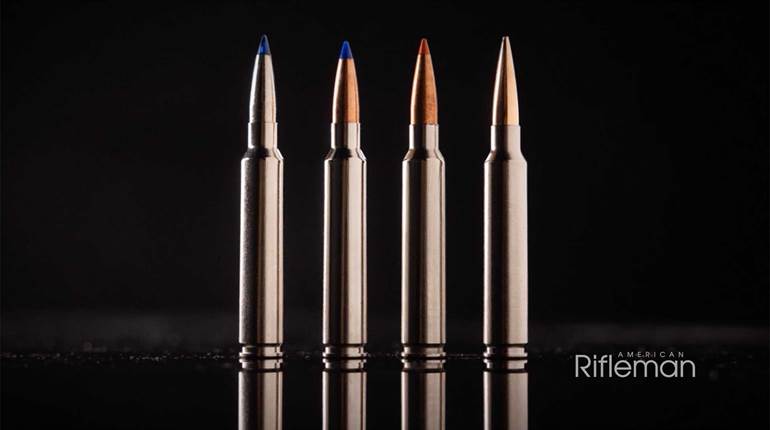
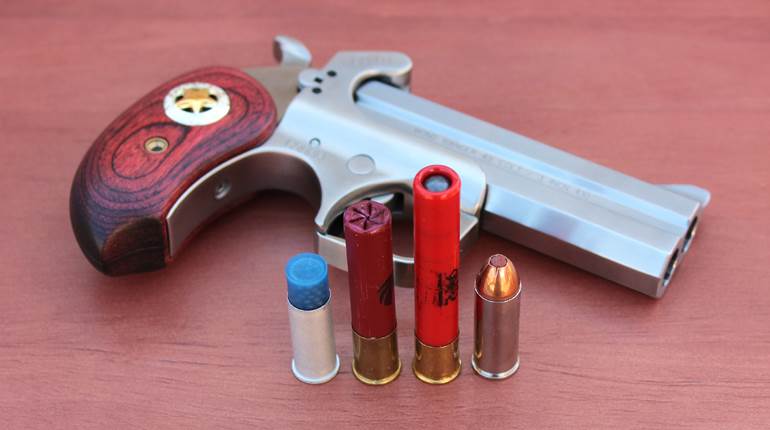
The oldest cartridge design still in large-scale production today, the rimfire suffers the ill effects of creation in the pre-center-fire period. Weaknesses stem from the ignition source; brass in the rim area must be thin enough to ensure detonation of the priming compound contained within when struck by the firing pin. Reduced-thickness brass necessitates low-pressure loadings, which result in lackluster external and terminal ballistics. As such, early, large-caliber rimfire cartridges have faded into obscurity, only chamberings best suited to plinking and small-game hunting remain. Development of new rimfire cartridges in the past half-century, and the past two decades in particular, have mostly been .17-cal.-commonly termed “sub-caliber”-cartridges. Although offering downrange advantages over stalwarts, such as the .22 Long Rifle, relatively mild pressures have prevented new cartridges from escaping the rimfire ballistic realm-until now. Enter the .17 Winchester Super Magnum (.17 WSM).
Rewriting The Rules
“Winchester is constantly striving to push the envelope on delivering faster, more powerful products in all categories to give our customers the advantage in the field,” said Brad Criner, senior product manager for Winchester Ammunition. The .17 WSM delivers upon this statement, and then some; however, achieving such performance proved problematic.
“The initial concept was derived more than a dozen years ago, and in direct development on this cartridge for a little over three years” reported Criner. “It took that long for technology to be developed to build the robust case that could withstand the higher pressures needed to drive a .17-cal., 20-grain bullet 3,000 fps.”
What advancements were made to enable the creation of the 33,000-p.s.i. .17 WSM cartridge? “Until now, the higher pressures split necks and burst rims, preventing us from introducing a cartridge of this magnitude,” he said. “In recent years, we developed a proprietary process for building the necked-down .17 HMR cases to significantly improve case strength and functionality. The same technology allowed us to develop the .17 WSM.” For comparison sake, the SAAMI-set maximum average pressure (MAP) for the .17 HMR is 26,000 p.s.i.
Fortunately for Winchester, it already had a basis-albeit unconventional-to which it could apply insight garnered from the aforementioned project-.27-cal. Powder-Actuated Tool (P.A.T.) loads for the construction industry that the company had loaded since the 1960s. “Why reinvent the wheel?” said Criner. The case, modified to handle the increased pressure rating, held sufficient propellant to achieve the desired velocity.
Choosing the ideal bullet caliber/weight proved simple for Winchester. “The .17 cal. has a great ballistic coefficient (BC), fit within the envelope and offered the highest velocity,” explained Criner. “We achieved our 3,000-fps goal and then some. We are safely hitting that number and could possibly get a little more but 3,000 fps allowed us to check the box on exceeding the ballistic performance of any rimfire magnum and approach center-fire ballistics (we actually exceed the ballistics of the .22 Hornet).” Thus far, Winchester has three bullet options: 20-grain red polymer tip (V-Max), 20-grain hollow-point and 25-grain polymer tip (gray), the latter of which has a factory-touted velocity of 2,600 fps.
Why not .20 caliber? Even if Hornady’s ultra-lightweight, 24-grain 0.204-inch-diameter NTX was used, the desired velocity for the cartridge could not be met; velocities would be similar to the 25-grain, .17-cal. polymer-tip load. The less-streamlined, light-for-caliber, .20-cal. bullets also exhibit notably lower BCs than .17-cal. projectiles of similar weight; the result is less energy downrange, as well as additional drop and wind deflection.
“That being said, we have not ruled out other ballistic possibilities in the future,” said Criner. “We are exploring options of different bullet calibers and other shell case calibers (P.A.T. is also loaded in 22- and 25-cal. shell cases).”
Performance in relation to cost determines a rimfire cartridge’s success and, ultimately, longevity; cite the .17 HMR (introduced in 2002) as an example of a widely accepted newer option, while the .17 Mach 2 (unveiled in 2004) is fading into obscurity-shooters are unwilling to pay a premium for the cartridge’s moderate ballistic advantages over the aged, yet immensely popular, .22 Long Rifle. Concerning downrange performance, as will be soon illustrated, the .17 WSM is on-par with center-fire cartridges; however, perusing MidwayUSA’s website, the three options range in price between $14 and $16.30 per 50. How is that possible?
“There are two primary drivers to the cost advantage of rimfire product versus a center-fire product,” reported Criner. “First, the primer is physically part of the rimfire case and does not need to be separate as is required for center-fire products. Secondly, the production process steps used in a rimfire are considerably less than those of a center-fire product, which includes multiple machining steps to create the intricate head and rim.”
What about availability? “We have ensured that the .17 WSM will be loaded on a regular basis in our magnum rotation,” he said.
Breaking Down The Ballistics
How does the .17 WSM “stack up” to its rimfire relatives and center-fire cousins? Despite its relatively petite size, with a maximum cartridge overall length of 1.590 inches and body diameter of 0.269 inches, the cartridge compares more favorably to the latter; however, any examination wouldn’t be complete without first contrasting it to the cartridge that enabled its existence, the .17 HMR.
Although not a true “apples-to-apples” comparison, due to the fact that the 20-grain V-Max loaded in the .17 HMR has a lower BC-.125-than that used in the .17 WSM (.185), with identical bullet weights, just assertions can be formulated. According to factory-published data, the .17 HMR propels the 20-grain V-Max to 2,550 fps, and with a 150-yard zero, the projectile impacts 1.7-inches high at 100 yards, 5-inches low at 200 yards, and 14.7-inches low at 250 yards. With a modest, 10-m.p.h. full-value wind, the bullet deflects off course 3.3 inches, 15.4 inches and 25.7 inches, respectively, at those same distances. Propelled to 3,000 fps from the .17 WSM, the more streamlined (and tougher, due to differing construction) 20-grain V-Max strikes 0.8-inches high at 100 yards, 2.5-inches low at 200 yards and 7-inches low at 250 yards. Deflection measurements are 1.6 inches, 8 inches and 13.6 inches less than those of the .17 HMR at the same distances. Considering the size of the game pursued, this is noteworthy. Interestingly, despite its lower muzzle velocity, thanks to its higher BC (.230) the 25-grain polymer tip experiences slightly less wind deflection beyond 200 yards.
Equally important, the bullet from the .17 HMR reaches its lower threshold for expansion (about 1,400 fps) just beyond 175 yards, while that from the .17 WSM-upsetting down to 1,600 fps-works beyond 300 yards. With this, the .17 HMR’s heaviest bullet option is 20 grains, whereas the .17 WSM is available with a 25-grain projectile. Energy figures illustrate a consistent, 100 ft.-lb.-plus advantage out to 200 yards, and more than double the energy at 250 yards.
In actuality, the “more fair” comparison is between the .17 WSM and the relatively new .17 Hornet, a wildcat based upon the .22 Hornet legitimized by Hornady. Propelled to 3,650 fps from the .17 Hornet, the same 0.172-inch bullet as used in the .17 WSM hits 0.4-inches high at 100 yards, 1.5-inches low at 200 yards and 4.3-inches low at 250 yards. Wind deflection at those distances are 1.3 inches, 5.6 inches and 9.2 inches, respectively, or 0.4 inches, 1.8 inches and 2.9 inches less than the .17 WSM-a small advantage. Its bullet would expand at distances beyond 425 yards; however, 31.2-inches of wind deflection at said distance makes the argument irrelevant. Due to the significant “step-up” in velocity, downrange energy figures greatly favor the Hornet. The center-fire .17 Hornet does offer the benefit of reloadability, but .17 Hornet ammunition sells for between $18.50 and $20 per 25, so the end-user pays more and gets half the ammunition when compared to the .17 WSM-no small consideration for the high-volume shooter.
What about the popular .22 Hornet? With a 35-grain V-Max-with a BC of .109-at 3,100 fps, considering a 150-yard zero, the bullet impacts 1-inch high at 100 yards and 3.5-inches and 10.4-inches low at 200 yards and 250 yards, respectively-not too bad. Wind deflection is where this cartridge takes a turn for the worse; those measurements are 2.9 inches, 13.7 inches and 23.4 inches, which are inline with the .17 HMR and telling.
As for the .22 WMR, a just comparison cannot be made; it could be said that it’s not comparing “apples to oranges,” but rather “apples to durians,” and the external ballistics bear out the latter. Due to the projectiles’ blunt profiles-and resulting BCs-at distances beyond the 150-yard zero, wind deflection numbers are nearly double those for the .22 Hornet, thus negating the .22 WMR’s use at moderate ranges.
Just as important as external ballistics is accuracy. Last September, I had an opportunity to test prototype .17 WSM loads from a prototype B.Mag bolt-action in Illinois. That said, on the unusually calm day, three-shot groups with the 20-grain load (the only one on-hand) at 100 yards, 200 yards and 300 yards measured 0.266 inches, 1.33 inches and 1.83 inches respectively.
So, who is .17 WSM ideal for? The .17 HMR owner looking for more, the high-volume prairie dog shooter, the routine varminter? “All of the above,” said Criner. “This will take the rimfire guy out to 200 yards and beyond, and it will allow the center-fire guy to shoot more rounds at longer distances at a lower cost.”
After crunching the numbers with regard to external ballistics, and seeing its accuracy potential firsthand, Winchester has proven the rimfire platform is still relevant, if not ideal, for certain applications. The .17 WSM will fulfill the needs of varmint and predator hunters alike, negating center-fire necessity at distances within 250 yards, perhaps farther. Best of all, the increase of capabilities comes at cost consistent with existing “high-performance” rimfire cartridges. It’s a formula for success.
“When we saw the huge potential of this cartridge [.17 WSM]-substantially higher performance at only modestly higher price-it was an easy call,” explained Bill Dermody, director of marketing for Savage Arms. “But, we didn’t just want to chamber the round; we wanted to make the rifle that would roll it out.” The rifle that emerged, the Bolt.Magnum, (B.Mag) took approximately 18 months to go from concept to completion. Why? The cartridge’s unusually high maximum average pressure (MAP), dimensions and construction created a quagmire for the company’s engineers.
Timing for the project was fortuitous; the company was already considering modernizing its rimfire line when approached by Winchester Ammunition. “We were working on a project to redesign what we call our ‘E-receiver,’ which is the foundation for our .22 Long Rifle, .22 WMR and .17 HMR rifles,” reported Dermody. “We wanted to make something more compact, with some updated features, such as a rotary magazine. At that point, we knew we’d have to backpedal somewhat to make the design suitable for the new cartridge.
We didn’t have a rimfire receiver designed for that kind of pressure-33,000 p.s.i. (.17 WSM) compared to 24,000 p.s.i. (.22 WMR) and 26,000 p.s.i. (.17 HMR)-and we didn’t want to ‘punt’ and chamber it in a center-fire gun such as a Model 25 or 110,” expounded Dermody. “So we just made a more robust rimfire system.” The key word here is “system,” as no single feature enables safe, reliable firing of the high-pressure cartridge in the scaled-down rifle.
First, the thick, yet malleable, brass of the cartridge’s rim-required due to the elevated pressure levels-mandates significant striking force be applied by the firing pin for trouble-free ignition-a feat the company’s previous designs could not accomplish. The answer: an atypical cock-on-close action. However, such a design had its detractions, too.
“The challenge isn’t hitting it hard enough,” explained Dermody. “The challenge is hitting it hard enough and still having a bolt that is easy for the shooter to operate. [Cock-on-close actions] provide more leverage, the benefits of which are realized whether shooting from the bench, prone or freehand.”
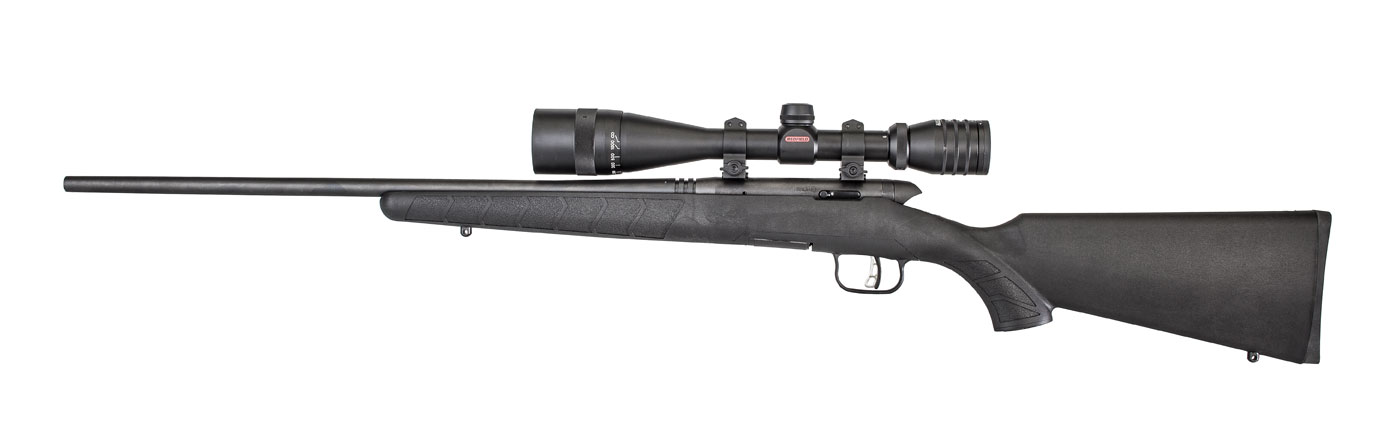
On the sample B.Mag the force required to close the bolt measured 22 pounds-enough that some young or small-stature marksmen might have difficultly without applying direct pressure from above, while simultaneously snugly holding the rifle or resting it atop a solid object (such as a bench) or on the ground (in conjunction with a bipod). The unusual, non-functional design of the bolt knob-reminiscent of the original Browning T-Bolt, as created by Jack Donaldson-exacerbates the problem; a traditional, checkered round or, better yet, flat, knob would prove to be a superior choice.
The B.Mag has dual-opposed locking lugs at the bolt’s rear-another measure to counter the increased pressure. Further, the bolt face is deeply recessed, and the extractor is of a quasi Sako-style/hook-type configuration. Ejection is provided by a fixed ejector positioned behind the magazine. Lastly, the bolt shroud is uniquely contoured so as to afford unobstructed access to the two-position safety. The bolt-release button is located on the left rear of the receiver.
The petite receiver is of a new design, measuring 513⁄16 inches in length and 0.95 inches in width. Attached to the rear is a die-cast trigger housing containing an updated version of the AccuTrigger that enables pull weight adjustment without the removal of the barreled action from the stock and exclusive of special tools; simply turn a plastic dial to decrease or increase pull weight within the 2-pound, 8-ounce to 6-pound range. A mousetrap-type spring on the front face of the housing provides downward pressure on the magazine for easy removal. Forward of the magazine cutout is a dual-purpose polymer tab. First, it serves as a “catch,” with the rear side securing the magazine via a corresponding flat. The forward face ensures the polymer bottom unit is held in place. A circlip prevents the piece from falling off the threaded stud, which also acts as a recoil lug, and grooves in the receiver minimize side movement. Because the barrel is devoid of iron sights, the receiver is drilled and tapped for scope bases. According to Dermody, the B.Mag’s base configuration is unique; those for other Savage models will not work.
Attachment of the B.Mag’s barrel also differs from its rimfire brethren, mimicking that used on the company’s center-fire rifles. Immediately noticeable are three grooves near the receiver’s front. According to Dermody, “The barrel grooves disguise our headspacing system, as it needs a range of ‘adjustability’ to set the perfect headspace. On this rifle the threads are countersunk into the receiver so this ‘range’ in the threads is not exposed, but this leaves a visible gap between the barrel and receiver. We incorporated this gap into the design by enlarging it and adding two more. Additionally, the difference [between the traditional locking nut system and the B.Mag’s] is that there is a stud underneath that keeps the barrel from rotating, rather than a nut around the barrel.”
As for specifics, the slender, 22-inch free-floating steel barrel measures 0.860 inches at the receiver and tapers to 0.520 inches at the muzzle, where it ends in a radius crown. Because of the volume of propellant consumed, as well as a reduced bore diameter combined with high-velocity bullets, it is recommended that the button-rifled barrel be cleaned frequently. “If you let it get too dirty you could have extraction issues,” he explained. “These are easily resolved with a bore brush and a little solvent or even lube, however.
Everybody makes guns to be shot,” said Dermody. “The Savage way is to also design them to be manufactured. Accuracy always comes first, we’re Savage, that’s who we are. But manufacturability comes right after that.” Nowhere is ease of manufacture more apparent than on the B.Mag’s synthetic stock.
With the exception of stipple patterns and fore-end designs, the B.Mag’s stock closely follows the lines of the Axis. Like its center-fire predecessor, the B.Mag’s stock has a separate, one-piece bottom unit with integral trigger guard, which is easily removed without tools and hides the two action screws. “It keeps a slender profile, with no visible action screws,” emphasized Dermody. Strangely, though, when the detachable, eight-round-capacity rotary magazine is in place, there’s not only a 1/16-inch gap behind it, but the back portion of the cutout snags the hand, largely negating the bottom unit’s streamlined advantage. Finally, the stock is fitted with dual sling-swivel studs and capped with a ¼-inch-thick rubber recoil pad, which is appropriate for the chambering.
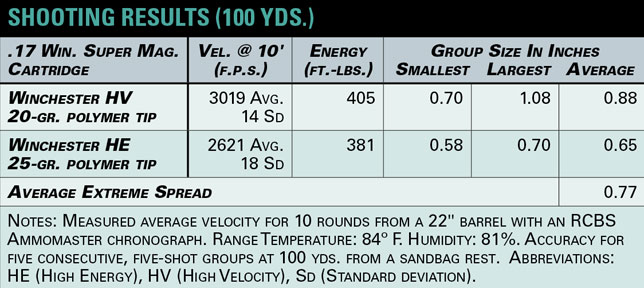
To conduct range evaluations, I topped the rifle with a Redfield Revenge 6-18X 44 mm riflescope in quick-detach rings on Weaver-style bases. Since the chambering’s ballistics are comparable to those of center-fire cartridges, I opted to test the rifle via five consecutive, five-shot groups at 100 yards. Currently, there are three ammunition choices from Winchester; however, the 20-grain hollow-point was unavailable, so both polymer tip loads-20- and 25-grain-were utilized. The rifle preferred the 25-grain polymer tip load, averaging 0.65 inches for 25 shots, and the smallest groups of which both measured 0.58 inches. Chronographing revealed both loads slightly exceeded factory-published numbers, averaging 3,019 fps for the 20-grain polymer-tip load, 2,621 fps for the 25-grain version.
During testing several observations were made. First, a high-velocity chambering, coupled with a slender barrel profile, results in rapid heating-especially in hot, summer-like temperatures. Secondly, being no fan of the magazine catch/release of the Axis rifle, it made sense that I’d have reservations about the B.Mag’s setup, which mimics it. Determining whether or not the magazine is secured is difficult, and one must double check to ensure it is properly seated. Several times during testing the magazine, which seemed in place, fell out during recoil.
When pushing the bolt forward from the rearmost position, as in chambering a round, it can easily be short stoked; once the bolt lugs are in alignment with the bolt handle cutout of the stock, the bolt handle can rotate downward. Doing so mars/dents the stock. Further, during testing, the sling swivel stud, which had a Versapod attached to it, fell completely out of the stock-not the best thing to have happen on a varmint rifle, as the gun is likely to have a bipod affixed to it.
The increased noise over other rimfire rounds is immediately noticeable; hearing protection is a must (and should be worn at all times when shooting anyway). As for the cock-on-close action, it posed no obstacle for me to operate; however, this might prove problematic for younger shooters, or those with less physical strength.
With the B.Mag, Savage Arms has created a platform to meet the unique center-fire-like demands of the .17 WSM cartridge, all while maintaining the scale of a traditional rimfire rifle and exhibiting the accuracy for which the company is renowned. As I discovered, though, it’s not without its detractions. That being said, it will make a good, value-priced option for predator hunting or a “walking varminter.”
Manufacturer: Savage Arms; (413) 568-7001; savagearms.com
Caliber: .17 Win. Super Mag.
Action Type: bolt-action, rimfire repeating rifle
Barrel: 22" 4140 steel, light contour
Rifling: six-groove, 1:9" RH twist
Magazine: detachable, rotary-style; eight-round capacity
Sights: none; receiver drilled and tapped for scope bases
Trigger: single-stage; adjustable AccuTrigger; 2-lb., 13-oz. pull
Stock: black synthetic: length of pull, 1315⁄16"; drop at comb, 1"; drop at heel, 3/4"
Overall Length: 40¼"
Weight: 4 lbs., 8 ozs.
Accessories: lock, owner’s manual
Suggested Retail Price: $349
Most Popular