“Guadalcanal Marine” by Matt Hall: www.valorstudios.com.
The state of Alabama made a vital and important contribution to the war effort during World War II. It was the home to military installations and war-related industries that made it a hive of activity between 1941 and 1945, forever altering the course of the state’s history. The full national mobilization activated the Alabama National Guard units, created Fort Rucker and expanded the facilities at Fort McClellan and Maxwell Army Airfield. Thousands of German and Italian prisoners of war lived out the duration of the conflict in camps such as the installation near Aliceville in Pickens County. Alabama was also the home of various industries that harvested the state’s abundant natural resources and produced the materiel that supported the war effort: coal and iron came from Birmingham; ships and aluminum came from Mobile; and ammunition came from the Redstone Ordnance Plant in Huntsville.
But the most important resource the state contributed to final victory in the Second World War was its people. During the war years, more than a quarter million Alabamians entered the uniformed service of the United States military. They served in every branch and in every theater of operations, and more than 6,000 of them lost their lives. The legacy of the Second World War is alive and well today throughout the state in the form of veterans from the Army, Navy, Coast Guard and, of course, the U.S. Marine Corps.
One particular Alabama World War II Marine veteran enjoys his retirement on a quiet farm near Mobile—or maybe it’s not so quiet. Aside from the sound of gunfire that occasionally echoes from his personal firing range, Sid Phillips’ property is a typically serene piece of rural South Alabama. If his name is familiar to you, it is probably because you first heard it back in 2007 when he was featured in the seven-part PBS documentary film “The War.” More recently, he was featured again in the HBO 10-part mini-series “The Pacific.” In addition to that, he is the author of “You’ll Be Sor-Ree: a Guadalcanal Marine Remembers the Pacific War” (published by Valor Studios in 2010 and available through www.marinesidphillips.com). It is a book that he began writing in 1997 to provide a chronicle of his experiences during the Second World War for his family. At age 86, his life now is busier and more complicated than it ever has been. But despite his newfound celebrity status, Phillips remains one of the most humble and approachable individuals you may ever meet. He has the infectious and genuine smile of a man who loves life and loves people. He is quick-witted and possesses an almost magical ability to make people feel welcome and comfortable. In a word, Sid Phillips is a gentleman. But beneath the amiable and light-hearted qualities of his charming personality lies a man who endured some of the most intense combat in 20th century warfare.
Born Sidney Clarke Phillips, Jr., in Mobile in September 1924, Phillips volunteered for the Marine Corps on Monday, Dec. 8, 1941, at the ripe old age of 17. He reported to recruit training at Parris Island, S.C., later that month where he was issued Springfield M1903 rifle serial number 345293. Six weeks later, he received the Eagle, Globe and Anchor emblem that all Marines receive upon completion of boot camp. Then he was swiftly assigned to the mortar platoon of H Company/2nd Battalion/1st Marine Regiment of the 1st Marine Division (or simply “H-2-1”). His battalion then crossed the country by train to Oakland, Calif., where it boarded the transport U.S.S. George F. Elliot (AP-13) and departed for Wellington, New Zealand, and the war with Japan. It was the summer of 1942 and the conflict was everywhere in the Pacific, so the 2nd Battalion/1st Marines (or “2-1”) remained in Wellington only briefly. On July 22, 1942, the men of 2-1 re-embarked on the George F. Elliot to the Solomon Islands. On Aug. 7, 1942, PFC Phillips hit the beach during the Operation Watchtower landings on Guadalcanal. During the following four months, Phillips and the men of H-2-1’s 81 mm mortar platoon endured the brutal living conditions and the savage combat that characterized the struggle for that island. During the night of Aug. 21, Phillips fought in the infamous Battle of the Tenaru. The following week he celebrated his 18th birthday. Although he was a member of a mortar crew, Phillips was regularly assigned to perimeter security duty. During those long nights in a foxhole on the line surrounded by jungle, he was given an M1903 Springfield rifle and two bandoliers of .30-cal. ammunition. It was some of the most unforgiving fighting that Marines experienced during World War II.
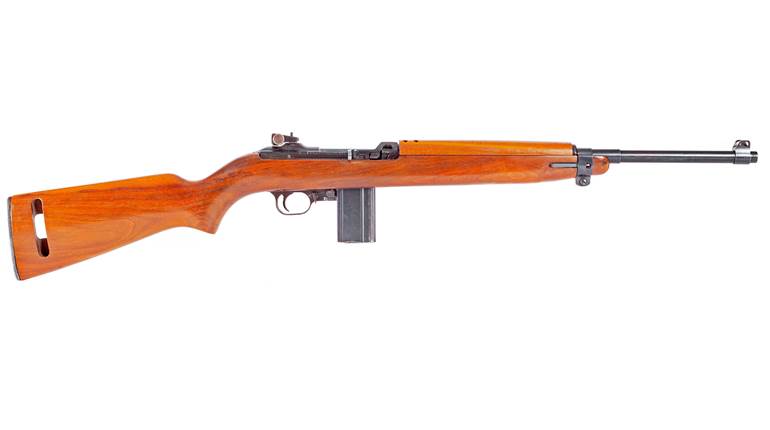
The 1st Marine Regiment departed Guadalcanal shortly before Christmas 1942 and proceeded to Melbourne, Australia. While there, the battalion camped on the city’s cricket ground and trained for the next battle. One day in mid-1943, PFC Phillips was posted to guard duty at the Fourth General Hospital in the city. Armed with an M1903 rifle, he snapped from parade rest to present arms for a group of officers and dignitaries entering the compound. One of them was none other than first lady Eleanor Roosevelt, and she paused long enough to ask the young Marine PFC where he was from and if he had fought on Guadalcanal. While in Australia, the men of H-2-1’s mortar platoon were issued M1 carbines to replace their .45 pistols. The men of 2-1 soon departed Melbourne and traveled north to Goodenough Island and, ultimately, to the east coast of New Guinea. The day after Christmas 1943, Phillips participated in the Operation Dexterity landings near Cape Gloucester at the western headlands of the island of New Britain. During the two months that followed, Phillips fought against the Japanese in the dense jungle of the northern Solomons. It was there he found many of the souvenirs he later brought home, including a Japanese 6.5 mm Type 38 Arisaka rifle.
In February 1944, the 1st Marine Division departed Cape Gloucester for the Russell Island Group. There, on a rat-infested mud hole named Pavuvu, Phillips shared many conversations with his regimental commanding officer, the legendary Col. Lewis B. “Chesty” Puller. Sharing a mutual enthusiasm for the history of the Civil War, both Marines spent many hours discussing that conflict in detail. Four years later, Puller signed Phillips’ honorable discharge from the Marine Corps Reserve (a document that proudly hangs on his wall to this day). It was also on Pavuvu that Phillips learned he would soon return to the United States. At that point, he was 19 years old and had been overseas for almost two full years.
He returned to the U.S. and was assigned to the Marine Detachment of Boca Chica Naval Air Station near Key West, Fla. While there, he regularly stood guard duty with yet another M1903 rifle. He also applied for the V12 officer training program. When he received admission to V12, he began college at the University of North Carolina in Chapel Hill and was still there when the Second World War ended in August 1945. The end of the conflict was also the end of the V12 program, so Phillips received his honorable discharge from the USMC (although he remained in the USMC Reserve until April 1948). With two years of university education already behind him, Phillips returned to Mobile and finished his degree at Spring Hill College on the G.I. Bill. After that, he completed medical school at the University of Alabama in Birmingham. In April 1946 he married Mary Victoria Houston and remained her devoted husband until leukemia claimed her life in 2000.
Dr. Phillips is an NRA Life member and an avid collector of military firearms. He owns everything from Revolutionary and Civil War-era muskets to a Trapdoor Rifle, a nice M1898 Krag, an M1917 Eddystone Enfield and an Underwood M1 Carbine. He also owns the Colt M1911 semi-automatic pistol his father brought back from World War I as well as the Japanese Arisaka rifle he picked up on the battlefield at Cape Gloucester in 1944. As interesting and diverse as this collection seems, there is one essential piece missing—the M1903 rifle. The man who can still remember the serial number of the ’03 he carried through Marine Recruit Training in 1942 does not currently own an example of the rifle. Nevertheless, a Remington M1903 was made available to him for a recent afternoon of shooting on the farm. When the rifle was placed in his hands, it was as if 86-year-old Sid Phillips was 17-year-old Pvt. Sid Phillips all over again. He immediately demonstrated a sequence of well-executed rifle drill moves followed by a quick demonstration of all of the shooting positions that he learned at Parris Island almost 70 years earlier. On his backyard firing line, his massive hands manipulated the ’03 with such precision that it appeared to be something he has been doing every day since the FDR administration. After his first few shots, it was immediately clear that his individual marksmanship skill level has not degraded at all. That nearly 9 pounds of steel and wood transformed Sid Phillips, the retired physician, back into Sid Phillips, the expert Marine rifleman.
Today’s entertainment industry can elevate an unknown individual to the level of household name. Celebrity status has certainly been delivered to countless unexceptional mediocrities in the reality television world. During the past decade, however, the entertainment industry has also conferred celebrity status on such names as Bill Guarnere, Don Malarkey and Richard D. Winters. The fact that this has also happened to Dr. Sidney Clarke Phillips, Jr., demonstrates that the world can still recognize a role model when it sees one. This son of Alabama never boasts about his wartime service and remains surprised by the army of well-wishers who want to shake his hand during his public appearances. If humility is the greatest of virtues, Sid Phillips has achieved greatness and deserves every bit of the accolade that he now receives in such abundance. Strangely, he does not seem interested in accolade at all. He would much rather go out in the backyard and do a little shooting.