Very few things in life are black-and-white, and things are seldom as simple as they appear. The truth usually lies somewhere in the middle. Okay, I am out of clichés now. But those catch phrases apply to the buzz, misconceptions and misunderstandings surrounding the .300 Whisper and .300 AAC Blackout cartridges—and to the guns chambered for them. There is a great deal of consumer confusion between the .300 Whisper and the .300 AAC Blackout. Are they the same? Are they different? If I buy a .300 Blackout can I use .300 Whisper ammunition in it safely? What about the .300 Whisper I’ve had since the 1990s? Is it safe with .300 Blackout ammunition? What about the other .30-.221 wildcats?
Here are two things we know for sure. The .300 AAC Blackout is a Sporting Arms and Ammunition Manufacturers’ Institute (SAAMI) standard cartridge. The .300 Whisper is a Commission Internationale Permanente pour l’Epreuve des Armes a’ Feu Portatives (CIP) standard cartridge. Rumor has it that the .300 AAC Blackout will likely become a CIP standard cartridge, as CIP allows duplicate cartridges with different names, which SAAMI does not. Please refer to schematics on p. 92 to see for yourself.
The .221 Fireball was developed in 1963 by Remington for use in the predecessor to the XP-100 pistol. Again something we know. It is unknown who first necked up the .221 Fireball to .30 cal., but the purpose was most likely metallic silhouette shooting, which was very popular at the time.
Two other things that we know: The .300 Whisper was developed, documented and trademark-
registered in 1992 by J.D. Jones. The .300 AAC Blackout was developed, documented and presented to SAAMI by Advanced Armament Corporation in 2009. Hornady Mfg. Co.—a SAAMI member company—recommends its .300 Whisper ammunition in firearms chambered for either .300 Whisper or .300 AAC Blackout. Confused yet?
Hornady is one of the most respected ammunition manufacturers in the world and, as I am a former Hornady employee, I know that it wouldn’t recommend such a practice unless it had thoroughly tested for safety, reliability and function. When Hornady says its ammunition is good to go in the .300 Whisper and .300 AAC Blackout, you can take that to the bank.
Background
J.D. Jones is likely responsible for the vast majority of the work in the field of subsonic ballistics during the past 20-plus years, and he is unofficially considered by many the father of modern subsonic ballistics. Jones owns SSK Industries and, among other accomplishments, developed the series of cartridges with both “JDJ” and “Whisper” designations. Jones developed “Whisper” cartridges from 6 mm to .50 cal. and everything in between. The .300 Whisper was the first in the series, developed in 1992.
My first experience with the .300 Whisper came when I was developing load data for the 5th Edition Hornady Handbook of Cartridge Reloading more than a decade ago. I was impressed enough to purchase an SSK barrel in .300 Whisper for my T/C Contender. It had the ability to shoot projectiles from 0.308" pistol bullets all the way up to heavy match rifle bullets, such as the Sierra 240-gr. BTHP MatchKing and later the 208-gr. A-MAX, which I have used to take game including whitetail deer. Jones explained that the .300 Whisper really shined when it was chambered in M16/AR-15 platform rifles, especially short-barreled rifles, as it acts more like a pistol cartridge than a rifle cartridge.
In 2009, word spread that AAC was bringing out a cartridge similar to the .300 Whisper and calling it the .300 Blackout. Enter the controversy. I called on Robert Silvers, director of research and development for AAC. He has been willing to share drawings, specifications, etc., and even forwarded the SAAMI-approved chamber reamer drawing of the .300 AAC Blackout reprinted below. Silvers and AAC have been forthcoming and helpful with any and all information about the .300 Blackout. If I had not had the background that I did with the .300 Whisper, nor a ringside seat inside the industry as a Hornady employee, I would have readily assumed that the .300 AAC Blackout is a completely different cartridge than the .300 Whisper. A large percentage of firearm enthusiasts believe that is the case, and it simply is not.
Why the .300 Whisper and the .300 AAC Blackout? To answer that I interviewed the two men responsible for the two most popular versions of the .30-.221 Fireball—SSK’s Jones and AAC’s Silvers. According to Jones, the .300 Whisper was developed in the Fall of 1992 with the first-use copyright on Nov. 12, 1992. The Whisper’s development “Simply boils down to my interest in developing ‘new’ cartridges and applications. Up to the point when I invented the .300 Whisper I don’t know of anyone who gave much thought to accuracy in a subsonic, silenced [arm] in this country,” stated Jones. “To be successful I thought the cartridge had to have both heavy-bullet, subsonic silenced and light-bullet, moderately high-velocity capabilities; be useful in the M16, single-shots, [and] bolt-actions; easily silenced with recreational shooting such as metallic silhouette and moderate big-game capabilities—such as pigs and deer—with exceptionally low recoil and decent accuracy. The .221 Fireball cartridge case was the right length, readily available and easily neck expanded to .30 caliber. The .223 case was looked at and found to present many problems due to its many variations in capacity, wall dimensions giving unacceptable neck wall thickness variations, in addition to being a tough trim job. Expanding neck dimensions to accommodate all of these variations would result in sloppy neck dimensions and in accuracy and sizing problems. An overly thick neck can allow a semi-automatic to chamber a round almost fully but not enough to fire.”
As to the development of the .300 Blackout, Silvers said: “We started development in 2009, but most of the work was done in 2010. A military customer wanted a way to be able to shoot .30-cal. bullets from an M4 platform while using normal bolts and magazines, and without losing the full 30-round capacity of standard magazines. They also wanted a source for ammunition made to their specs. We could not have just used .300-.221 or .300 Whisper because Remington is a SAAMI company, and will only load ammunition that is a SAAMI-standard cartridge.We had to take the .300-221 wildcat concept, determine the final specs for it, and submit it to SAAMI. We did that, and called it the .300 AAC Blackout (.300 BLK).”
Reamer/Chamber Drawings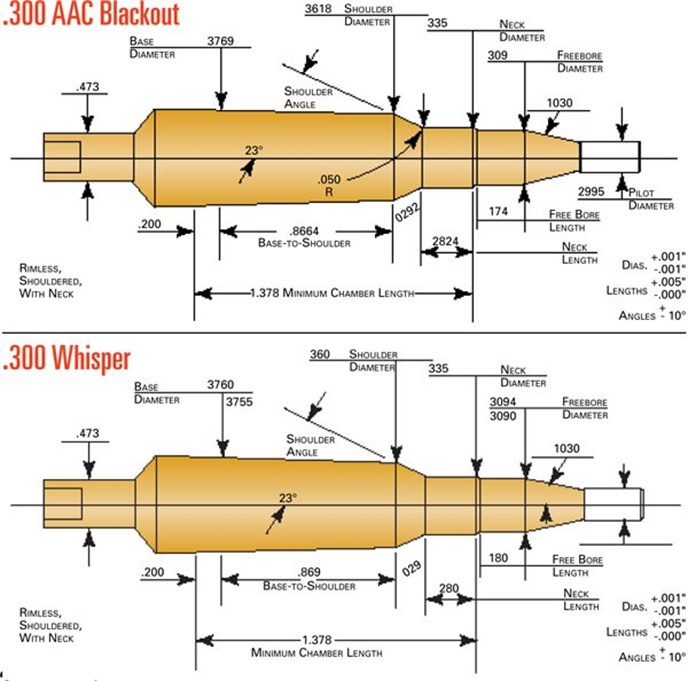
Differences
But how similar are the two cartridges? Is .300 Blackout ammunition compatible with guns chambered for .300 Whisper and vice-versa? Silver replied: “Hornady .300 Whisper ammo, according to Hornady, has been specifically tested to be within SAAMI specifications for .300 AAC Blackout. If you shoot .300 BLK ammo in chambers that have a shorter or tighter throat, pressures will go up—perhaps above SAAMI maximums—so it is not OK to mix ammo.”
Jones said: “It is the same case—I don’t know why not. Same chamber works, same loading dies work. The S&W guns function fine with Hornady ammo in subsonic or high velocity. I killed two deer with Hornady [.300 Whisper ammunition] and although I would prefer a bit heavier bullet, both deer were cleanly killed.”
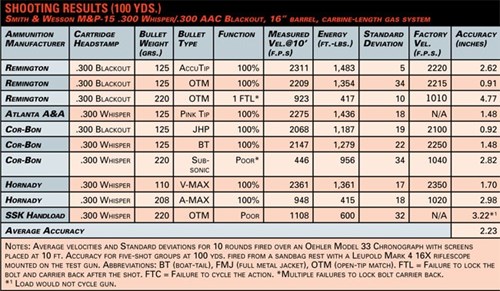
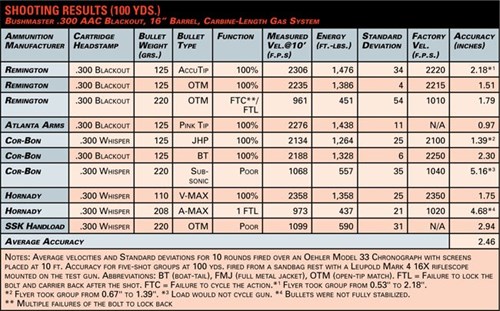
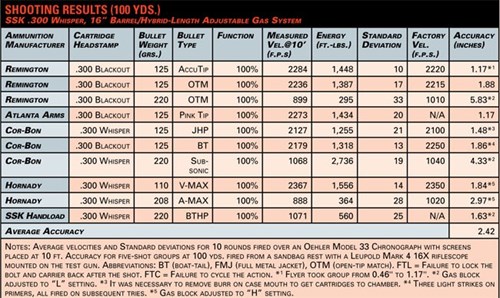
I wanted to see for myself what the differences between the two cartridges were in a real-world scenario. I approached Smith & Wesson, Freedom Group and SSK for test rifles chambered in .300 Whisper and/or .300 BLK. I contacted Cor-Bon, Hornady, Remington and purchased some Atlanta Arms & Ammunition cartridges for testing. I tested more than 600 rounds of ammunition from the aforementioned manufacturers for accuracy, velocity, consistency, function and overall performance. I also tested some handloads provided by SSK Industries.
All of the information is presented in the tables and schematics for the reader to make his or her own conclusions. I can tell you, based on a great deal of time in a ballistics lab, if you fire the same ammunition in two different guns and if one of those guns is tighter in the chamber, throat and/or barrel, the pressure and velocity will be higher in the tighter gun, exactly as Silvers stated above.
After my field testing, I concluded there is very little difference, if any, between the .300 Whisper and .300 AAC Blackout. So if they’re virtually identical for practical purposes, how, exactly, are they different? Silvers told me: “I have never seen an SSK .300 Whisper drawing—it is proprietary to SSK, so it is hard to say how it is different. We focused .300 BLK on normal full-power ammo rather than subsonic-designed ammo, which is optimal for existing U.S.G.I. magazines, and developed rifles which can shoot all types of ammo without requiring an adjustable gas block.”
“The development process was to take the Remington .221 Fireball drawing, opened it to .30 cal., keep the headspace the same, move the headspace datum point to not be on a radius, and then picked a chamber neck diameter that would allow compatibility with most existing brass,” Silvers said. “We also picked a throat that would be long enough so that a Sierra 220-gr. MatchKing could be loaded to full magazine length of 2.260" and have 0.010" jump to the lands. The added benefit of this longer throat is to allow for higher velocities with normal ammo. Because this throat is longer than some of the wildcat chambers, pressure may go up if you shoot .300 BLK ammo in a wildcat chamber,” Silvers concluded.
Asked how they are different, Jones replied: “I don’t really know—the few [.300 BLK] cases I’ve seen appeared to me to be identical with the Whisper cases made by Hornady except for the headstamp. It is supposed to have a longer throat from what I read.”
So we’ve determined that there’s not a lot—if any difference between the two cartridges—so why the change of names?
When asked why AAC went with .300 AAC Blackout instead of .300 Whisper, Silver said “.300 Whisper is not SAAMI-approved and SAAMI will not accept trademarked cartridge names. Over the years, there have been many versions of taking a .221 Fireball or .223 case and making it .30 caliber. Several of them have similar, but not identical chambers. In order to assure ammunition and firearm and ammunition compatibility and interchangeability, an industry standard was needed. This required picking a final set of specifications, and submitting it for industry consideration. Also, if we did not pick a new name, then we would have had to make the round compatible with the tightest chamber ever called .300-.221, .300 Fireball or .300 Whisper—and that would have limited supersonic velocity in the same way that the tighter throat of .223 Rem. chambers cannot shoot as hot ammo as 5.56 mm chambers.”
Finally, I asked Jones and Silvers to sum up the .300 Whisper/.300 AAC Blackout differences as best they could in a final statement, to which Jones replied, “If it looks like a duck, talks like a duck, flies like a duck, walks like a duck, it is essentially a duck. At this point the SSK adjustable gas system is a huge advantage, and the S&W single port system works with all the Hornady ammo.” Silvers summed up with the “.300 AAC Blackout is the SAAMI standard and over 85 companies have announced their support by making products for it.”
The .300 Whisper was not the first .221 Fireball necked to .30 caliber, but it is well-thought-out, well-documented and the most popular. When Jones created the Whisper series of cartridges, he developed a genre that most definitely has legs. When it comes to the .300 AAC Blackout, Silvers and AAC have done things “by the book” and are well positioned with a SAAMI standardized cartridge.
Conclusion
Is there really that much difference between the .300 Whisper and the .300 Blackout? Given the fact that major manufacturers such as Hornady are building ammunition headstamped .300 Whisper and recommending it for use in either platform—in addition to producing reloading dies that are marked “300 Whisper/Blackout” and Smith & Wesson stamps the barrel of its M&P-15 Whisper barrels with: “300 Whisper/300 AAC Blackout” it is safe to say that differences are minimal. Through the years lots of great cartridges have gone by multiple names, i.e.,7x57 mm Mauser and .275 Rigby. Will the “Whisper” or “Blackout” names stick? Only time will tell. Either way, J.D. Jones developed the concept of a high-velocity/subsonic dual-role cartridge in 1992 and has done much through the years to perpetuate the concept. For any who doubt, it has all been well documented in industry reference books such as Cartridges Of The World and others. That said, there is new momentum behind this cartridge, whatever the world wants to call it.
Shooting Results